Kirjojen hintavertailu. Mukana 12 390 323 kirjaa ja 12 kauppaa.

Kirjahaku

Etsi kirjoja tekijän nimen, kirjan nimen tai ISBN:n perusteella.

4 kirjaa tekijältä Volker M. Welter

Ernst L. Freud, Architect

Ernst L. Freud, Architect

Volker M. Welter

Berghahn Books
2011
pokkari
Ernst L. Freud (1892–1970) was a son of Sigmund Freud and the father of painter Lucian Freud and the late Sir Clement Freud, politician and broadcaster. After his studies in Munich and Vienna, where he and his friend Richard Neutra attended Adolf Loos’s private Bauschule, Freud practiced in Berlin and, after 1933, in London. Even though his work focused on domestic architecture and interiors, Freud was possibly the first architect to design psychoanalytical consulting rooms—including the customary couches—a subject dealt with here for the first time. By interweaving an account of Freud’s professional and personal life in Vienna, Berlin, and London with a critical discussion of selected examples of his domestic architecture, interior designs, and psychoanalytic consulting rooms, the author offers a rich tapestry of Ernst L. Freud’s world. His clients constituted a “Who’s Who” of the Jewish and non-Jewish bourgeoisie in 1920s Berlin and later in London, among them the S. Fischer publisher family, Melanie Klein, Ernest Jones, the Spenders, and Julian Huxley. While moving within a social class known for its cultural and avant-garde activities, Freud refrained from spatial, formal, or technological experiments. Instead, he focused on creating modern homes for his bourgeois clients.
Tremaine Houses

Tremaine Houses

Volker M. Welter

Getty Publications
2019
sidottu
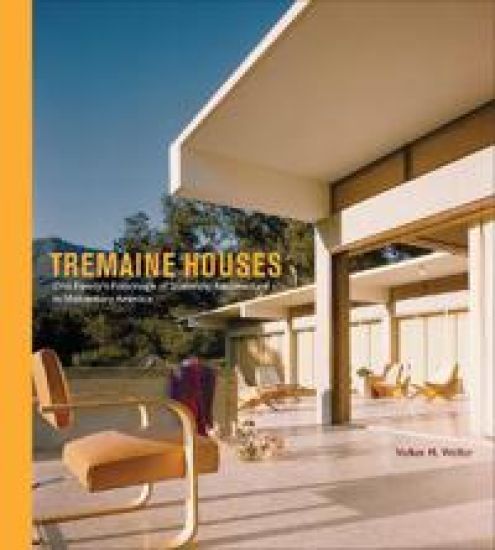
From the late 1930s to the early 1970s, two brothers, Burton G. Tremaine and Warren D. Tremaine, and their respective wives, Emily Hall Tremaine and Katharine Williams Tremaine, commissioned approximately thirty architecture and design projects. Richard Neutra and Oscar Niemeyer designed the best-known Tremaine houses; Philip Johnson and Frank Lloyd Wright also created designs and buildings for the family that achieved iconic status in the modern movement. Focusing on the Tremaines’ houses and other projects, such as a visitor center at a meteor crater in Arizona, this volume explores the Tremaines’ architectural patronage in terms of the family’s motivations and values, exposing patterns in what may appear as an eclectic collection of modern architecture. Architectural historian Volker M. Welter argues that the Tremaines’ patronage was not driven by any single factor; rather, it stemmed from a network of motives comprising the clients’ practical requirements, their private and public lives, and their ideas about architecture and art.
Exiled in L.A.

Exiled in L.A.

Volker M. Welter

GETTY TRUST PUBLICATIONS
2025
nidottu
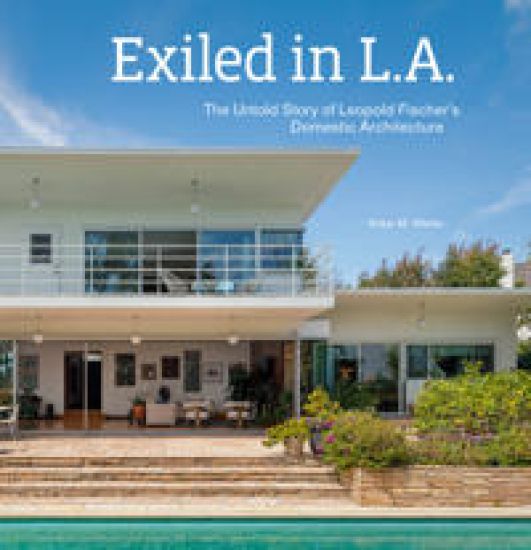
In 1936, Leopold Fischer (1901-1975), in exile from Nazi Germany, arrived in California, where he created a small but distinct oeuvre of mostly domestic architecture. In contrast to his famous peers Rudolph Schindler and Richard Neutra, immigrants whose Southern California buildings are frequently examined-and who, like Fischer, studied with the modernist architect Adolf Loos-Fischer and his California structures have, until now, escaped the attention of architectural history.Exiled in L.A. examines Fischer's important, yet overlooked, contributions to Southern California architecture. As the whereabouts of Fischer's archives remain unknown, Volker M. Welter grounds the designer's California works in comparison with his pre-exile projects and the compositions of fellow architects in California. In the 1920s, Fischer created experimental working-class housing estates in Germany that pioneered ecological construction and living practices. Comparable to their predecessors, Fischer's California buildings revolve around the "functioning, the organization of a home," as he defined domestic architecture in 1926. Featuring new photography and detailed architectural plans, this book is an original contribution to the literature on Southern California's built heritage.
Biopolis

Biopolis

Volker M. Welter

MIT Press
2003
pokkari
An examination of the work and influence of Scottish urban planner and theorist Patrick Geddes. The Scottish urbanist and biologist Patrick Geddes (1854-1932) is perhaps best known for introducing the concept of "region" to architecture and planning. At the turn of the twentieth century, he was one of the strongest advocates of town planning and an active participant in debates about the future of the city. He was arguably the first planner to recognize the importance of historic city centers, and his renewal work in Edinburgh's Old Town is visible and impressive to this day. Geddes's famous analytical triad-place, work, and folk, corresponding to the geographical, historical, and spiritual aspects of the city-provides the basic structure of this examination of his urban theory. Volker Welter examines Geddes's ideas in the light of nineteenth-century biology-in which Geddes received his academic training-showing Geddes's use of biological concepts to be far more sophisticated than popular images of the city as an organic entity. His urbanism was informed by his lifelong interest in the theory of evolution and in ecology, cutting-edge areas in the late nineteenth century. Balancing Geddes's biological thought is his interest in the historical Greek concept of polis, usually translated as city-state but implying a view of the city as a cultural and spiritual phenomenon. Although Geddes's work was far-ranging, the city provided the unifying focus of nearly all of his theoretical and practical work. Throughout the book, Welter relates Geddes's theory of the city to contemporary European debates about architecture and urbanism.