Kirjojen hintavertailu. Mukana 11 627 220 kirjaa ja 12 kauppaa.

Kirjahaku

Etsi kirjoja tekijän nimen, kirjan nimen tai ISBN:n perusteella.

7 kirjaa tekijältä W. G. Runciman

Very Different, But Much the Same

Very Different, But Much the Same

W. G. Runciman

Oxford University Press
2014
sidottu
Very Different, but Much the Same takes as its starting point the distribution of political, ideological, and economic power between English society's constituent roles from the time when Daniel Defoe was writing Robinson Crusoe, and argues that Defoe would find it remarkably similar three centuries later despite all the changes in technology, lifestyles, amenities, beliefs, attitudes, norms, and values by which he would no doubt be astonished. The disjunction between the two is explained by bringing to bear the approach of current evolutionary sociological theory in which the reproduction or extinction of a society's institutional practices is traced to selective environmental pressures which are independent of the personal motives and subjective experiences of the individuals whose practices they are. It is further argued that the rates of high absolute and low relative social mobility that sociologists have documented in detail for the twentieth century are likely to have been much the same during the eighteenth and nineteenth centuries. The conclusion drawn is that for as long as the country was not defeated in a European war, the probability of a radical change in institutional distribution of power was extremely low throughout, however much contemporary observers or later historians would have either welcomed or deplored it.
Social Science and Political Theory

Social Science and Political Theory

W. G. Runciman

Cambridge University Press
1969
pokkari
Mr Runciman studies the relation of sociology to political philosophy, clarifies an number of disputed and often unclear topics in the social sciences, and extends traditional political philosophy in the direction of developments which, in 1969 at the time of this book's publication, were recent. After defining his terms and considering the scope and limits of the social sciences as a whole, he examines the sociological writings of Marx, Max Weber and other sociologists, and then goes on to discuss such contemporary sociological problems as the study of voting behaviour, alternative theories and models of society, and the changing of class structure in industrialized societies. In a final essay he considers whether there is a point at which conflict between rival political philosophies is necessarily unresolvable. For this second edition Mr Runciman has made extensive corrections in the text to take account of further work.
The Theory of Cultural and Social Selection

The Theory of Cultural and Social Selection

W. G. Runciman

Cambridge University Press
2009
pokkari
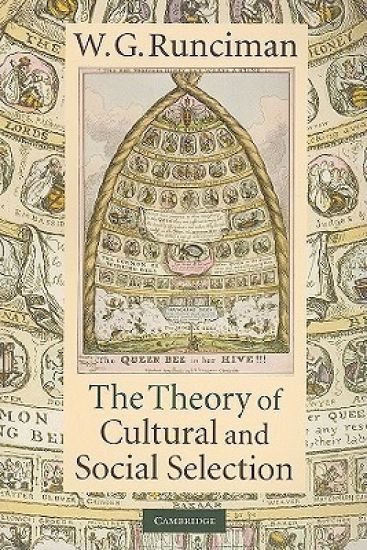
In The Theory of Cultural and Social Selection, W. G. Runciman presents an original and wide-ranging account of the fundamental process by which human cultures and societies come to be of the different kinds that they are. Drawing on and extending recent advances in neo-Darwinian evolutionary theory, Runciman argues that collective human behaviour should be analyzed as the acting-out of information transmitted at the three separate but interacting levels of heritable variation and competitive selection - the biological, the cultural, and the social. The implications which this carries for a reformulation of the traditional agenda of comparative and historical sociology are explored with the help of selected examples, and located within the context of current debates about sociological theory and practice. The Theory of Cultural and Social Selection is a succinct and highly imaginative contribution to one of the great intellectual debates of our times, from one of the world's leading social theorists.
A Treatise on Social Theory

A Treatise on Social Theory

W. G. Runciman

Cambridge University Press
1983
pokkari
In this first volume of a projected trilogy, the author argues that a methodology adequate to solve the long-standing debate over the status of the social as against the natural sciences can be constructed in terms of a fourhold distinction between the reportage, explanation, description and evaluation of human behaviour. The distinction rests on an analysis of the scope and nature of social theory which is not only original in conception but far-reaching in its implications for the assessment of the results of sociological, anthropological and historical research. In this volume, there are set out the separate and distinctive criteria by which the reports, explanations, descriptions and evaluations put forward by social scientists of rival theoretical schools require to be tested. These criteria will then be applied in Volume II to a substantive theory of social relations, social structure and social evolution, and in Volume III to a detailed analysis of the society of twentieth-century England. Each of the three volumes can be read independently of the others. Thus the trilogy will, when completed, be seen to form a coherent and unified whole.
A Treatise on Social Theory

A Treatise on Social Theory

W. G. Runciman

Cambridge University Press
1989
pokkari
This second of three volumes sets out a general account of the structure and evolution of human societies. The author argues first that societies are to be defined as sets of roles whose incumbents are competitors for access to, or control of, the means of production, persuasion and coercion; and second, that the process by which societies evolve is one of competitive selection of the practices by which roles are defined analagous, but not reducible, to natural selection. He illustrates and tests these theses with evidence drawn from the whole range of societies documented in the historical and ethnographic record. The result is an original, powerful and far-reaching reformulation of evolutionary sociological theory which will make it possible to do for the classification and analysis of societies what Darwin and his successors have done for the classification and analysis of species.
A Critique of Max Weber's Philosophy of Social Science

A Critique of Max Weber's Philosophy of Social Science

W. G. Runciman

Cambridge University Press
2002
pokkari
This essay is written in the belief that it is possible to say both where Max Weber’s philosophy of social science is mistaken and how these mistakes can be put right. Runciman argues that Weber’s analysis breaks down at three decisive points: the difference between theoretical pre-suppositions and implicit value-judgements; the manner in which ‘idiographic’ explanations are to be subsumed under causal laws; and the relation of explanation to description in sociology. The arguments which Weber put forward are fundamental to the methodology of the social sciences, and since his death it has come to be increasingly widely held that with perhaps the sole exception of Mill’s System of Logic there is still no other body of work of comparable importance in the academic literature on these topics. Runciman’s attempt to correct Weber’s mistakes therefore constitutes in itself a valuable contribution to the philosophy of social science.
Great Books, Bad Arguments

Great Books, Bad Arguments

W. G. Runciman

PRINCETON UNIVERSITY PRESS
2010
sidottu
Plato's Republic, Hobbes's Leviathan, and Marx's Communist Manifesto are universally acknowledged classics of Western political thought. But how strong are the core arguments on which they base their visions of the good society that they want to bring into being? In this lively and provocative book, W. G. Runciman shows where and why they fail, even after due allowance has been made for the different historical contexts in which they wrote. Plato, Hobbes, and Marx were all passionately convinced that justice, peace, and order could be established if only their teachings were implemented and the right people put into power. But Runciman makes a powerful case to the effect that all three were irredeemably naive in their assumptions about how human societies function and evolve and how human behavior could be changed. Yet despite this, Runciman insists that Republic, Leviathan, and The Communist Manifesto remain great books. Born of righteous anger and frustration, they are masterfully eloquent pleas for better worlds--worlds that Plato, Hobbes, and Marx cannot bring themselves to admit to be unattainable.