Kirjahaku
Etsi kirjoja tekijän nimen, kirjan nimen tai ISBN:n perusteella.
40 kirjaa tekijältä W. G. Sebald
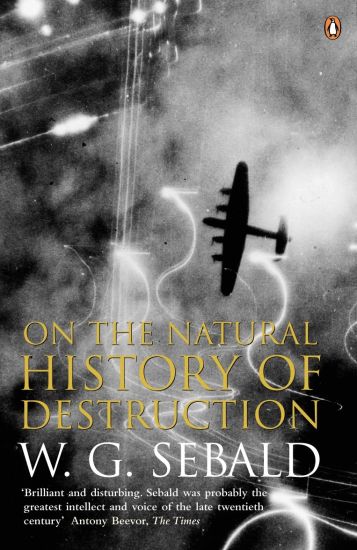
Sebald's On the Natural History of Destruction explores German writers' silence about a moment of mass destructionIn the last years of World War II, a million tons of bombs were dropped by the Allies on one hundred and thirty-one German towns and cities. Six hundred thousand civilians died, and three and a half million homes were destroyed. When it has cast such a very dark shadow over his life and work, Sebald asks, how have so many writers allowed themselves to write it out of their experience and avoid articulating the horror? W.G. Sebald's On the Natural History of Destruction sparked a wide-ranging debate in the German press.'Sebald makes exquisite art out of vile history' Boyd Tonkin, Independent'One of the most important writers of our time' A.S. Byatt, New Statesman 'Demands to be read for its grand emotional power ... it absorbs and horrifies and illuminates' Scotsman'Brilliant and disturbing' Antony Beevor, The TimesW . G. Sebald was born in Wertach im Allgäu, Germany, in 1944 and died in December 2001. He studied German language and literature in Freiburg, Switzerland and Manchester. In 1996 he took up a position as an assistant lecturer at the University of Manchester and settled permanently in England in 1970. He was Professor of European Literature at the University of East Anglia and is the author of The Emigrants, The Rings of Saturn, Vertigo, Austerlitz, After Nature, On the Natural History of Destruction, Campo Santo, Unrecounted, For Years Now and A Place in the Country. His selected poetry is published in a volume called Across the Land and the Water.
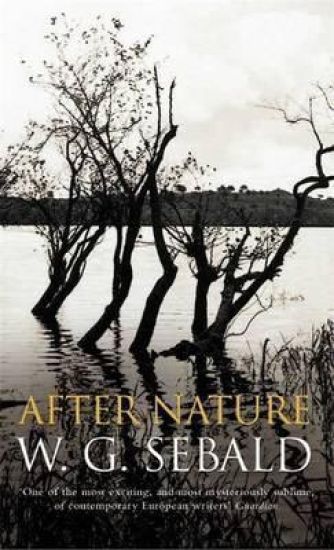
After Nature is the very first literary work by W. G. Sebald, author of Austerlitz'The greatest writer of our time' Peter CareyAfter Nature by W.G. Sebald, author of Austerlitz, is his first literary work and the start of his highly personal and brilliant writing journey. In this long prose poem, Sebald introduces many of the themes that he explores in his subsequent books. Focusing on the conflict between man and nature, each of the three distinct parts of After Nature give centre stage to a different character from a different century - the last being W.G. Sebald himself.'A deeply intelligent book, but also a marvellously warm, exciting and compassionate one' Andrew Motion'A début of rare poetic grandeur' Irish Times'Astonishing writing. A true poet at work' Evening Standard'Graceful, allusive, serious, but also immensely readable' Sunday Telegraph'When you read Sebald you are transported to another realm' Literary ReviewW . G. Sebald was born in Wertach im Allgäu, Germany, in 1944 and died in December 2001. He studied German language and literature in Freiburg, Switzerland and Manchester. In 1996 he took up a position as an assistant lecturer at the University of Manchester and settled permanently in England in 1970. He was Professor of European Literature at the University of East Anglia and is the author of The Emigrants, The Rings of Saturn, Vertigo, Austerlitz, After Nature, On the Natural History of Destruction, Campo Santo, Unrecounted, For Years Now and A Place in the Country. His selected poetry is published in a volume called Across the Land and the Water.
Campo Santo is a collection of essays by W. G. SebaldWhen W.G. Sebald died tragically in 2001 a unique voice was silenced. Campo Santo is a collection of the pieces he left behind - none of them previously published in book form - which provide a powerful insight into the themes that came to dominate his life. Four pieces pay tribute to Corsica, weaving elegiacally between past and present. Sebald also examines the works of writers such as Kafka, Nabokov, and Günter Grass, showing both how literature can provide restitution for the injustices of the world and how such literature came to have so great an influence on him. Campo Santo is a fitting memorial to W.G. Sebald, who himself studied the shifting nature of memory and time with such sensitivity.'A precious addition to the canon' Independent'Will come to be seen as indispensable to an understanding of his work' Sunday Times'Full of a sense of liberation and lightness ... these [pieces] abound in energy and work the authentic Sebaldian magic' Literary Review'We have become suspicious, rightly, of claims for literary greatness, but in Sebald's case the claim was triumphantly justified. He was, he is, the real thing' John Banville, Guardian'Sebald was probably the greatest intellect and voice of the late twentieth century' Anthony Beevor, The Times'A writer whose explorations of time and memory make him arguably the closest author modern European letters has to rival Borges' Sunday TimesW . G. Sebald was born in Wertach im Allgäu, Germany, in 1944 and died in December 2001. He studied German language and literature in Freiburg, Switzerland and Manchester. In 1996 he took up a position as an assistant lecturer at the University of Manchester and settled permanently in England in 1970. He was Professor of European Literature at the University of East Anglia and is the author of The Emigrants, The Rings of Saturn, Vertigo, Austerlitz, After Nature, On the Natural History of Destruction, Campo Santo, Unrecounted, For Years Now and A Place in the Country. His selected poetry is published in a volume called Across the Land and the Water.
Unrecounted is a book of poems and images from one of the most admired European writers, W.G. Sebald, and his friend and collaborator, the German artist Jan Peter Tripp. For a number of years until Sebald's death in 2001, the two exchanged poems and lithographs. Unrecounted is the startlingly original result of this long artistic friendship - a creative dialogue inspired by shared concerns. Tripp's lithographs, which portray pairs of eyes - among them those of Beckett, Borges, Proust - combine with W.G. Sebald's words in Unrecounted to speak of moments salvaged from time passing, of our eyes bearing witness, and of memory and remembrance.'Condenses Sebald's complex visual imagination to its poetic core' Scotland on Sunday'Elegiac, enhancing ... Sebald will not be forgotten' Time Out'A haunting testament to Sebald's singular and lasting vision' Observer'The magic of W.G. Sebald's incandescent body of work continues to unfold, with this unexpected collaboration' Susan Sontag'Anyone with a serious interest in fiction should read Sebald' Daily TelegraphW.G. Sebald was born in Germany in 1944 and settled permanently in England in 1970, where he was Professor of European Literature at the University of East Anglia until his death in 2001. He is the author of four works of fiction: The Emigrants, which won the Berlin Literature Prize, the Heinrich Heine Prize, and the Joseph Breitbach Prize; The Rings of Saturn; Vertigo; and Austerlitz, which was awarded the Independent Foreign Fiction Prize and the National Book Critics Circle Award. Alongside this stand books of poetry For Years Now, After Nature, Unrecounted, and Across the Land and the Water, and the non-fiction books On the Natural History of Destruction and Campo Santo. Jan Peter Tripp was born in 1945 and lives and works in Alsace.
A Place in the Country is a window into the brilliant mind of W. G. Sebald'The greatest writer of our time' Peter CareyWhen W. G. Sebald travelled to Manchester in 1966, he packed in his bags certain literary favourites which would remain central to him throughout the rest of his life and during the years when he was settled in England. In A Place in the Country, he reflects on six of the figures who shaped him as a person and as a writer, from Jean-Jacques Rousseau to Jan Peter Tripp. Fusing biography and essay, and finding, as ever, inspiration in place - as when he journeys to the Ile St. Pierre, the tiny, lonely Swiss island where Jean-Jacques Rousseau found solace and inspiration - Sebald lovingly brings his subjects to life in his distinctive, inimitable voice.'A fascinating volume that confirms Sebald as one of Europe's most mysterious and best-loved literary imaginations' Evening Standard'Sebald was in possession of the uncanny ability to make his own intellectual obsessions, immediately, compulsively his reader's' Observer'Irresistible . . . an intimate anatomy of the pathos, absurdity and perverse splendour of trying to find patterns in the chaos of the world' IndependentW . G. Sebald was born in Wertach im Allgäu, Germany, in 1944 and died in December 2001. He studied German language and literature in Freiburg, Switzerland and Manchester. In 1996 he took up a position as an assistant lecturer at the University of Manchester and settled permanently in England in 1970. He was Professor of European Literature at the University of East Anglia and is the author of The Emigrants, The Rings of Saturn, Vertigo, Austerlitz, After Nature, On the Natural History of Destruction, Campo Santo, Unrecounted and a selection of poetry, Across the Land and the Water.Jo Catling taught German for a number of years alongside W. G. Sebald at the University of East Anglia, where she is currently a senior lecturer in the School of Literature, Drama and Creative Writing.
‘We have become suspicious, rightly, of claims for literary greatness, but in Sebald’s case the claim was triumphantly justified. He was, he is, the real thing’ John Banville, GuardianFrom acclaimed critic, novelist and academic W. G. Sebald, author of Austerlitz and The Rings of Saturn, a collection of essay on the Austrian writers who meant so much to him - appearing for the first time in EnglishAs a German in self-chosen exile from his country of birth, Sebald found a particular affinity with these writers from a neighbouring nation. The traumatic evolution of Austria from vast empire to diminutive Alpine republic, followed by its annexation by Germany, meant that concepts such as ‘home/land’, ‘borderland’ and ‘exile’ occupy a prominent role in its literature, just as they would in Sebald’s own.Through a series of remarkable close readings of texts by Bernhard, Stifter, Kafka, Handke, Roth and more, Sebald charts both the pathologies which so often drove their work and the seismic historical forces which shaped them. This sequence of essays will be a revelation to Sebald’s English-language readers, tracing as they do so many of the themes which animate his own literary writings, to which these essays form a kind of prelude.'A writer whose life and work has become a wonderful vindication of literary culture in all its subtle and entrancing complexity' Guardian‘Sebald was probably the greatest intellect and voice of the late twentieth century’ Antony Beevor, The Times
A classic novel of post-war Europe, haunting and timelessly beautiful'The greatest writer of our time' Peter CareyIn 1939, five-year-old Jacques Austerlitz is sent to England on a Kindertransport and placed with foster parents. This childless couple promptly erase from the boy all knowledge of his identity and he grows up ignorant of his past. Later in life, after a career as an architectural historian, Austerlitz - having avoided all clues that might point to his origin - finds the past returning to haunt him and he is forced to explore what happened fifty years before. Austerlitz is W.G. Sebald's melancholic masterpiece.'Mesmeric, haunting and heartbreakingly tragic. Simply no other writer is writing or thinking on the same level as Sebald' Eileen Battersby, Irish Times'Greatness in literature is still possible' John Banville, Irish Times, Books of the Year'A work of obvious genius' Literary Review'A fusion of the mystical and the solid ... His art is a form of justice - there can be, I think, no higher aim' Evening Standard'Spellbindingly accomplished; a work of art' The Times Literary Supplement 'I have never read a book that provides such a powerful account of the devastation wrought by the dispersal of the Jews from Prague and their treatment by the Nazis' Observer'A great book by a great writer' Boyd Tonkin, IndependentW . G. Sebald was born in Wertach im Allgäu, Germany, in 1944 and died in December 2001. He studied German language and literature in Freiburg, Switzerland and Manchester. In 1996 he took up a position as an assistant lecturer at the University of Manchester and settled permanently in England in 1970. He was Professor of European Literature at the University of East Anglia and is the author of The Emigrants, The Rings of Saturn, Vertigo, Austerlitz, After Nature, On the Natural History of Destruction, Campo Santo, Unrecounted, A Place in the Country. His selected poetry is published in a volume called Across the Land and the Water.
Austerlitz is W. G. Sebald's haunting novel of post-war Europe.In 1939, five-year-old Jacques Austerlitz is sent to England on a Kindertransport and placed with foster parents. This childless couple promptly erase from the boy all knowledge of his identity and he grows up ignorant of his past. Later in life, after a career as an architectural historian, Austerlitz - having avoided all clues that might point to his origin - finds the past returning to haunt him and he is forced to explore what happened fifty years before. Austerlitz is W.G. Sebald's melancholic masterpiece.'Mesmeric, haunting and heartbreakingly tragic. Simply no other writer is writing or thinking on the same level as Sebald' Eileen Battersby, Irish Times'Greatness in literature is still possible' John Banville, Irish Times, Books of the Year'A work of obvious genius' Literary Review'A fusion of the mystical and the solid ... His art is a form of justice - there can be, I think, no higher aim' Evening Standard'Spellbindingly accomplished; a work of art' The Times Literary Supplement 'I have never read a book that provides such a powerful account of the devastation wrought by the dispersal of the Jews from Prague and their treatment by the Nazis' Observer'A great book by a great writer' Boyd Tonkin, IndependentW . G. Sebald was born in Wertach im Allgäu, Germany, in 1944 and died in December 2001. He studied German language and literature in Freiburg, Switzerland and Manchester. In 1996 he took up a position as an assistant lecturer at the University of Manchester and settled permanently in England in 1970. He was Professor of European Literature at the University of East Anglia and is the author of The Emigrants, The Rings of Saturn, Vertigo, Austerlitz, After Nature, On the Natural History of Destruction, Campo Santo, Unrecounted, A Place in the Country. His selected poetry is published in a volume called Across the Land and the Water.
Four narratives weave history and fiction together as refugees from the Holocaust remember their experiences
A fictional account of a walking tour along England's coast provides the narrator with a rich source for reflection on the country's history
The four long narratives in The Emigrants appear at first to be the straightforward biographies of four Germans in exile. Sebald reconstructs the lives of a painter, a doctor, an elementary-school teacher, and Great Uncle Ambrose. Following (literally) in their footsteps, the narrator retraces routes of exile which lead from Lithuania to London, from Munich to Manchester, from the South German provinces to Switzerland, France, New York, Constantinople, and Jerusalem. Along with memories, documents, and diaries of the Holocaust, he collects photographs--the enigmatic snapshots which stud The Emigrants and bring to mind family photo albums. Sebald combines precise documentary with fictional motifs, and as he puts the question to realism, the four stories merge into one unfathomable requiem.
The Rings of Saturn--with its curious archive of photographs--records a walking tour of the eastern coast of England. A few of the things which cross the path and mind of its narrator (who both is and is not Sebald) are lonely eccentrics, Sir Thomas Browne's skull, a matchstick model of the Temple of Jerusalem, recession-hit seaside towns, wooded hills, Joseph Conrad, Rembrandt's "Anatomy Lesson," the natural history of the herring, the massive bombings of WWII, the dowager Empress Tzu Hsi, and the silk industry in Norwich. W.G. Sebald's The Emigrants (New Directions, 1996) was hailed by Susan Sontag as an "astonishing masterpiece perfect while being unlike any book one has ever read." It was "one of the great books of the last few years," noted Michael Ondaatje, who now acclaims The Rings of Saturn "an even more inventive work than its predecessor, The Emigrants."
Perfectly titled, Vertigo --W.G. Sebald's marvelous first novel -- is a work that teeters on the edge: compelling, puzzling, and deeply unsettling.An unnamed narrator, beset by nervous ailments, journeys accross Europe to Vienna, Venice, Verona, Riva, and finally to his childhood home in a small Bavarian village. He is also journeying into the past. Traveling in the footsteps of Stendhal, Casanova, and Kafka, the narrator draws the reader, line by line, into a dizzying web of history, biography, legends, literature, and -- most perilously -- memories.
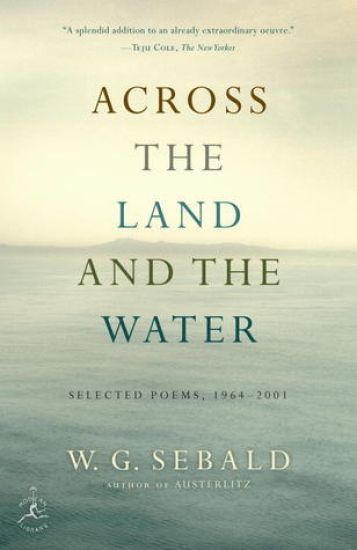
Across the Land and the Water: Across the Land and the Water: Selected Poems, 1964-2001
W. G. Sebald
Modern Library
2013
nidottu
"A splendid addition to an already extraordinary oeuvre."--Teju Cole, The New Yorker German-born W. G. Sebald is best known as the innovative author of Austerlitz, the prose classic of World War II culpability and conscience that put its author in the company of Nabokov, Calvino, and Borges. Now comes the first major collection of this literary master's poems. Skillfully translated by Iain Galbraith, they range from pieces Sebald wrote as a student in the sixties to those completed right before his untimely death in 2001. In nearly one hundred poems--the majority published in English for the first time--Sebald explores his trademark themes, from nature and history, to wandering and wondering, to oblivion and memory. Soaring and searing, the poetry of W. G. Sebald is an indelible addition to his superb body of work, and this collection is bound to become a classic in its own right. "How fortunate we are to have this writer's startling imagination freshly on display once again, expressed in language honed to a perfect simplicity."--Billy Collins "A watershed volume . . . nothing less than transcendent."--BookPage " Sebald was] a defining writer of his era."--The New Republic
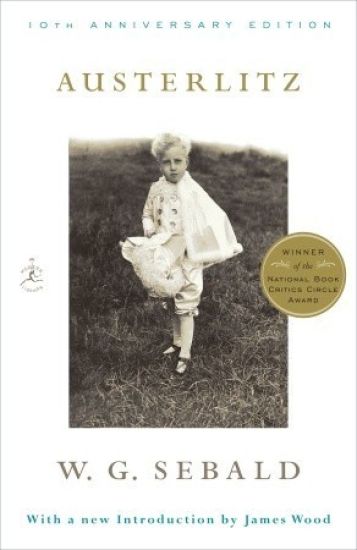
W. G. Sebald's celebrated masterpiece, "one of the supreme works of art of our time" (The Guardian), follows a man's search for the answer to his life's central riddle. "Haunting . . . a powerful and resonant work of the historical imagination . . . Reminiscent at once of Ingmar Bergman's Wild Strawberries, Kafka's troubled fables of guilt and apprehension, and, of course, Proust's Remembrance of Things Past."--Michiko Kakutani, The New York Times One of The New York Times's 10 Best Books of the 21st Century - A Kirkus Reviews Best Fiction Book of the Century - A Los Angeles Times, Entertainment Weekly, and New York Magazine Best Book of the Year Winner of the National Book Critics Circle Award, Koret Jewish Book Award, Independent Foreign Fiction Prize, and Jewish Quarterly Wingate Literary Prize A small child when he comes to England on a Kindertransport in the summer of 1939, Jacques Austerlitz is told nothing of his real family by the Welsh Methodist minister and his wife who raise him. When he is a much older man, fleeting memories return to him, and obeying an instinct he only dimly understands, Austerlitz follows their trail back to the world he left behind a half century before. There, faced with the void at the heart of twentieth-century Europe, he struggles to rescue his heritage from oblivion. Over the course of a thirty-year conversation unfolding in train stations and travelers' stops across England and Europe, W. G. Sebald's unnamed narrator and Jacques Austerlitz discuss Austerlitz's ongoing efforts to understand who he is--a struggle to impose coherence on memory that embodies the universal human search for identity.

From the renowned author of Austerlitz (named a Top 10 Book of the 21st Century by the New York Times) comes the first English translation of his extraordinary essays on the Austrian writers who shaped his life and work. Silent Catastrophes brings together the two books W.G. Sebald wrote on the Austrian writers who meant so much to him: The Description of Misfortune and Strange Homeland, published in Austria in 1985 and 1991. As a German in self-chosen exile from his country of birth, Sebald found a particular affinity with these writers from a neighboring nation. The traumatic evolution of Austria from vast empire to diminutive Alpine republic, followed by its annexation by Nazi Germany, meant that concepts such as "home/land," "borderland" and "exile" occupy a prominent role in its literature, just as they would in Sebald's own. Through a series of remarkable close readings of texts by Bernhard, Stifter, Kafka, Handke, Roth, and more, Sebald charts both the pathologies which so often drove their work and the seismic historical forces which shaped them. This sequence of essays will be a revelation to Sebald's English-language readers, tracing as they do so many of the themes which animate his own literary writings, to which these essays form a kind of prelude. This is an essential new edition from "a writer whose life and work has become a wonderful vindication of literary culture in all its subtle and entrancing complexity" (The Guardian).
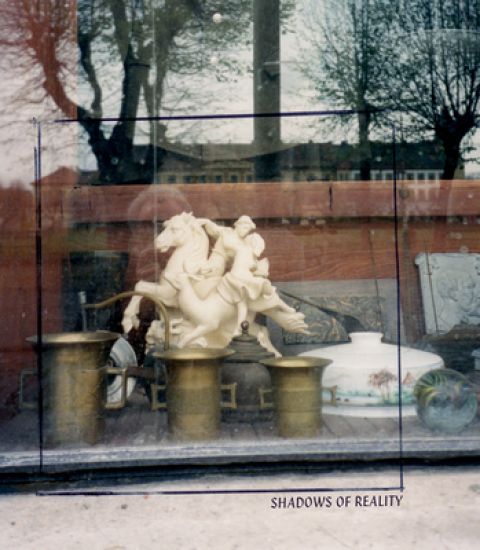
The first-ever volume of the photographs of German writer W.G. Sebald, exquisitely designed to shed new light on his creative process, as it chronicles the images and encounters that shaped his writing life. Shadows of Reality presents a unique, fully illustrated catalogue of W.G. Sebald's photographs- an extraordinary combination of film negatives, prints, and slides from the University of East Anglia's photographic collection, the Deutsches Literaturarchiv Marbach, and the Sebald Estate. Complementing the exhibition Lines of Sight- W.G. Sebald's East Anglia and edited by literary scholar Clive Scott and photography curator Nick Warr, this wonderfully comprehensive book covers the multiple photographic facets of Sebald's published work and includes a substantial amount of material that has not been made public before. Introduced by Nick Warr, who offers an intriguing overview of the author's critical relationship to photography, Shadows of Reality also includes an illuminating interview with Michael Brandon-Jones, the photographer who collaborated with Sebald on all of his publications. The book features a collection of extracts-principally on photography-from interviews with Sebald himself, bequeathed to the archive of recordings held at the University of East Anglia by his close friend Gordon Turner, who also provides a memoir. Accompanying these are inspired essays by Clive Scott and Angela Breidbach on Sebald's writing-with-photographs and the complex and mercurial interactions of those photographs with narrative design. A deeply important collection for anyone interested in Sebald's creative processes or the ways in which photography might serve fiction, Shadows of Reality is an inexhaustible treasure trove of new discoveries and revelations about the cherished international author.