Kirjojen hintavertailu. Mukana 11 627 220 kirjaa ja 12 kauppaa.

Kirjahaku

Etsi kirjoja tekijän nimen, kirjan nimen tai ISBN:n perusteella.

14 kirjaa tekijältä W. Terrence Gordon

McLuhan: A Guide for the Perplexed

McLuhan: A Guide for the Perplexed

W. Terrence Gordon

CONTINUUM PUBLISHING CORPORATION
2010
sidottu
Marshall McLuhan was dubbed a media guru when he came to prominence in the 1960s. The Woodstock generation found him cool; their parents found him perplexing. Today he is often referred to as a media ecologist, a phrase that would have pleased him for its resonance with James Joyces Echoland. Joyces kaleidoscopic verbal creativity stimulated McLuhans vision for a unified explanation of everything from Woodstock to Wall Street, from woodcuts to weapons, in terms of media and their effects. During his career, he found time to write about high literature (Chesterton, Wyndham Lewis, Pound, Joyce) and popular culture (movies, comics, and advertising), managing even to explore the link between them in reviewing the work of his arch-rival Northrop Frye (Inside Blake and Hollywood). By 1963 McLuhan was Director of the Centre for Culture and Technology at the University of Toronto and would be a public intellectual on the international stage for more than a decade, then linked forever to his two best known coinages: the global village and the medium is the message.Both phrases express a paradox. We easily interpret the first as an image for our planet dramatically shrunken by the powerful media of instant communication. Broadband buzz and G3 gossip. For this we scarcely need McLuhan. But the medium is the message has an unsettling counter-intuitive quality that provoked critical commentaries many of startling irrelevance to McLuhans thrust and purpose. Legions of bewildered students and intimidated faculty may have kept silent, and McLuhans many interviewers often merely registered irritation, but Jonathan Miller and Umberto Eco were among the luminaries who lodged vigorous protests, stumbling over McLuhans metaphor for how media operate and how they shape and control the speed, scale, and forms of human association and action. This was the key idea at the core of his Understanding Media. Even as Understanding Media was launched, McLuhan was raiding psychology, philosophy, structuralism, and taking second plunder from literary studies. By the end of his career, he had harnessed the complementarities of figure/ground, cause/effect, structure/function, and clich/archetype to his earlier work. Their full and final expression was achieved in the posthumously published Laws of Media. Taken as a whole, McLuhans writings reveal a profound coherence and illuminate his unifying vision for the study of language, literature, and culture, grounded in the broad understanding of any medium or technology as an extension of the human body. McLuhan: A Guide for the Perplexed is a close reading of all of his work with a focus on tracing the systematic development of his thought. The overriding objective is to clarify all of McLuhans thinking, to consolidate it in a fashion which prevents misreadings, and to open the way to advancing his own program: ensuring that the world does not sleepwalk into the twenty-first century with nineteenth-century perceptions.
McLuhan: A Guide for the Perplexed

McLuhan: A Guide for the Perplexed

W. Terrence Gordon

Continuum Publishing Corporation
2010
nidottu
"McLuhan: A Guide for the Perplexed" is a close reading of all of his work with a focus on tracing the systematic development of his thought. The overriding objective is to clarify all of McLuhan's thinking, to consolidate it in a fashion which prevents misreadings, and to open the way to advancing his own program: ensuring that the world does not sleepwalk into the twenty-first century with nineteenth-century perceptions. Marshall McLuhan was dubbed a media guru when he came to prominence in the 1960s. The Woodstock generation found him cool; their parents found him perplexing. Today he is often referred to as a media ecologist, a phrase that would have pleased him for its resonance with James Joyce's Echoland. Joyce's kaleidoscopic verbal creativity stimulated McLuhan's vision for a unified explanation of everything from Woodstock to Wall Street, from woodcuts to weapons, in terms of media and their effects. During his career, he found time to write about high literature (Chesterton, Wyndham Lewis, Pound, and Joyce) and popular culture (movies, comics, and advertising), managing even to explore the link between them in reviewing the work of his arch-rival Northrop Frye ("Inside Blake" and "Hollywood"). By 1963 McLuhan was Director of the Centre for Culture and Technology at the University of Toronto and would be a public intellectual on the international stage for more than a decade, then linked forever to his two best known coinages: the global village and the medium is the message. Both phrases express a paradox. We easily interpret the first as an image for our planet dramatically shrunken by the powerful media of instant communication. Broadband buzz and G3 gossip. For this we scarcely need McLuhan. But the medium is the message has an unsettling counter-intuitive quality that provoked critical commentaries - many of startling irrelevance to McLuhan's thrust and purpose. Legions of bewildered students and intimidated faculty may have kept silent, and McLuhan's many interviewers often merely registered irritation, but Jonathan Miller and Umberto Eco were among the luminaries who lodged vigorous protests, stumbling over McLuhan's metaphor for how media operate and how they shape and control the speed, scale, and forms of human association and action. This was the key idea at the core of his "Understanding Media". Even as "Understanding Media" was launched, McLuhan was raiding psychology, philosophy, structuralism, and taking second plunder from literary studies. By the end of his career, he had harnessed the complementarities of figure/ground, cause/effect, structure/function, and cliche/archetype to his earlier work. Their full and final expression was achieved in the posthumously published "Laws of Media". Taken as a whole, McLuhan's writings reveal a profound coherence and illuminate his unifying vision for the study of language, literature, and culture, grounded in the broad understanding of any medium or technology as an extension of the human body. "Continuum's Guides for the Perplexed" are clear, concise and accessible introductions to thinkers, writers and subjects that students and readers can find especially challenging - or indeed downright bewildering. Concentrating specifically on what it is that makes the subject difficult to grasp, these books explain and explore key themes and ideas, guiding the reader towards a thorough understanding of demanding material.
Saussure for Beginners

Saussure for Beginners

W. Terrence Gordon

For Beginners
2015
nidottu
A concise, accessible introduction to the great linguist who shaped the study of language for the 20th century, "Saussure for Beginners" puts the challenging ideas of Ferdinand de Saussure (1857-1913) into clear and illuminating terms, focusing on the unifying principles of his teachings and showing how his thoughts on linguistics migrated to anthropology.Ferdinand de Saussure's work is so powerful that it not only redefined modern linguistics, it also opened our minds to new ways of approaching anthropology, literary criticism, and psychoanalysis. Saussure felt that 19th century linguistics avoided hard questions about what language is and how it works. By 1911, he had taught a general linguistics course only three times. Upon his death, however, his students were so inspired by his teachings that they published them as the "Course in General Linguistics.""Saussure For Beginners" takes you through this course, points out the unifying principles, and shows how these ideas migrated from linguistics to other subjects.
Joyce for Beginners

Joyce for Beginners

W. Terrence Gordon

For Beginners
2021
nidottu
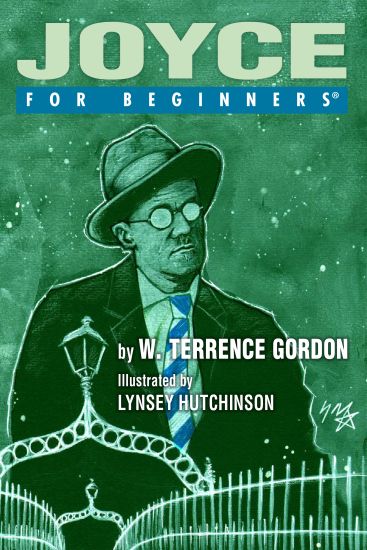
The works of James Joyce are part of the literary canon worldwide--and the need to have his works broken out into palatable pieces, even for the most avid of fans, is known the world over as well. In Joyce For Beginners, W. Terrence Gordon does just that. With the assistance of Lynsey Hutchinson's humorous illustrations throughout, Gordon successfully captures bits and pieces of Joyce's works and reconstructs them in a picturesque way for the reader to visualize the stories. Gordon also examines Joyce's passion for music and how it materializes in his writing. This will be the perfect addition to any Joyce lover's library.