Our personal and political worlds are rife with arguments and disagreements, some of them petty and vitriolic. The inability to compromise and understand the other side is widespread today. What can we do to change this? In Think Again philosopher Walter Sinnott-Armstrong draws on a long tradition of logic to show why we should stop focusing on winning arguments and instead argue in a more constructive way.Based on a hugely popular online course with more than a million followers around the world, Think Again explains how to analyse, evaluate and make better arguments while also spotting bad reasoning and avoiding certain fallacies. Through lively, practical examples from everyday life, politics and popular culture, Walter Sinnott-Armstrong offers brilliantly straightforward, wise advice that we can all use at work, at home and online.
Our personal and political worlds are rife with arguments and disagreements, some of them petty and vitriolic. The inability to compromise and understand the opposition is epidemic today, from countries refusing to negotiate, to politicians pandering to their base. Social media has produced a virulent world where extreme positions dominate. There is much demonization of the other side, very little progress is made, and the end result is further widening of positions. How did this happen, and what might be done to address it? Walter Sinnott-Armstrong says there is such a thing as a "good" argument: Reasonable arguments can create more mutual understanding and respect, and even if neither party is convinced by the other, compromise is still possible. Think Again shows the importance of good arguments and reveals common misunderstandings. Rather than a means to persuade other people or beat them in an intellectual competition, Sinnott-Armstrong sees arguments as an essential tool for constructive interaction with others. After showing how the failure of good arguments has led us to society's current woes, he shows readers what makes a good argument. In clear, lively, and practical prose, and with plentiful examples from politics, popular culture, and everyday life, Sinnott-Armstrong explains what defines an argument, identifies the components of good arguments as well as fallacies to avoid, and demonstrates what good arguments can accomplish. Armed with these tools, readers will be able to spot bad reasoning and bad arguments, and to advance their own views in a forceful yet logical way. These skills could even help repair our tattered civic culture.
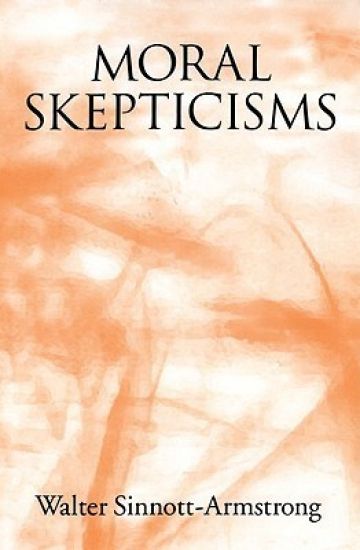
Moral epistemology is the term for thinking about how a moral belief can be justified. All contentious moral issues --from gay marriage to terrorism--raise difficult questions about the formation and status of moral beliefs. If we do form an opinion, how is that belief justified, particularly when others may feel quite differently? And even if we reach a consensus, how is that unanimous belief justified? These questions raise fundamental issues about the nature of morality, language, metaphysics, and justification and knowledge; but they also have tremendous practical importance regarding how to (if indeed we can) resolve controversial moral issues in health care ethics, politics, the law, and education. Most agree that moral nihilism--the idea that moral beliefs simply cannot be justified--is undesirable. Sinnott-Armstrong here provides an extensive survey of this difficult subject, tackling such questions as: Does knowledge require true belief? Are any moral beliefs true, and are any justified? The second half of the book brings into dialogue various moral theories that have grappled with these questions, such as naturalism, normativism, intuitionism, and coherentism, all of which are attempts to answer moral skepticism. Sinnott-Armstrong finds all of these theories lacking in their ability to fight off moral nihilism. He defends his own theory, which he calls "moderate moral skepticism," which argues that some moral beliefs can be modestly justified, but not extremely justified.
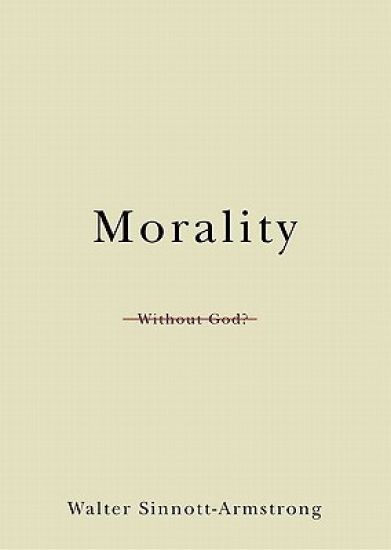
Some argue that atheism must be false, since without God, no values are possible, and thus "everything is permitted." Walter Sinnott-Armstrong argues that God is not only not essential to morality, but that our moral behavior should be utterly independent of religion. He attacks several core ideas: that atheists are inherently immoral people; that any society will sink into chaos if it is becomes too secular; that without morality, we have no reason to be moral; that absolute moral standards require the existence of God; and that without religion, we simply couldn't know what is wrong and what is right. Sinnott-Armstrong brings to bear convincing examples and data, as well as a lucid, elegant, and easy to understand writing style. This book should fit well with the debates raging over issues like evolution and intelligent design, atheism, and religion and public life as an example of a pithy, tightly-constructed argument on an issue of great social importance.
Sinnott-Armstrong here provides an extensive survey of the difficult subject of moral beliefs. He covers theories that grapple with questions of morality such as naturalism, normativism, intuitionism, and coherentism. He then defends his own theory that he calls "moderate moral skepticism," which is that moral beliefs can be justified, but not extremely justified.
Some argue that atheism must be false, since without God, no values are possible, and thus "everything is permitted." Walter Sinnott-Armstrong argues that God is not only not essential to morality, but that our moral behaviour should be utterly independent of religion. He attacks several core ideas: that atheists are inherently immoral people; that any society will sink into chaos if it is becomes too secular; that without morality, we have no reason to be moral; that absolute moral standards require the existence of God; and that without religion, we simply couldn't know what is wrong and what is right. Sinnott-Armstrong brings to bear convincing examples and data, as well as a lucid, elegant, and easy to understand writing style. This book should fit well with the debates raging over issues like evolution and intelligent design, atheism, and religion and public life as an example of a pithy, tightly-constructed argument on an issue of great social importance. "In his call for sincere dialogue with theists, Sinnott-Armstrong provides a welcome relief from the apoplectic excesses of Richard Dawkins and Christopher Hitchens, while also addressing objections to homosexuality and evolution frequently raised by evangelical Christians." --Publishers Weekly "[I]t is accessible and lively, my hope is that it will be widely read, especially by theists."--Peter Lamal, The Humanist "... the clarity of this text successfully defuses many erroneous claims about religion and morality, both popular and academic; this volume certainly deserves a wide audience in this increasingly secular and skeptical world." -Choice "Morality Without God? is an engaging, pithy book arguing against the necessity of God and religion for a robust morality. Walter Sinnott-Armstrong has distinguished himself as a leading philosopher in his work on metaethics and moral psychology, as well as books on moral and epistemological skepticism, and in Morality Without God? he commendably succeeds in writing a philosophically respectable introduction to the problems facing religious morality suitable for virtually any audience." --Philosophia Christi
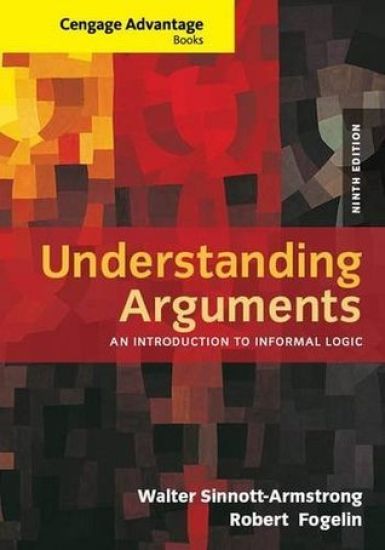
ADVANGEBOOKS - UNDERSTANDING ARGUMENTS: AN INTRODUCTION TO INFORMAL LOGIC, 9E shows readers how to construct arguments in everyday life, using everyday language. In addition, this easy-to-read textbook also devotes three chapters to the formal aspects of logic including forms of argument, as well as propositional, categorical, and quantificational logic. Plus, this edition helps readers apply informal logic to legal, moral, scientific, religious, and philosophical scenarios, too.
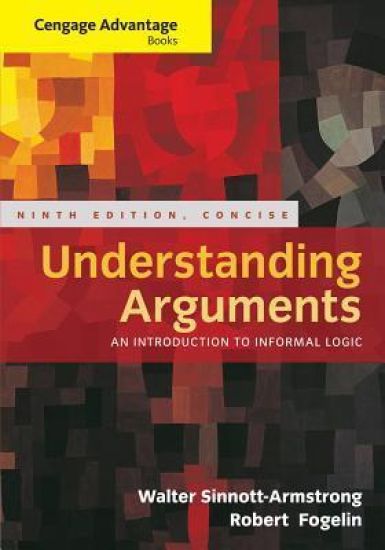
CENGAGE ADVANTAGE BOOKS: UNDERSTANDING ARGUMENTS, CONCISE EDITION, 1E uses everyday life experiences to teach the basics of informal logic. By taking out the non-essential instruction, this edition hones in on the "argument construction" involved in day-to-day life, and how to do it better. Plus, to round out the discussion, CENGAGE ADVANTAGE BOOKS: UNDERSTANDING ARGUMENTS, CONCISE EDITION, 1E includes a three-chapter overview of formal logic as well.
Ideal for undergraduate courses in philosophy of law, this comprehensive anthology examines such topics as the concept of law, the dispute between natural law theorists and legal positivists, the relations between law and morality, criminal responsibility and legal punishment, the rights of the individual against the state, justice and equality, and legal evidence as compared with scientific evidence. The readings have been selected from both philosophy and law journals and include classic texts, contemporary theoretical developments, and well-known recent court cases. The text features extensive introductions that make even the most profound writings accessible to undergraduates.
A balanced and thought-provoking guide to all the big questions about AI and ethics Can computers understand morality? Can they respect privacy? And what can we do to make AI safe and fair? The artificial intelligence revolution has begun. Today, there are self-driving cars on our streets, autonomous weapons in our armies, robot surgeons in our hospitals – and AI's presence in our lives will only increase. Some see this as the dawn of a new era in innovation and ease; others are alarmed by its destructive potential. But one thing is clear: this is a technology like no other, one that raises profound questions about the very definitions of human intelligence and morality. In Moral AI, world-renowned researchers in moral psychology, philosophy, and artificial intelligence – Jana Schaich Borg, Walter Sinnott-Armstrong and Vincent Conitzer – tackle these thorny issues head-on. Writing lucidly and calmly, they lay out the recent advances in this still nascent field, peeling away the exaggeration and misleading arguments. Instead, they offer clear examinations of the moral concerns at the heart of AI programs, from racial equity to personal privacy, fake news to autonomous weaponry. Ultimately, they argue that artificial intelligence can be built and used safely and ethically, but that its potential cannot be achieved without careful reflection on the values we wish to imbue it with. This is an essential primer for any thinking person.
A balanced and thought-provoking guide to all the big questions about AI and ethics Can computers understand morality? Can they respect privacy? And what can we do to make AI safe and fair? The artificial intelligence revolution has begun. Today, there are self-driving cars on our streets, autonomous weapons in our armies, robot surgeons in our hospitals – and AI's presence in our lives will only increase. Some see this as the dawn of a new era in innovation and ease; others are alarmed by its destructive potential. But one thing is clear: this is a technology like no other, one that raises profound questions about the very definitions of human intelligence and morality. In Moral AI, world-renowned researchers in moral psychology, philosophy, and artificial intelligence – Jana Schaich Borg, Walter Sinnott-Armstrong and Vincent Conitzer – tackle these thorny issues head-on. Writing lucidly and calmly, they lay out the recent advances in this still nascent field, peeling away the exaggeration and misleading arguments. Instead, they offer clear examinations of the moral concerns at the heart of AI programs, from racial equity to personal privacy, fake news to autonomous weaponry. Ultimately, they argue that artificial intelligence can be built and used safely and ethically, but that its potential cannot be achieved without careful reflection on the values we wish to imbue it with. This is an essential primer for any thinking person.
Current controversies over abortion, affirmative action, school prayer, hate speech, and other issues have sparked considerable public debate about how the U.S. Constitution should be interpreted. Such controversies, along with the changing composition of an often deeply divided Supreme Court, have led to a resurgence of interest in theories of con
Current controversies over abortion, affirmative action, school prayer, hate speech, and other issues have sparked considerable public debate about how the U.S. Constitution should be interpreted. Such controversies, along with the changing composition of an often deeply divided Supreme Court, have led to a resurgence of interest in theories of constitutional interpretation. This anthology, edited by Susan J. Brison and Walter Sinnott-Armstrong, presents some of the most exciting and influential contemporary work in this area. Written by ten of the country's most prominent legal scholars, the selections represent a wide variety of interpretive approaches, reflecting different political orientations from the far right to the far left. These theorists have drawn on a variety of other disciplines, including literature, economics, history, philosophy, and politics, and have in turn influenced these fields. The selections were chosen for their accessibility, originality, variety, and importance. Together they provide an excellent introduction to constitutional interpretation as well as a valuable collection for experienced scholars in the field.
People with scrupulosity have rigorous, obsessive moral beliefs that lead them to perform extreme, compulsive moral acts. A waitress with this condition checks and rechecks levels of cleaners and solvents to avoid any risk of poisoning her customers. Another individual asks repeatedly whether he fasted correctly, despite swallowing his own saliva. Those with scrupulosity stretch out their prayers for hours to be sure that they have said nothing incorrectly. They worry constantly about cleanliness, sinfulness, and all the ways they could be falling short of perfection. Using a range of fascinating case studies, Jesse S. Summers and Walter Sinnott-Armstrong argue that scrupulosity constitutes a mental illness and not moral sainthood. In doing so, they consider several important philosophical questions: Do the moral beliefs and judgments of those with scrupulosity differ from ours, or are these individuals just stricter in their moral observance? Are they morally responsible for their actions? Should they be pressured into psychiatric treatment, even when therapy leads them to act in ways they find immoral? Summers and Sinnott-Armstrong illustrate how psychiatric cases can inform the way we think about these and other philosophical issues, particularly those surrounding responsibility, rationality, and the nature of belief, morality, and mental illness. Clean Hands? will fascinate psychiatrists who treat patients with scrupulosity, philosophers who study morality, and anyone who has ever wondered about and struggled with the obligations and limits of morality.