Kirjojen hintavertailu. Mukana 11 699 587 kirjaa ja 12 kauppaa.

Kirjahaku

Etsi kirjoja tekijän nimen, kirjan nimen tai ISBN:n perusteella.

28 kirjaa tekijältä Walter Williams

The Historical Origin of Islam by Walter Williams
historically,as you progress through time,you will eventually encounter a powerful triad of religions:christianity,islam and judaism.all of these religions have had strong mass appeal and persuasive powers, and they remain the most powerful tools in the western world interests,they were developed and are perpetuated to preserve past gains,enhance present gains,and ensure future gains.
The Accidental War

The Accidental War

Walter Williams

Harper Voyager
2018
nidottu
Blending fast-paced military science fiction and space opera, the first volume in a dynamic trilogy from the New York Times bestselling author of The Praxis, set in the universe of his popular and critically acclaimed Dread Empire’s Fall series—a tale of blood, courage, adventure and battle in which the fate of an empire rests in the hands of a cadre of desperate exiles.It’s been seven years since the end of the Naxid War. Sidelined for their unorthodox tactics by a rigid, tradition-bound military establishment, Captain Gareth Martinez and Captain the Lady Sula are stewing in exile, frustrated and impatient to exercise the effective and lethal skills they were born to use in fighting the enemy.Yet after the ramshackle empire left by the Shaa conquerors is shaken by a series of hammer blows that threaten the foundations of the commonwealth, the result is a war that no one planned, no one expected, and no one knows how to end.Now, Martinez, Sula, and their confederate Nikki Severin must escape the clutches of their enemies, rally the disorganized elements of the fleet, and somehow restore the fragile peace—or face annihilation at the hands of a vastly superior force.
Creating an Information Security Program from Scratch
This book is written for the first security hire in an organization, either an individual moving into this role from within the organization or hired into the role. More and more, organizations are realizing that information security requires a dedicated team with leadership distinct from information technology, and often the people who are placed into those positions have no idea where to start or how to prioritize. There are many issues competing for their attention, standards that say do this or do that, laws, regulations, customer demands, and no guidance on what is actually effective. This book offers guidance on approaches that work for how you prioritize and build a comprehensive information security program that protects your organization. While most books targeted at information security professionals explore specific subjects with deep expertise, this book explores the depth and breadth of the field. Instead of exploring a technology such as cloud security or a technique such as risk analysis, this book places those into the larger context of how to meet an organization's needs, how to prioritize, and what success looks like. Guides to the maturation of practice are offered, along with pointers for each topic on where to go for an in-depth exploration of each topic. Unlike more typical books on information security that advocate a single perspective, this book explores competing perspectives with an eye to providing the pros and cons of the different approaches and the implications of choices on implementation and on maturity, as often a choice on an approach needs to change as an organization grows and matures.
Creating an Information Security Program from Scratch
This book is written for the first security hire in an organization, either an individual moving into this role from within the organization or hired into the role. More and more, organizations are realizing that information security requires a dedicated team with leadership distinct from information technology, and often the people who are placed into those positions have no idea where to start or how to prioritize. There are many issues competing for their attention, standards that say do this or do that, laws, regulations, customer demands, and no guidance on what is actually effective. This book offers guidance on approaches that work for how you prioritize and build a comprehensive information security program that protects your organization. While most books targeted at information security professionals explore specific subjects with deep expertise, this book explores the depth and breadth of the field. Instead of exploring a technology such as cloud security or a technique such as risk analysis, this book places those into the larger context of how to meet an organization's needs, how to prioritize, and what success looks like. Guides to the maturation of practice are offered, along with pointers for each topic on where to go for an in-depth exploration of each topic. Unlike more typical books on information security that advocate a single perspective, this book explores competing perspectives with an eye to providing the pros and cons of the different approaches and the implications of choices on implementation and on maturity, as often a choice on an approach needs to change as an organization grows and matures.
The Implementation Perspective

The Implementation Perspective

Walter Williams

University of California Press
1980
pokkari
After the 'big' decisions are made in legislatures and executive offices, what is done by those who implement and operate social service programs will determine their success or failure. Yet, over and over again, the managers of public organization disregard or handle poorly the critical problems involved in starting and developing new programs or in modifying existing ones. This book presents a new decision-making rationale - the implementation perspective - as the basic guide to social service program management. The cardinal principle is that the central focus of policy must be at the point of service delivery. Here is where management must redirect its attention. The demand is to concentrate on the hard, dirty, time-consuming work of building the local delivery capacity needed to provide better social services and to implement new program decisions over time. The "Implementation Perspective" is a message for our times. Even those who would continue the nation's effort to meet its social obligations are finding that simply calling for big new programs and more spending is no longer satisfying. Moreover, Proposition 13, the balanced budget movement, inflation, and compelling demands for new funds in such areas as energy, now squeeze social programs. New directions may have to come, not from new funds, but from rethinking and redirection and, more to the point, the better management of existing programs.
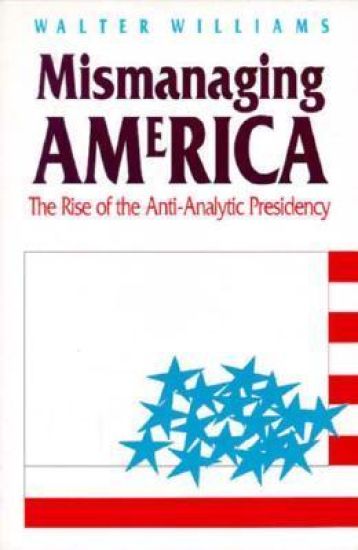
Mismanaging America

Mismanaging America

Walter Williams

University Press of Kansas
1990
nidottu
Is the federal government inept? Walter Williams says yes. Thanks to Ronald Reagan's ill-conceived cutbacks, reliable policy advice is no longer available to the president. The result has been the S&L bailout, the HUD scandal - mismanagement on an unprecedented scale. In this book Willims aims to show how Reagan, the first truly anti-analytic president, decimated the ranks of policy analysts and special information experts in the name of trimming back big government. Williams sets the stage and provides programme notes that explain both the crucial role of advisors and policy analysts in presidential policy making and where the system has gone wrong. ""Governments succeed or fail on information, analysis, and advice"", Williams writes, ""but the system that provides our information analysis has been gutted"". In ""Mismanaging America"" he not only reveals the linkage between the US ailing policy process and the anaemic, inept government that created the S&L and HUD scandals, but proposes urgently needed reforms to fight America's decline.
Reaganism and the Death of Representative Democracy

Reaganism and the Death of Representative Democracy

Walter Williams

Georgetown University Press
2003
sidottu
This is a reasoned but passionate look at how Reaganism - the political philosophy of Ronald Reagan - has severely damaged representative democracy as created by the nation's founders. According to Williams, Reagan and his foremost disciple George W. Bush have created a plutocracy where the United States is no longer a government of the people, by the people, and for the people but is ruled by the wealthiest individuals and corporate America. Refreshingly unafraid to point out that Reaganism's anti-government fundamentalism stands on feet of clay, Walter Williams asks that Americans move from their political apathy to pay attention to the politicians and the corporations lurking behind the power curtain to see the dangers they represent to the true essential of the American way of life. Williams' most important contribution is his extended analysis of the central role the key institutions - the presidency, Congress, the federal agencies - must play for the U.S. government to be capable in both sustaining representative democracy and protecting the safety and economic security of the American people. A clear result of the weakened institutions has been the grossly inadequate homeland security effort following September 11, and the massive corporate fraud revealed by Enron and other large firms that robbed the nation of hundreds of billions of dollars in stock values and depleted the pension savings of millions of people. The initial destructive blow that damaged the institutions of governance can be traced to Ronald Reagan and his simplistic antigovernment philosophy that fostered rapacious business practices and personal greed. The book also takes the media to task, criticizing the dismal record of failing to investigate the political and corporate chicanery that has brought us to this pass. Keenly argued and scrupulously documented, Walter Williams has written a stinging wake-up call to the dangers of the demise of representative democracy and the rise of plutocracy that American citizens can ignore only at their peril.
Honest Numbers and Democracy

Honest Numbers and Democracy

Walter Williams

Georgetown University Press
1998
pokkari
In "Honest Numbers and Democracy", Walter Williams offers a revealing history of policy analysis in the federal government and a scorching critique of what's wrong with social policy analysis today. Williams, a policy insider who witnessed the birth of domestic policy analysis during the Johnson administration, contends that the increasingly partisan U.S. political environment is vitiating both "honest numbers" - the data used to direct public policy - and, more importantly, honest analysts, particularly in the White House. Drawing heavily on candid off-the-record interviews with political executives, career civil servants, elected officials and Washington-based journalists, Williams documents the steady deformation of social policy analysis under the pressure of ideological politics waged by both the executive and legislative branches. Beginning with the Reagan era and continuing into Clinton's tenure, Williams focuses on the presidents' growing penchant to misuse and hide numbers provided by their own analysts to assist in major policy decisions. "Honest Numbers and Democracy" is the first book to examine in-depth the impact of the electronic revolution, its information overload, and rampant public distrust of the federal government's data on the practice of policy analysis. A hard-hitting account of the factors threatening the credibility of the policymaking process, this book will be required reading for policy professionals, presidential watchers, and anyone interested in the future of U.S. democracy.
The Bicycle Garden

The Bicycle Garden

Walter Williams

Fernwood Hedges Books
2014
sidottu
Kirkus Review--The Bicycle Garden Lively, colorful illustrations enhance this family bedtime story about bicycles and magic. What kid doesn't want a shiny new bike? Siblings Timka and Dasha are lucky enough to be able to grow one in their backyard with the help of some magic seeds. It works great at first, but then the bicycle continues to grow until it reaches the sky. The brother and sister, distraught that the bike has become unusable, plant more seeds and grow more bikes, all of which grow and grow until the backyard is a jungle of gigantic tires and metal. The author's colored-pencil illustrations are the book's standout feature, with vibrant primary hues and simplified, exuberant figures that seem influenced by Henri Matisse's work. Each illustration clearly supports its corresponding page of text-no more than one sentence per page-and takes liberties with space, perspective and form in a way that children may find delightfully silly and adults, appealingly modernist. As such, they recall the work of author/illustrators such as Patrick McDonnell and Dahlov Ipcar. One page, in which the children go riding through a jumbled, joyful city, is particularly well-done, as are illustrations that show their tiny house, seen through vast frameworks of brightly colored metal. Bicycles and gardens are almost universal objects of fascination for young children, who will likely see themselves in the inventively named young protagonists. Parents may be tempted to read a larger message into the story-is it a cautionary tale about economic growth and development?-but younger readers will simply enjoy its fantastical theme and its happy, satisfying ending. A charming picture book, full of visual appeal, which may become a family favorite.
Security for Service Oriented Architectures
Although integrating security into the design of applications has proven to deliver resilient products, there are few books available that provide guidance on how to incorporate security into the design of an application. Filling this need, Security for Service Oriented Architectures examines both application and security architectures and illustrates the relationship between the two. Supplying authoritative guidance on how to design distributed and resilient applications, the book provides an overview of the various standards that service oriented and distributed applications leverage, including SOAP, HTML 5, SAML, XML Encryption, XML Signature, WS-Security, and WS-SecureConversation. It examines emerging issues of privacy and discusses how to design applications within a secure context to facilitate the understanding of these technologies you need to make intelligent decisions regarding their design.This complete guide to security for web services and SOA considers the malicious user story of the abuses and attacks against applications as examples of how design flaws and oversights have subverted the goals of providing resilient business functionality. It reviews recent research on access control for simple and conversation-based web services, advanced digital identity management techniques, and access control for web-based workflows. Filled with illustrative examples and analyses of critical issues, this book provides both security and software architects with a bridge between software and service-oriented architectures and security architectures, with the goal of providing a means to develop software architectures that leverage security architectures.It is also a reliable source of reference on Web services standards. Coverage includes the four types of architectures, implementing and securing SOA, Web 2.0, other SOA platforms, auditing SOAs, and defending and detecting attacks.