Kirjojen hintavertailu. Mukana 11 244 527 kirjaa ja 12 kauppaa.

Kirjahaku

Etsi kirjoja tekijän nimen, kirjan nimen tai ISBN:n perusteella.

21 kirjaa tekijältä Warren Carter

John and Empire

John and Empire

Warren Carter

T. T.Clark Ltd
2008
sidottu
In this significant and innovative contribution, Warren Carter explores John's Gospel as a work of imperial negotiation in the context of Ephesus, capital of the Roman province of Asia. Carter employs multiple methods, rejects sectarian scenarios, and builds on other Christian writings and recent studies of diaspora synagogues that combined participationist lifestyles with observance of distinctive practices to argue that imperial negotiation was a contested issue for late first-century Jesus-believers. While a number of Jesus-believers probably lived societally-accommodated lives, John's Gospel employs a "rhetoric of distance" to urge much less accommodation and to create an alternative "anti-society" for followers of Jesus crucified by the empire but vindicated by God. In addition to establishing this tense historical setting, chapters identify various arenas and strategies of imperial negotiation in wide-ranging discussions of the gospel's genre, plot, Christological titles, developing traditions, eternal life, the image of God as father, ecclesiology, Jesus' conflict with Pilate, and resurrection and ascension.Carter has explored interactions between the emerging Christian movement and the Roman Empire in various articles and book-length studies such as Matthew and the Margins (Orbis), Matthew and Empire (Trinity Press International/Continuum), Pontius Pilate: Portraits of a Roman Governor (Liturgical), and The Roman Empire and the New Testament (Abingdon).
John and Empire

John and Empire

Warren Carter

T. T.Clark Ltd
2008
nidottu
In this significant and innovative contribution, Warren Carter explores "John's Gospel" as a work of imperial negotiation in the context of Ephesus, capital of the Roman province of Asia. Carter employs multiple methods, rejects sectarian scenarios, and builds on other Christian writings and recent studies of diaspora synagogues that combined participationist lifestyles with observance of distinctive practices to argue that imperial negotiation was a contested issue for late first-century Jesus-believers. While a number of Jesus-believers probably lived societally-accommodated lives, John's Gospel employs a "rhetoric of distance" to urge much less accommodation and to create an alternative "anti-society" for followers of Jesus crucified by the empire but vindicated by God.In addition to establishing this tense historical setting, chapters identify various arenas and strategies of imperial negotiation in wide-ranging discussions of the gospel's genre, plot, Christological titles, developing traditions, eternal life, the image of God as father, ecclesiology, Jesus' conflict with Pilate, and resurrection and ascension.Carter has explored interactions between the emerging Christian movement and the Roman Empire in various articles and book-length studies such as "Matthew and the Margins" (Orbis), "Matthew and Empire" (Trinity Press International/Continuum), "Pontius Pilate: Portraits of a Roman Governor" (Liturgical), and "The Roman Empire and the New Testament" (Abingdon).
Matthew and the Margins

Matthew and the Margins

Warren Carter

T. T.Clark Ltd
2004
nidottu
This detailed commentary presents the gospel of matthew as a counter-narrative, showing that it is a work of resistance written from and for a minority community of disciples committed to Jesus, the agent of God's saving presence. It was written and functions to shape the identity and lifestyle of the early community of jesus' followers as an alternative community that can resist the dominant authorities both in rome and in the synagogue. The Gospel anticpates the time when Jesus will return and establish God's reign over all, including the powers in Rome.
1, 2, and 3 John: An Introduction and Study Guide

1, 2, and 3 John: An Introduction and Study Guide

Warren Carter

BLOOMSBURY PUBLISHING PLC
2024
sidottu
This insightful study engages the debates and interpretations of the brief and somewhat elusive writings known in the Christian canon as 1, 2, and 3 John. Chapter 1 identifies six unknowns about the origins of the three writings: authors, relationship to John’s Gospel, order, date and location of the writings, and their audiences. Chapters 2 and 3 delineate the debate concerning the relationship of these writings to a purported “Johannine tradition” and “Johannine community” in which a schism is claimed to have occurred. An alternative view recognizes that while there are some connections with John’s Gospel, it is more compelling to see the writings as independent rather than derivative, as internally not externally directed, as pastoral not polemical, and as schism-free. Chapters 4-7 discuss important aspects of 1 John. Chapter 4 argues that its structure or organization is based on rhetorical and conceptual links among the writing’s small units. Chapter 5 reads 1 John as a pastoral “in-house” writing, rather than a polemical attack on opponents. Chapter 6 identifies the genre of I John as not a letter or sermon but an epideictic speech that seeks to strengthen the identity, commitments, and practices of its believing recipients. Chapter 7 outlines theological understandings that underpin the writing’s pastoral work.Chapters 8 and 9 focus on 2 and 3 John as writings that provide two different approaches to itinerant teachers. The narrative fiction in 2 John presents the elder’s warning and skepticism about itinerant teachers whereas the author of 3 John, by contrast, advocates reception and welcome for itinerant teachers.
1, 2, and 3 John: An Introduction and Study Guide

1, 2, and 3 John: An Introduction and Study Guide

Warren Carter

BLOOMSBURY PUBLISHING PLC
2024
nidottu
This insightful study engages the debates and interpretations of the brief and somewhat elusive writings known in the Christian canon as 1, 2, and 3 John. Chapter 1 identifies six unknowns about the origins of the three writings: authors, relationship to John’s Gospel, order, date and location of the writings, and their audiences. Chapters 2 and 3 delineate the debate concerning the relationship of these writings to a purported “Johannine tradition” and “Johannine community” in which a schism is claimed to have occurred. An alternative view recognizes that while there are some connections with John’s Gospel, it is more compelling to see the writings as independent rather than derivative, as internally not externally directed, as pastoral not polemical, and as schism-free. Chapters 4-7 discuss important aspects of 1 John. Chapter 4 argues that its structure or organization is based on rhetorical and conceptual links among the writing’s small units. Chapter 5 reads 1 John as a pastoral “in-house” writing, rather than a polemical attack on opponents. Chapter 6 identifies the genre of I John as not a letter or sermon but an epideictic speech that seeks to strengthen the identity, commitments, and practices of its believing recipients. Chapter 7 outlines theological understandings that underpin the writing’s pastoral work.Chapters 8 and 9 focus on 2 and 3 John as writings that provide two different approaches to itinerant teachers. The narrative fiction in 2 John presents the elder’s warning and skepticism about itinerant teachers whereas the author of 3 John, by contrast, advocates reception and welcome for itinerant teachers.
The Roman Empire and the New Testament

The Roman Empire and the New Testament

Warren Carter

Abingdon Press
2006
pokkari
This work provides an indispensable introduction to Roman society, culture, law, politics, religion, and daily life as they relate to the study of the New Testament. The Roman Empire formed the central context in which the New Testament was written. Anyone who wishes to understand the New Testament texts must become familiar with the political, economic, societal, cultural, and religious aspects of Roman rule. Much of the New Testament deals with enabling its readers to negotiate, in an array of different manners, this pervasive imperial context. This book will help the reader see how social structures and daily practices in the Roman world illumine so much of the content of the New Testament message. For example, to grasp what Paul was saying about food offered to idols one must understand that temples in the Roman world were not "churches," and that they functioned as political, economic, and gastronomic centers, whose religious dealings were embedded within these other functions.Brief in presentation yet broad in scope, "The Roman Empire and the New Testament: An Essential Guide" will introduce students to the information and ideas essential to coming to grips with the world in which early Christianity was born.
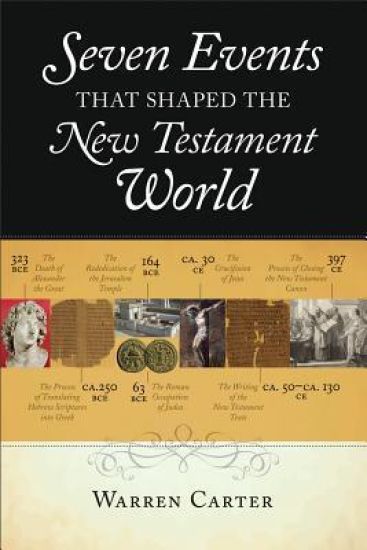
Seven Events That Shaped the New Testament World

Seven Events That Shaped the New Testament World

Warren Carter

Baker Academic, Div of Baker Publishing Group
2013
nidottu
This useful, concise introduction to the worlds around the New Testament focuses on seven key moments in the centuries before and after Jesus. It enlightens readers about the beginnings of the Christian movement, showing how religious, political, and economic factors were interwoven in the fabric of the New Testament world.Leading New Testament scholar Warren Carter has a record of providing student-friendly texts. This introduction offers a "big picture" focus and is logically and memorably organized around seven events, which Carter uses as launching pads to discuss larger cultural dynamics and sociohistorical realities that were in some way significant for followers of Jesus and the New Testament. Photos and maps are included.
Matthew – Storyteller, Interpreter, Evangelist

Matthew – Storyteller, Interpreter, Evangelist

Warren Carter

Baker Academic, Div of Baker Publishing Group
2004
nidottu
For ten years, the well-received first edition of this introduction offered readers a way to look at scriptural texts that combines historical, narrative, and contemporary interests. Carter explores Matthew by approaching it from the perspective of the "authorial audience"--by identifying with and reading along with the audience imagined by the author. Now an updated second edition is available as part of a series focusing on each of the gospel writers as storyteller, interpreter, and evangelist.This edition preserves the essential identity of the original material, while adding new insights from Carter's more recent readings of Matthew's gospel in relation to the Roman Imperial world.Four of the seventeen chapters have been significantly revised, and most have had minor changes. There are also new endnotes directing readers to Carter's more recent published work on Matthew. Scholars and pastors will use the full bibliography and appendix on redaction and narrative approaches, while lay readers will appreciate the clear and straightforward text.
Matthew 16:21-28:20

Matthew 16:21-28:20

Warren Carter

William B. Eerdmans Publishing Company
2025
sidottu
An insightful commentary on the Gospel of Matthew that focuses on historical context and reception history Building on decades of focused work on the first Gospel, Warren Carter brings the fruit of that research to bear in a tour de force of historical insight and methodological rigor. Within this remarkable two-volume commentary, Carter situates the Gospel of Matthew within the context of Jewish traditions and negotiations of Roman imperialism after the destruction of Jerusalem in 70 CE. He positions the Gospel as illuminating how a community of Jesus-followers constantly navigates Roman power. He pays particular attention to Jesus's strategies for dealing with Roman rule, showing how Jesus alternately replicates it, accommodates it, resists it, and develops a way of life committed to the empire of God. In addition to examining the Gospel of Matthew in its historical and social context, Carter shines new light on instances of the book's reception, illustrating how scholars have interpreted it from the era of the early church up to the present. This fascinating commentary is an essential and distinctive resource for New Testament scholars and students of theology.
Pontius Pilate

Pontius Pilate

Warren Carter

Liturgical Press
2003
pokkari
Pontius Pilate examines the portraits of this Roman governor found in the Gospels. Unlike some discussions of Pilate, this one takes Pilate's role as governor and representative of Roman imperial power seriously. It views Pilate predominantly as a strong, efficient, and astute governor, not as a weak and indecisive man, pressured into killing Jesus against Pilate's convictions. The conclusion considers some of the ethical and theological issues the scenes involving Pilate raise for contemporary readers. Chapters are "Would the Real Pilate Please Stand Up?" "Reading the Gospel Accounts of Pilate," "Governors and the Roman Imperial System," "Mark's Pilate," "Matthew's Pilate," "Luke's Pilate," and "John's Pilate." Warren Carter, Ph.D., is professor of New Testament at Saint Paul School of Theology, Kansas City, Missouri. He has published numerous scholarly and ecclesial publications.
Mark

Mark

Warren Carter

Liturgical Press
2019
sidottu
The Academy of Parish Clergy 2020 Reference Book of the Year2020 Association of Catholic Publishers first place award in Scripture2020 Catholic Press Association third place award for best new religious book seriesThis reading of Mark's Gospel engages this ancient text from the perspective of contemporary feminist concerns to expose and resist all forms of domination that prevent the full flourishing of all humans and all creation. Accordingly, it foregrounds the Gospel's constructions of gender in intersectionality with the visions, structures, practices, and personnel of Roman imperial power. This reading embraces a rich tradition of feminist scholarship on the Gospel, as well as masculinity studies, particularly pervasive hegemonic masculinity. Its politically engaged discussion of Mark's Gospel provides a resource for clergy, students, and laity concerned with contemporary constructions of gender, power, and a world in which all might experience fullness of life.
The New Testament

The New Testament

Warren Carter

Abingdon Press
2013
pokkari
In this concise, accessible book, Warren Carter and A.J. Levine introduce three aspects of New Testament study: the world of the text (plots, characters, setting, and themes), the world behind the text (the concerns, circumstances, and experiences of the early Christian communities), and the world in front of the text (the meaning for contemporary readers).As students engage the New Testament, theyface a central issue that has confronted all students before them, namely, that these texts have been and are read in diverse and often quite conflicting ways. These multiple readingsinvolve different methods: historical-critical, traditional (history of interpretation), colonial, multicultural, and sociological, with feminist and liberationist implications for the first-century readers as well as the ongoing implications for today's reader. For example, Carter and Levineshow how a text can be used by both colonizer and colonized, feministand anti-feminist, or pro- and anti-Jewish.The authors also showhow scholarly work can be both constructive and threateningto the contemporary Church and how polemical texts can be used, whether for religious study, theological reflection, or homiletical practice.
God in the New Testament

God in the New Testament

Warren Carter

Abingdon Press
2016
nidottu
Warren Carter addresses how New Testament writings construct their presentation of God using narrative and thematic approaches. Chapters will discuss Matthew's Gospel, Luke-Acts, John's Gospel (and letters), Paul, post-Pauline letters, Hebrews, and Revelation. In addition there will be a chapter on the Catholic Epistles. The author uses four questions to show how God is presented: How is God presented in relation to Israel? How is God presented in relation to Jesus and the Spirit? How is God presented in relation to believers/disciples/the church? How is God presented in relation to "the world" (both material creation and humanity)? The approach is not to impose these questions, grid-like, on the material but to use them to surface the important factors of each writing's emphases.
Telling Tales about Jesus

Telling Tales about Jesus

Warren Carter

Fortress Press,U.S.
2016
pokkari
Warren Carter leads the beginning student in an inductive exploration of the New Testament Gospels, asking about their genre, the view that they were written by eyewitnesses, the early church traditions about them, and how they employ Hellenistic biography. He examines the distinctive voice of each Gospel, describing the "tale about Jesus" each writer tells, then presenting likely views regarding the circumstances in which they were written, giving particular attention to often overlooked aspects of the Roman imperial setting. A sociohistorical approach suggests that Mark addressed difficult circumstances in imperial Rome; redaction criticism shows that Matthew edited traditions to help define identity in competition with synagogue communities in response to a fresh assertion of Roman power; a literary - thematic approach shows that Luke offers assurance in a context of uncertainty; an intertextual approach shows how John used Wisdom traditions to present Jesus as the definitive revealLer of God's presence to answer an ancient quest for divine knowledge. A concluding chapter addresses how the Gospels inform and shape our understanding of Jesus of Nazareth.
Matthew and Empire

Matthew and Empire

Warren Carter

Continuum International Publishing Group - Trinity
2001
nidottu
Although New Testament scholars have examined Paul's writings and their relationship to the Roman empire and its imperial policies and writings, they have focused little attention on ways in which the Gospels were influenced by that imperialism. In Matthew and Empire, Warren Carter argues that Matthew's Gospel protests Roman imperialism by asserting that God's purposes and will are performed not by the empire and emperor but by Jesus and his community of disciples. Matthew and Empire makes the claim for reading Matthew in this way against the almost exclusive emphasis on the relationship with the synagogue that has long been a staple of Matthean criticism. Carter establishes Matthew's imperial context by examining Roman imperial ideology and material presence in Antioch, the traditional provenance for Matthew. He argues that Matthean Christology, which presents Jesus as God's agent, is shaped by claims and protests against those claims that the emperor and empire are agents of God. In successive chapters Carter pays particular attention to the Gospel's central irony, namely that in depicting God's ways and purposes, the Gospel employs the very imperial framework that it resists. Matthew and Empire challenges traditional readings of Matthew and Empire encourages fresh perspectives in Matthean scholarship. Warren Carter is Pherigo Professor of New Testament at Saint Paul School of Theology and author of Matthew and the Margins: A Socio-Political and Religious Reading.
The New Testament

The New Testament

Warren Carter

Abingdon Press
2014
sidottu
In this concise, accessible book, Warren Carter and A.J. Levine introduce three aspects of New Testament study: the world of the text (plots, characters, setting, and themes), the world behind the text (the concerns, circumstances, and experiences of the early Christian communities), and the world in front of the text (the meaning for contemporary readers). As students engage the New Testament, they face a central issue that has confronted all students before them, namely, that these texts have been and are read in diverse and often quite conflicting ways. These multiple readings involve different methods: historical-critical, traditional (history of interpretation), colonial, multicultural, and sociological, with feminist and liberationist implications for the first-century readers as well as the ongoing implications for today's reader. For example, Carter and Levine show how a text can be used by both colonizer and colonized, feminist and anti-feminist, or pro- and anti-Jewish. The authors also show how scholarly work can be both constructive and threatening to the contemporary Church and how polemical texts can be used, whether for religious study, theological reflection, or homiletical practice. "... a brilliant contemporary representative of the biblical discipline of the Einleitung, Introduction. ... In the best tradition of historical-critical biblical scholarship, Carter and Levine advocate a respectful, critical and generous engagement with the texts, involving readers in finding meanings. ... There are many gems in the heart of this book, including excursuses in shaded boxes, and some misguided traditional interpretations are safely despatched. Dagmar Winter, Journal for the Study of The New Testament Booklist 2015
Jesus and the Empire of God

Jesus and the Empire of God

Warren Carter

Wipf Stock Publishers
2021
pokkari
The New Testament Gospels came into existence in a world ruled by Roman imperial power. Their main character, Jesus, is crucified on a Roman cross by a Roman governor. How do the Gospels interact with the structures, practices, and personnel of the Roman world? What strategies and approaches do the Gospels attest? What role for accommodation, for imitation, for critique, for opposition, for decolonizing, for reinscribing, for getting along, for survival? This book engages these questions by discussing the Gospel accounts of Jesus' origins and birth, his teachings and miraculous actions, his entry to Jerusalem, his death, and his resurrection, ascension, and return. The book engages not only the first-century world but also raises questions about our own society's structures and practices concerning the use of power, equitable access to resources, the practice of justice, and merciful and respectful societal interactions.
Jesus and the Empire of God

Jesus and the Empire of God

Warren Carter

Wipf Stock Publishers
2021
sidottu
The New Testament Gospels came into existence in a world ruled by Roman imperial power. Their main character, Jesus, is crucified on a Roman cross by a Roman governor. How do the Gospels interact with the structures, practices, and personnel of the Roman world? What strategies and approaches do the Gospels attest? What role for accommodation, for imitation, for critique, for opposition, for decolonizing, for reinscribing, for getting along, for survival? This book engages these questions by discussing the Gospel accounts of Jesus' origins and birth, his teachings and miraculous actions, his entry to Jerusalem, his death, and his resurrection, ascension, and return. The book engages not only the first-century world but also raises questions about our own society's structures and practices concerning the use of power, equitable access to resources, the practice of justice, and merciful and respectful societal interactions.
The Massacre of the Innocents

The Massacre of the Innocents

Warren Carter

BLOOMSBURY PUBLISHING PLC
2023
sidottu
In The Massacre of the Innocents: Studies in the Cultural Afterlife of a Gospel Scene, Warren Carter examines some fifty instances of the interpretation of the Matthean “Massacre of the Innocents” (Matt 2:16-18). He emphasizes the agency of interpreters, who in their particular contexts and media, “think with” the shocking Matthean scene to address the often-tragic circumstances of their audiences. He argues throughout that the structure of the Gospel scene facilitates this “thinking with.” The scene is structured as a triad of power relations with a tyrant (Herod), victims (infants and parents), and violent means of tyranny (the massacre). Interpreters use this triad of power relations to identify tyrant/s, victims, and means of tyranny in their own situations. Carter illustrates the use of this triad of power relations across two millennia, in numerous socio-political contexts, and media as diverse as sermons, images, poems and hymns, dramas and festivals, films, novels, Christmas carols, and Children’s Bibles.