Kirjojen hintavertailu. Mukana 11 717 486 kirjaa ja 12 kauppaa.

Kirjahaku

Etsi kirjoja tekijän nimen, kirjan nimen tai ISBN:n perusteella.

5 kirjaa tekijältä Wayne R. Kime

Colonel Richard Irving Dodge

Colonel Richard Irving Dodge

Wayne R. Kime

University of Oklahoma Press
2006
sidottu
Few soldiers saw more of the late-nineteenth-century West and its peoples or made more friends and acquaintances, civilian and military, than the energetic and sociable Col. Richard Irving Dodge. In this first biography of the soldier-author, Wayne R. Kime describes Dodge's early years, experiences as a writer, and forty-three-year career as an infantry officer in the U.S. Army, setting his life story in a rich historical context.Between 1848 and 1891 Dodge participated in the Great Sioux War, explored the Black Hills, commanded infantry regiments, and served as an aide-de-camp to General William Tecumseh Sherman. He was personally engaged in the ongoing power struggle between the army and the Bureau of Indian Affairs over how best to solve the country's so-called Indian problem.Dodge was a paradox. He admired Plains Indians and lamented the end of their way of life brought on by confinement on reservations and the slaughter of buffalo. Yet he also considered Indians to be ""savages"" who could be ""civilized"" only by threat of force. As Kime reveals, the contradictions in Dodge's life and thought mirrored the ambivalence that many Americans felt about Indian policy and westward expansion.
Pierre M. Irving and Washington Irving

Pierre M. Irving and Washington Irving

Wayne R. Kime

Wilfrid Laurier University Press
1978
nidottu
Washington Irving and his nephew Pierre first met as adults in 1826. In compliance with teh wises of his uncle, Pierre assumed the roles of real estate agent, comptroller, editor, confidant and nurse. After the author's death in 1859, Pierre compiled The Life and Letters of Washington Irving, which for three generations remained the standard biographic portrait.The present work traces the relationships between Pierre and Washington Irving. In addition it includes a biography of Pierre M. Irving.
Pierre M. Irving and Washington Irving

Pierre M. Irving and Washington Irving

Wayne R. Kime

Wilfrid Laurier University Press
1978
sidottu
Washington Irving and his nephew Pierre first met as adults in 1826. In compliance with teh wises of his uncle, Pierre assumed the roles of real estate agent, comptroller, editor, confidant and nurse. After the author's death in 1859, Pierre compiled The Life and Letters of Washington Irving , which for three generations remained the standard biographic portrait. The present work traces the relationships between Pierre and Washington Irving. In addition it includes a biography of Pierre M. Irving.
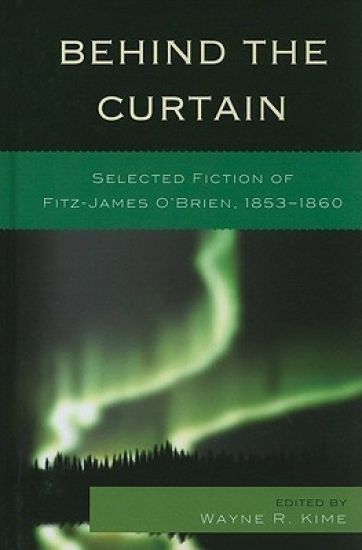
Behind the Curtain

Behind the Curtain

Wayne R. Kime

University of Delaware Press
2011
sidottu
In the decade that followed his emigration to the United States in 1851, Fitz-James O'Brien (1828-1862) produced a steady stream of contributions to American newspapers and magazines. As short story writer, essayist, poet, dramatist, reporter, reviewer, drama critic, and editor he won reputation as one of the ablest young writers in New York City, displaying what one contemporary termed an "extraordinary" talent. But soon after his early death from complications of a battle wound, the sense of wonder at O'Brien's prolific accomplishments began to dissipate. In 1881 his friend William Winter brought out The Poems and Stories of Fitz-James O'Brien, a one-volume collection that spared him the oblivion that awaits even the ablest magazine writers. That book, with reprintings derived from it, has formed almost by itself the basis for O'Brien's lasting reputation. In the early decades of the twentieth century O'Brien continued to be admired as the most significant practitioner in the short story in the United States of the 1850s. However, since then the recognition of his achievement has focused on a few tales of the macabre and the supernatural. He is now remembered in two unrelated contexts: as a colorful member of the "Bohemian" circle that flourished in New York City in the years prior to the Civil War, and as author of such stories as "The Diamond Lens," "The Lost Room," and "What Was It? A Mystery." The present volume reintroduces the fiction of Fitz-James O'Brien to modern readers by presenting fourteen of his works, five here reprinted for the first time, that together suggest the development and range of his accomplishment as a short story writer. Additionally, editorial commentary on individual stories reveals O'Brien's attunement to the fashions, fads, interests, and concerns that manifested themselves in his adopted city and country. Though immersed in the details of his own era, O'Brien cherished a belief that some of his writings would live beyond it. The present collection offers evidence t
Thirteen Stories by Fitz-James O'Brien

Thirteen Stories by Fitz-James O'Brien

Wayne R. Kime

University of Delaware Press
2012
sidottu
his volume forms part of a continuing initiative by Wayne R. Kime to make available the writings of Fitz-James O’Brien (1828-1862), an Irish-American literary man who during his lifetime won reputation as one of the most talented young authors in the United States, but who has been all but forgotten since. It follows Fitz-James O’Brien: Selected Literary Journalism, 1852-1860 (Susquehanna University Press, 2003) and Behind the Curtain: Selected Fiction of Fitz-James O’Brien (University of Delaware Press and Rowman & Littlefield Publishing Group, 2011), both edited by Kime. Like its predecessors, the volume offers evidence that “not only for his vivid contemporaneity but also for his originality, range, and technical skill” (Fitz-James O’Brien: Selected Literary Journalism, 10), O’Brien’s claim to lasting memory was well justified. Thirteen Stories by Fitz-James O’Brien: The Realm of Mind presents a group of works that explore one of the author’s special interests, the representation of individual consciousness. All but three of the stories are reprinted here for the first time. The works are arranged chronologically, by date of publication, under five headings: Expanded Faculties (“The Old Boy,” “The Spider’s Eye,” “Seeing the World”), Induced Visions (“The Hasheesh Eater,” “Broadway Bedeviled”), New Knowledge (“Mr. Grubbe’s Night with Memnon,” “The Golden Ingot,” “How I Overcame My Gravity”), Love and Hate (“Number 101,” “Jubal, the Ringer”), and Dreams (“A Terrible Night,” “The Crystal Bell,” “From Hand to Mouth”). A general introduction, brief introductions to the individual stories, and explanatory notes complement the reprinted texts. The volume has been designed to appeal to both general and specialist readers.