Kirjojen hintavertailu. Mukana 11 343 146 kirjaa ja 12 kauppaa.

Kirjahaku

Etsi kirjoja tekijän nimen, kirjan nimen tai ISBN:n perusteella.

6 kirjaa tekijältä Wendy Wall

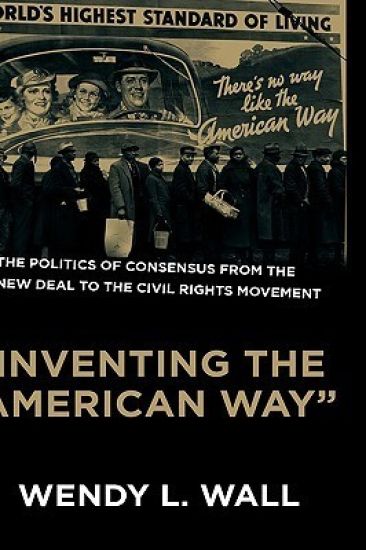
Inventing the "American Way"

Inventing the "American Way"

Wendy Wall

Oxford University Press Inc
2008
sidottu
Popular thought holds that America in the affluent postwar decades avoided extremes and shared a common set of convictions that can be briefly defined as a confidence in American-style capitalism and the democratic abundance it generated; distaste for class conflict; dedication to social unity at home and to anti-communism abroad; interfaith cooperation; and, by the early 1960s, support for civil rights. In this book, Wendy Wall looks at how and why Americans of diverse backgrounds and divergent political views agreed upon a need for and put forward a unifying set of national values. She particularly focuses on three groups: businessmen and advertising executives, government officials and cultural elites, and a loose collation of activists and intellectuals. they collectively launched a sweeping campaign to educate Americans on essential civic values, using radio, television, universities, and advertising. In this detailing of what was in fact a period of culture wars, Wall exmaines the birth of such concepts as 'free enterprise' and the 'vital center' that contiue to be used by politicians today. Speaking to those in multiple fields, this book will appeal to readers who enjoyed such books as Gary Gerstle's American Crucible, Daniel Rodgers' Atlantic Crossing, Mary Dudziak's Cold War Civil Rights, and Elizabeth Borgwardt's A New Deal for the World.

Inventing the "American Way"

Inventing the "American Way"

Wendy Wall

Oxford University Press Inc
2009
nidottu
In the wake of World War II, Americans developed an unusually deep and all-encompassing national unity, as postwar affluence and the Cold War combined to naturally produce a remarkable level of agreement about the nation's core values. Or so the story has long been told. Inventing the "American Way" challenges this vision of inevitable consensus. Americans, as Wendy Wall argues in this innovative book, were united, not so much by identical beliefs, as by a shared conviction that a distinctive "American Way" existed and that the affirmation of such common ground was essential to the future of the nation. Moreover, the roots of consensus politics lie not in the Cold War era, but in the turbulent decade that preceded U.S. entry into World War II. The social and economic chaos of the Depression years alarmed a diverse array of groups, as did the rise of two "alien" ideologies: fascism and communism. In this context, Americans of divergent backgrounds and beliefs seized on the notion of a unifying "American Way" and sought to convince their fellow citizens of its merits. Wall traces the competing efforts of business groups, politicians, leftist intellectuals, interfaith proponents, civil rights activists, and many others over nearly three decades to shape public understandings of the "American Way." Along the way, she explores the politics behind cultural productions ranging from The Adventures of Superman to the Freedom Train that circled the nation in the late 1940s. She highlights the intense debate that erupted over the term "democracy" after World War II, and identifies the origins of phrases such as "free enterprise" and the "Judeo-Christian tradition" that remain central to American political life. By uncovering the culture wars of the mid-twentieth century, this book sheds new light on a period that proved pivotal for American national identity and that remains the unspoken backdrop for debates over multiculturalism, national unity, and public values today.
Staging Domesticity

Staging Domesticity

Wendy Wall

Cambridge University Press
2006
pokkari
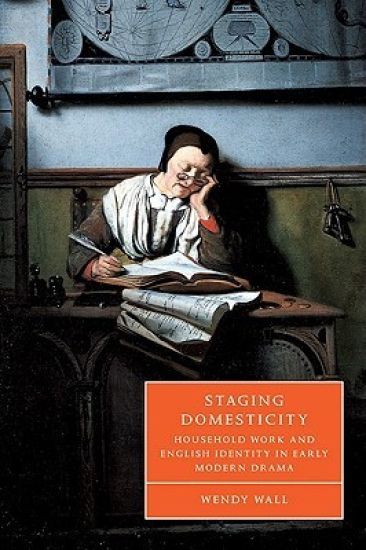
What role does food and cooking play in how people imagine themselves and their communities? In this book Wendy Wall argues that representations of housework in the early modern period helped to forge crucial conceptions of national identity. Rich with a detailed account of household practices in the period, Staging Domesticity reads plays on the London stage in the light of the first printed cookbooks in England. Working from original historical sources on wetnursing, laundering, sewing, medical care and butchery, Wall shows that domesticity was represented as deeply familiar but also enticingly alien. Wall analyses a wide range of the repertoire, including some now little-known plays, as well as key works in the period by Shakespeare and others. Wall concludes that, rather than dramatizations of only court-based and aristocratic domestic life, literature of the period drew on work from the more common household.
Staging Domesticity

Staging Domesticity

Wendy Wall

Cambridge University Press
2002
sidottu
What role does food and cooking play in how people imagine themselves and their communities? In this book Wendy Wall argues that representations of housework in the early modern period helped to forge crucial conceptions of national identity. Rich with a detailed account of household practices in the period, Staging Domesticity reads plays on the London stage in the light of the first printed cookbooks in England. Working from original historical sources on wetnursing, laundering, sewing, medical care and butchery, Wall shows that domesticity was represented as deeply familiar but also enticingly alien. Wall analyses a wide range of the repertoire, including some now little-known plays, as well as key works in the period by Shakespeare and others. Wall concludes that, rather than dramatizations of only court-based and aristocratic domestic life, literature of the period drew on work from the more common household.
Recipes for Thought

Recipes for Thought

Wendy Wall

University of Pennsylvania Press
2019
pokkari
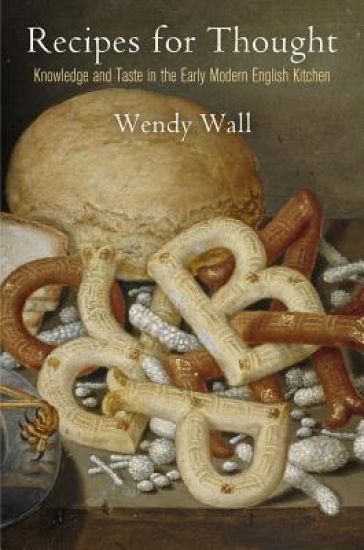
For a significant part of the early modern period, England was the most active site of recipe publication in Europe and the only country in which recipes were explicitly addressed to housewives. Recipes for Thought analyzes, for the first time, the full range of English manuscript and printed recipe collections produced over the course of two centuries. Recipes reveal much more than the history of puddings and pies: they expose the unexpectedly therapeutic, literate, and experimental culture of the English kitchen. Wendy Wall explores ways that recipe writing-like poetry and artisanal culture-wrestled with the physical and metaphysical puzzles at the center of both traditional humanistic and emerging "scientific" cultures. Drawing on the works of Shakespeare, Spenser, Jonson, and others to interpret a reputedly "unlearned" form of literature, she demonstrates that people from across the social spectrum concocted poetic exercises of wit, experimented with unusual and sometimes edible forms of literacy, and tested theories of knowledge as they wrote about healing and baking. Recipe exchange, we discover, invited early modern housewives to contemplate the complex components of being a Renaissance "maker" and thus to reflect on lofty concepts such as figuration, natural philosophy, national identity, status, mortality, memory, epistemology, truth-telling, and matter itself. Kitchen work, recipes tell us, engaged vital creative and intellectual labors.
Recipes for Thought

Recipes for Thought

Wendy Wall

University of Pennsylvania Press
2015
sidottu
For a significant part of the early modern period, England was the most active site of recipe publication in Europe and the only country in which recipes were explicitly addressed to housewives. Recipes for Thought analyzes, for the first time, the full range of English manuscript and printed recipe collections produced over the course of two centuries. Recipes reveal much more than the history of puddings and pies: they expose the unexpectedly therapeutic, literate, and experimental culture of the English kitchen. Wendy Wall explores ways that recipe writing-like poetry and artisanal culture-wrestled with the physical and metaphysical puzzles at the center of both traditional humanistic and emerging "scientific" cultures. Drawing on the works of Shakespeare, Spenser, Jonson, and others to interpret a reputedly "unlearned" form of literature, she demonstrates that people from across the social spectrum concocted poetic exercises of wit, experimented with unusual and sometimes edible forms of literacy, and tested theories of knowledge as they wrote about healing and baking. Recipe exchange, we discover, invited early modern housewives to contemplate the complex components of being a Renaissance "maker" and thus to reflect on lofty concepts such as figuration, natural philosophy, national identity, status, mortality, memory, epistemology, truth-telling, and matter itself. Kitchen work, recipes tell us, engaged vital creative and intellectual labors.