Kirjojen hintavertailu. Mukana 11 627 630 kirjaa ja 12 kauppaa.

Kirjahaku

Etsi kirjoja tekijän nimen, kirjan nimen tai ISBN:n perusteella.

39 kirjaa tekijältä Wesley E Pippenger

Essex County, Virginia Index to Court Orders, 1702-1715
Almost all early records of Essex County have been abstracted or transcribed, either by John Frederick Dorman, or by Ruth and Sam Sparacio. Excepted from publication to date have been the Court Orders for the period from October 10, 1702 to March 19, 1716/7. Several issues impact this: (1) no orders survive for July 1709 to April 1710, April 12 to July 1711, and Spring 1715 to Spring 1717, and (2) Book 4 is in such bad condition that it is rarely used.Presented here is an index to orders in Deeds & Wills Book 10, pp. 133-149 (October 10, 1702 to March 11, 1702/3), and items in Order Book 3 (August 11, 1703 to March 11, 1707/8), and Order Book 4 (April 10, 1708 to March 15, 1714/5). For Order Book 4, the following pages are missing: 77-81, 173-246, and 323-370.At first glance the original typewritten index may be deemed a godsend, as it certainly fills a void to allow us a glimpse into the content of Order Books 3 and 4. That glance soon turns into a train wreck after careful examination of the index's content. Once the author sorted his extracted entries by page number, he found the following issues with the original typewritten index when compared to the original order books: (1) the indexers left some complete and many partial pages unindexed; (2) did not index entire lists of county payments, imported persons or jury members; (3) omitted all criminal matters, details of court cases, ages of orphans or slaves when stated, and the difference between Jr. and Sr.; and (4) did not cross-index all actions, petitions or suits. In addition, the compilers of the original typewritten index were inconsistent in preserving the actual date based on the calendar. In other words, it was often unclear whether January 1705 is 1705/6 or 1704/5. The bulk of these issues has been adjusted in Pippenger's Essex County, Virginia Index to Court Orders, 1702-1715, which presents approximately 3,335 new entries, and thus increases the quantity of entries extracted from the original typewritten index by about twenty-four percent.2020, 81/2x11, paper, alphabetical, 296 pp
Essex County, Virginia Marriage Records, 1884-1921
This work presents marriage records for Essex County, Virginia for the period 1884 to 1921. It continues publication of marriage records after those by this compiler and Suzanne P. Derieux for the period 1850-1883. The major difference here is that the format is condensed to include only the pertinent data rather than reproducing the printed form of either the marriage register, marriage license, or related record pieces.The critical notice to users is that Marriage Register 1, that is titled and runs 1804-1921, contains for the subject period the data for when the marriage was planned. That said, the procedure was that when the groom and bride applied for a marriage license, the court clerk recorded the planned information in the register. This included statistics about the parties: their marital status, age, race, place of birth, place of residence, and the names of their parents. At that time the couple was issued a license that was to be completed by an officiating minister with the actual date of marriage, place of marriage, and signed by the officiating minister. This actual information was not updated in the previously-created register. Because of this, there is routinely a difference between the register information and the license information.Data are presented in a standard sequence that is similar to what is found in the register: name of parties, groom to bride; notation as to race when non-white, i.e. (C) for colored or (F) for free, etc.; date of marriage (planned if no marriage license survives, else updated from license); place of marriage; page and line of Marriage Register 1 in which the data are found; ages of the groom and bride; marital status of the groom and bride; place of birth of the groom and bride; place of residence of the groom and bride; parents of the groom and bride; occupation of the groom; minister officiating the marriage; and remarks, if any, including notation of parental or guardian consent.Several facsimile reprints of original marriage documents and an index to full-names, places and occupations add to the value of this work.2021, 81/2x11, paper, index, 252 pp
Essex County, Virginia General Index to Deeds No. 1, 1797-1867, Deed Books 35 to 51
The purpose of this work is to present a single alphabetical index based on the General Index to Deeds No. 1, 1797-1867, that was created in the style known as a Campbell Index. In other words, the purpose here is not to validate the index but to resequence it. What typically results from a Campbell Index is a jumble that requires users to flip back and forth between groups of pages throughout the entire index to seek out where various groups are continued elsewhere.This present index is largely made up of entries to over 7,000 deeds, being either: bargain and sales, bills of sale, or trust deeds. Of additional interest may be: thirty-eight polls for the election of various officials; twenty-two apprenticeships; a bastard bond; thirty-six emancipation or manumission deeds; forty-one insolvents; forty-six marriage contracts or settlements; sixteen bonds for ministers to solemnize the rites of matrimony; bonds for sheriff, constable, tobacco inspector, or Commissioner of the Revenue; references to military service; or other non-routine items.Some deficiencies in the original index have been addressed here. As a result, over 1,500 additional index entries were added by the compiler over the original courthouse index. References to plats that did not appear in the original index have been added.2022, 81/2x11, paper, alphabetical, 354 pp.
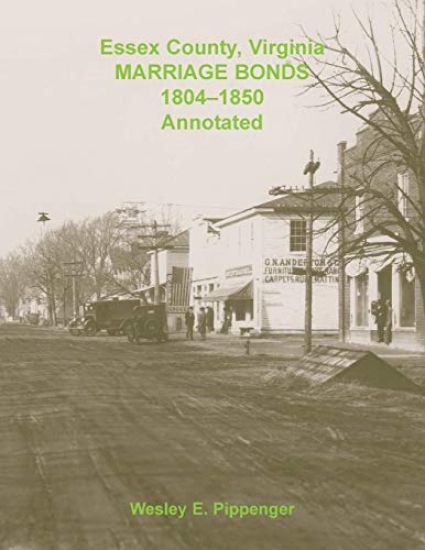
Essex County, Virginia Marriage Bonds, 1804-1850, Annotated
This work is a compilation of data found in 1,478 marriage bonds or consents of Essex County, Virginia, for the years 1804 through 1850. These are the earliest marriage records that survive for the county � those before were either burned or inadvertently destroyed. These original records are not generally served to researchers, rather researchers are directed to a bound Register of Marriages (Book One) that lists the bonds. Each entry references the page in this Register on which the information may be found. The most bonds were issued in 1835 (forty-seven) and 1827 (forty), with the other years averaging about thirty each. The fewest bonds are found for 1826 (seventeen).Individual entries in this work were derived primarily from marriage bonds and consents (by guardian or parent), and have been supplemented with data taken from outside sources such as: family Bible records, cemetery records, military records, and other publications. Not all entries contain information from outside sources. The format is two-fold: the first part of the paragraph is used for sequencing of the groom, and includes what data the compiler has found outside of the marriage record itself. Followed by this is the consolidated public marriage record (with the names of the bride and groom in capital letters), including the date of the marriage bond, and citing the main sources for the information used. The text is supplemented with nearly 900 footnotes by the compiler, an every-name index that contains over 9,000 entries, and a bibliography.
Essex County, Virginia Deed Abstracts, 1786-1805, Deed Books 33 to 36
The purpose of this work is not to reproduce the record but to extract the content so that researchers may determine if the actual recorded copy needs to be consulted elsewhere. Entries here give the page numbers from the original record, date of the instrument and recording, signatories (both parties and witnesses), type of record, and a brief abstract to show the purpose of the original writing.Few deeds give actual metes and bounds, but rather give adjacencies as landmarks or reference to the properties of other owners. Many deeds give acreage as an estimate in round numbers, like "100 acres more or less." Spelling of known parties varies significantly, even within the same record. Commissions where a wife was examined to relinquish her rights are not always filed with the record to which they pertain. Individual items such as animals, kitchen or household furniture, or other personal items are indexed as personal property.Of particular interest in the deed books for this period are the multiple lists of taxes collected and election or poll lists. These may be useful to researchers as a type of early enumeration or census for a particular district within Essex County. This collection is filled with references to apprentices, bonds for public position, guardians, emancipation of slaves, powers of attorney, and deeds, gifts, mortgages, agreements, and polls. An index to full-names, places and subjects adds to the value of this work.
Alexander Family

Alexander Family

Wesley E Pippenger

Heritage Books
2018
pokkari
For some time the author delayed preparing a genealogy for this part of his family--the biggest reason being that he could not learn anything about the ancestry of the last wife of his ancestor, James Washington Alexander, who apparently married five times. Also, it seemed doubtful that a group of seven brothers and sisters Alexander in Somerset County, Maryland were really the issue of a Rev. James Alexander as had been claimed by some researchers for several decades. Recent research has linked the group of seven children to John Alexander of Eredy, County Donegal, Ireland, and his son William Alexander.The author has primarily followed only his direct line that removed from Maryland to Virginia, through John Sheldon Alexander, and has not pursued his siblings' descendants past about 1800.Facsimile reprints of original documents, photographs of people and places, a bibliography, and an every-name index add to the value of this work.
Essex County, Virginia Will Abstracts, 1751-1842 and Estate Records Index, 1751-1799
This work presents abstracts of Last Wills and Testament found in Essex County, Virginia court records, beginning with Will Book 9 in 1751, and continuing into Will Book 24 that ends within 1842. The reason for beginning with will abstracts in 1751 is that all estate-related records before that date had been previously abstracted and published by several compilers. A list of those publications is included. The result is that we now have published abstracts of all Essex County wills from 1692 to 1842, but only index entries to estate-related records after 1751.Because this work fills the gap after 1750 for abstracts of Last Wills and Testament only, it leaves uncovered complete text of non-will items for the period 1751-1799. Therefore, an index to the non-will items for that period has been created and is included herein. This work now leaves users with a complete index of all estate-related items (accounts, allotments, bonds, divisions, dower, inventories, sales, etc.) found in Essex County, Virginia will books from the time of county formation in 1692 up through 1865, with abstracts of wills from county formation into 1842.Names of witnesses and the date of probate are included, while all marginal notes as to transactions after the date of probate, like letters of administration granted, or certificates issued, are not always included. Spelling varies between scribes and the spelling of some surnames evolved over time. The author has standardized some spellings, like surname Sthreshley. Several facsimile reprints of original wills and an index to full-names, places and subjects add to the value of this work.
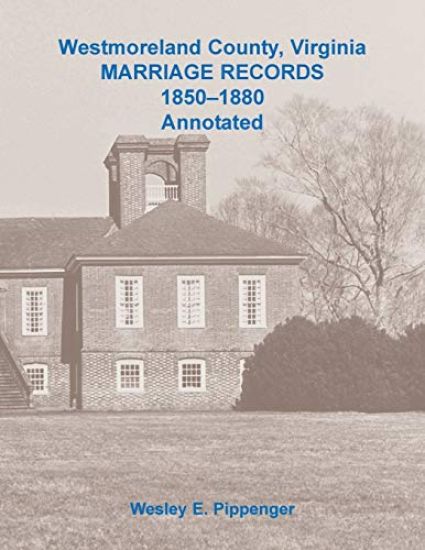
Westmoreland County, Virginia Marriage Records, 1850-1880 Annotated
This work is a compilation of data found in 1,510 marriage records of Westmoreland County, Virginia, for the years 1850 through 1880. Not all of these marriage records are found at the courthouse in Montross, Virginia, as twenty-seven are found only in church records and nineteen in neighboring counties. Fifty-four licenses were issued for which there is no further information or minister return.The data here are derived from multiple sources, including: marriage licenses or applications, minister returns of marriage, consents by guardian or parent, or entries in either of two bound marriage registers, and supplemented with family Bible records, cemetery records, military records, and other publications. The index, which is made up of over 12,000 entries, contains a heading for C.S.A. to list 212 Confederate soldiers identified.Data have been presented as found in the original records by considering all individual pieces found. Oddly, the date of marriage on the minister return and in either of the two marriage registers (state and local copy) differs frequently. In these cases, the date found on the minister return portion of the marriage license is used. Also, the compiler has inserted information from outside sources in brackets, i.e. " ]," or in nearly 1,100 footnotes. These additional sources include a range of published marriage records from Westmoreland and surrounding counties. Additional publications used are found in the bibliography. Specific sources are listed at the end of each item. An index to full-names, places and subjects adds to the value of this work.
Essex County, Virginia Newspaper Notices, 1738-1938
Long before the Rappahannock Times came to being, a number of newspapers covered Essex County from Fredericksburg, Richmond, and Williamsburg, Virginia. The earliest newspaper printed in Tappahannock, Virginia, that we have copies of, is the Tidewater Index, for May 10, 1873. The Tidewater Democrat followed this in 1896, and by 1923 we find the Rappahannock Times, which is being printed today. The continuity of issues that have survived is poor, and the bulk of what is known to exist is found on microfilm at the Library of Virginia in Richmond.Entries from Tappahannock newspapers are verbatim transcripts, while entries from other newspapers may be abstracts. In addition to marriage and death notices, entries are included for land and/or buildings for sale or rent, notices of stolen or strayed livestock, items for sale and sales events, run-away slaves, lists of letters in the post office, accidents, and much more. The source is listed at the end of each entry. An index to full-names, places and subjects adds to the value of this work.
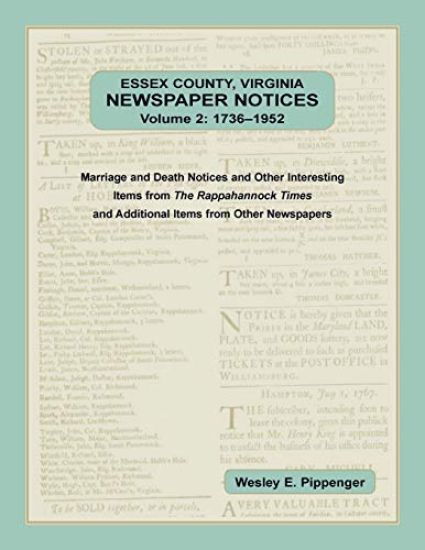
Essex County, Virginia Newspaper Notices, Volume 2, 1736-1952
This collection follows an earlier publication that contained marriage and death notices and other items of interest in an assortment of early newspapers that covered Essex County, Virginia and the town of Tappahannock. Presented here are similar items that have been gleaned from The Rappahannock Times, published in Tappahannock, for the period 1939 through 1952.Since publication of the first volume, the compiler has collected additional items from the Virginia Gazette and the Richmond Enquirer, in large part due to discovering a compilation of related transcripts by the late Miss Mary Wright, of Ashland, Virginia, done sometime in the early 1950's.Included in this work are announcements about the opening of new businesses, births, marriages and deaths, house or building fires, and other events in the development of the area. Not included are frequent references to who was visiting where, who has been sick with what illness or in what hospital, engagement announcements, church services, what minister was preaching where, social meeting announcements and details, political announcements, and other items not directly related to the development of Tappahannock or Essex County.Entries are verbatim transcripts. The index contains entries for all names, places, occupations, and many subjects.
Essex County, Virginia Deed Abstracts, 1805-1819, Deed Books 37 to 39
The purpose of this work is not to reproduce the record but to extract the content so that researchers may determine if the actual recorded copy needs to be consulted elsewhere. Entries here give the page numbers from the original record, date of the instrument and recording, signatories (both parties and witnesses), type of record, and a brief abstract to show the purpose of the original writing. Few deeds give actual metes and bounds, but rather give adjacencies as landmarks or reference to the properties of other owners. Many deeds give acreage as an estimate in round numbers, like "100 acres more or less." Spelling of known parties varies significantly, even within the same record. Commissions where a wife was examined to relinquish her rights are not always filed with the record to which they pertain. Individual items such as animals, kitchen or household furniture, or other personal items are indexed as personal property. Of particular interest in the deed books for this period are the multiple polls or election lists. These may be useful to researchers as a type of early enumeration or census of eligible voting white males for a particular district within Essex County. This collection is filled with references to apprentices, bonds for public position, guardians, emancipation of slaves, military service references, powers of attorney, and deeds, gifts, mortgages, agreements, and polls. An index to full-names, places and subjects adds to the value of this work.
Essex County, Virginia Death Records, 1856-1896

Essex County, Virginia Death Records, 1856-1896

Wesley E Pippenger

Heritage Books
2019
pokkari
An Act passed by the State of Virginia in 1853 required that a register of marriages, a register of births and a register of deaths be kept by court clerks. It also required that a copy of these records be provided to two locations: the Auditor of Public Accounts in Richmond, Virginia, and the local clerk of the court. Unfortunately, the two records often differ. This compilation is based primarily on the copy that was filed with the Auditor of Public Accounts. It represents 3,927 death records for whites, non-whites and slaves, for the period 1856-1896. There are no records in this series for 1853-1855 and 1863-1869. The records in this volume include: 1,327 white; 2,096 colored; 467 slave; 29 unidentified; 13 free black; and 1 mulatto. Entries include the full name of the deceased, race: White or Colored (free or slave), name of slave owner, gender, date of death, place of death, name of disease or cause of death, age, names of parents, where born, occupation, consort of or unmarried, name of person giving the information of death, and designation of informant. Earlier entries for Colored may also list whether free or slave and name of slave owner. The front matter includes: Abbreviations, Act Requiring Vital Statistics, Common Diseases and Causes of Death, and two Register of Death examples (1861 and 1896). A place name index adds to the value of this work.