Kirjojen hintavertailu. Mukana 12 390 323 kirjaa ja 12 kauppaa.

Kirjahaku

Etsi kirjoja tekijän nimen, kirjan nimen tai ISBN:n perusteella.

7 kirjaa tekijältä Whitney Phillips, Ryan M. Milner

You Are Here

You Are Here

Whitney Phillips; Ryan M. Milner

MIT Press
2021
nidottu
How to understand a media environment in crisis, and how to make things better by approaching information ecologically.Our media environment is in crisis. Polarization is rampant. Polluted information floods social media. Even our best efforts to help clean up can backfire, sending toxins roaring across the landscape. In You Are Here, Whitney Phillips and Ryan Milner offer strategies for navigating increasingly treacherous information flows. Using ecological metaphors, they emphasize how our individual me is entwined within a much larger we, and how everyone fits within an ever-shifting network map.
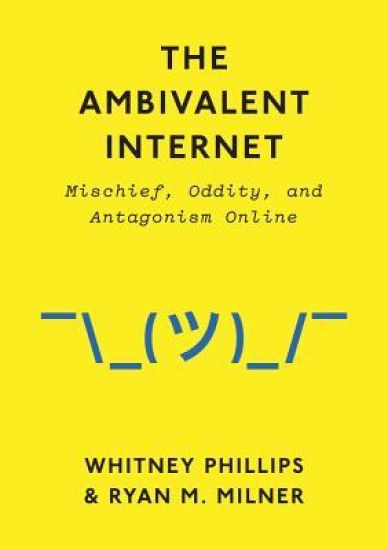
The Ambivalent Internet

The Ambivalent Internet

Whitney Phillips; Ryan M. Milner

Polity Press
2017
sidottu
This book explores the weird and mean and in-between that characterize everyday expression online, from absurdist photoshops to antagonistic Twitter hashtags to deceptive identity play. Whitney Phillips and Ryan M. Milner focus especially on the ambivalence of this expression: the fact that it is too unwieldy, too variable across cases, to be essentialized as old or new, vernacular or institutional, generative or destructive. Online expression is, instead, all of the above. This ambivalence, the authors argue, hinges on available digital tools. That said, there is nothing unexpected or surprising about even the strangest online behavior. Ours is a brave new world, and there is nothing new under the sun – a point necessary to understanding not just that online spaces are rife with oddity, mischief, and antagonism, but why these behaviors matter. The Ambivalent Internet is essential reading for students and scholars of digital media and related fields across the humanities, as well as anyone interested in mediated culture and expression.
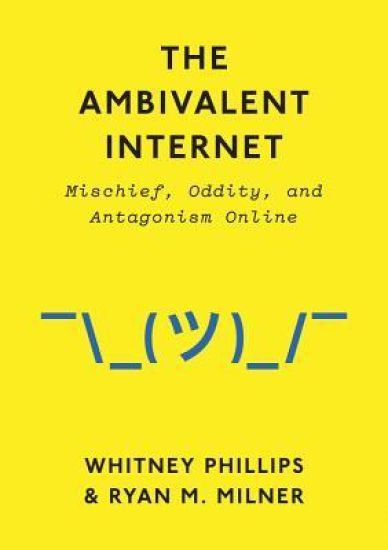
The Ambivalent Internet

The Ambivalent Internet

Whitney Phillips; Ryan M. Milner

Polity Press
2017
nidottu
This book explores the weird and mean and in-between that characterize everyday expression online, from absurdist photoshops to antagonistic Twitter hashtags to deceptive identity play. Whitney Phillips and Ryan M. Milner focus especially on the ambivalence of this expression: the fact that it is too unwieldy, too variable across cases, to be essentialized as old or new, vernacular or institutional, generative or destructive. Online expression is, instead, all of the above. This ambivalence, the authors argue, hinges on available digital tools. That said, there is nothing unexpected or surprising about even the strangest online behavior. Ours is a brave new world, and there is nothing new under the sun – a point necessary to understanding not just that online spaces are rife with oddity, mischief, and antagonism, but why these behaviors matter. The Ambivalent Internet is essential reading for students and scholars of digital media and related fields across the humanities, as well as anyone interested in mediated culture and expression.
Share Better and Stress Less

Share Better and Stress Less

Whitney Phillips; Ryan Milner

Miteen Press
2024
nidottu
"Offers sensible steps for foreseeing and minimizing damage to ourselves and others on social media." --Kirkus Reviews We know that pollution damages our physical environments--but what about the digital landscape? Touching on everything from goat memes gone wrong to conflict in group chats to the sometimes unexpected side effects of online activism, this lively guide to media literacy draws on ecological, social justice, and storytelling frameworks to help readers understand how information pollution spreads and why. It also helps them make sense of the often stressful and strange online world. Featuring a hyperconnected cast of teens and their social-media shenanigans, this reader-friendly paperback with a refreshed cover tackles the thorny topic of internet ethics while empowering--and inspiring--young readers to weave a safe, secure, and inclusive digital world. Readers are invited to delve further into the subject with the help of comprehensive source notes and a bibliography in the back matter.
The Walls Have the Floor

The Walls Have the Floor

Tom McDonough; Whitney Phillips

MIT Press
2018
pokkari
The graffiti of the French student and worker uprising of May 1968, capturing participatory politics in action.Graffiti itself became a form of freedom.-Julien Besancon, The Walls Have the FloorFifty years ago, in 1968, barricades were erected in the streets of Paris for the first time since the Paris Commune of nearly one hundred years before. The events of May 1968 began with student protests against the Vietnam War and American imperialism, expanded to rebellion over student living conditions and resistance to capitalist consumerism. An uprising at the Sorbonne was followed by wildcat strikes across France, uniting students and workers and bringing the country's economy to a halt. There have been many accounts of these events. This book tells the story in a different way, through the graffiti inscribed by protestors as they protested.The graffiti collected here is by turns poetic, punning, hopeful, sarcastic, and crude. It quotes poets as often as it does political thinkers. Many wrote "I have nothing to write," signaling not their naivete but their desire to participate. Other anonymous declarations included "Prohibiting prohibited"; "The dream is reality"; "The walls have ears. Your ears have walls"; "Exaggeration is the beginning of invention"; "Comrades, you're nitpicking"; "You don't beg for the right to live, you take it"; and "I came/I saw/I believed." A meeting is called at the Grand Amphitheater of the Sorbonne: "Agenda: the worldwide revolution." This was interactive, participatory politics before Twitter and Facebook.Although the revolution of May 1968 didn't topple the government (Charles de Gaulle fled the country, only to return; in June, his party won a resounding electoral mandate), it made history. In The Walls Have the Floor, Julien Besancon collected traces of this history before the walls were painted over, and published this collection in July 1968 even as the paint was drying. Read today, the graffiti of 1968 captures, in a way no conventional history can, the defining spontaneity of the events.