Building on ideas first advanced by Arnold Schoenberg and later developed by Erwin Ratz, this book introduces a new theory of form for instrumental music in the classical style. The theory provides a broad set of principles and a comprehensive methodology for the analysis of classical form, from individual ideas, phrases, and themes to the large-scale organization of complete movements. It emphasizes the notion of formal function, that is, the specific rolea given formal unit plays in the structural organization of a classical work.
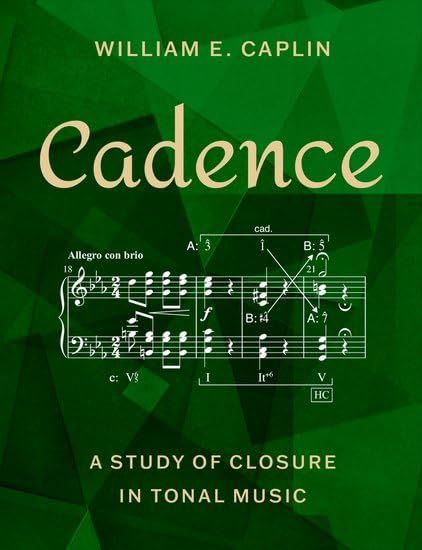
Cadence is a comprehensive examination of how formal units in European art music of the tonal era achieve closure. The book brings together the author's decades-long investigations into cadence, a compositional device that is readily experienced both by musicians and non-musicians, but one that has proven intractable to clear and precise theoretical formulation. Rooted in Caplin's broader theory of formal functions, the book first develops concepts of cadence for music of the high classical style and then extends these ideas to gauge cadential practice in earlier and later style periods. Throughout the study, various manifestations of cadence are defined in terms of their morphology (their harmonic and melodic profiles) as well as their function (the specific formal contexts in which they are deployed). Cadence introduces a host of theoretical concepts illustrated by copious musical examples, all of which contain extensive analytical annotations of harmony, melody and form. Though the book is addressed primarily to music theorists, the many issues of compositional practice raised in this study will resonate with the interests of composers, historians, and performers alike.
Cadence is a comprehensive examination of how formal units in European art music of the tonal era achieve closure. The book brings together the author's decades-long investigations into cadence, a compositional device that is readily experienced both by musicians and non-musicians, but one that has proven intractable to clear and precise theoretical formulation. Rooted in Caplin's broader theory of formal functions, the book first develops concepts of cadence for music of the high classical style and then extends these ideas to gauge cadential practice in earlier and later style periods. Throughout the study, various manifestations of cadence are defined in terms of their morphology (their harmonic and melodic profiles) as well as their function (the specific formal contexts in which they are deployed). Cadence introduces a host of theoretical concepts illustrated by copious musical examples, all of which contain extensive analytical annotations of harmony, melody and form. Though the book is addressed primarily to music theorists, the many issues of compositional practice raised in this study will resonate with the interests of composers, historians, and performers alike.
In Musical Form, Forms, and Formenlehre, three eminent music theorists reflect on the fundamentals of "musical form." They discuss how to analyze form in music and question the relevance of analytical theories and methods in general. They illustrate their basic concepts andc oncerns by offering some concrete analyses of works by Mozart (Idomeneo Overture, Jupiter Symphony) and Beethoven (First and Pastoral Symphony, Egmont Overture, and Die Ruinen von Athen Overture). The volume is divided into three parts, focusing on Caplin's "theory of formal functions," Hepokoski's concept of "dialogic form," and Webster's method of "multivalent analysis" respectively. Each part begins with a basic essay by one of the three authors. Subsequently, the two opposing authors comment on issues and analyses they consider to be problematic or underdeveloped, in a style that ranges from the gently critical to the overtly polemical. Finally, the author of the initial essay is given the opportunity to reply to the comments, and to further refine his own fundamental ideas on musical form.