Kirjojen hintavertailu. Mukana 11 342 296 kirjaa ja 12 kauppaa.

Kirjahaku

Etsi kirjoja tekijän nimen, kirjan nimen tai ISBN:n perusteella.

4 kirjaa tekijältä William Frawley

Vygotsky and Cognitive Science

Vygotsky and Cognitive Science

William Frawley

Harvard University Press
1997
sidottu
Is a human being a person or a machine? Is the mind a social construction or a formal device? It is both, William Frawley tells us, and by bringing together Vygotsky's sociocultural theory of the mind and cognitive science's computational model, he shows us how this not only can but must be. To do so, Frawley focuses on language, particularly on how the computational mind uses language to mediate the internal and the external during thought. By reconciling the linguistic device and the linguistic person, he argues for a Vygotskyan cognitive science. Frawley begins by exploding the internalist/externalist dichotomy that presently drives cognitive science and falsely pits computationalism against socioculturalism. He replaces the reigning Platonic paradigm of computational mind-science with a framework based on an unusual, unified account of Wittgenstein, thus setting the stage for a Vygotskyan cognitive science centered on three aspects of mind: subjectivity, real-time operation, and breakdown. In this context, he demonstrates how computational psychology accommodates a critical aspect of Vygotskyan theory--private speech--as the mind's metacomputational regulator. An examination of certain congenital disorders (such as Williams Syndrome, Turner Syndrome, and autism) that disrupt speech further clarifies the issue of computational and cognitive control.
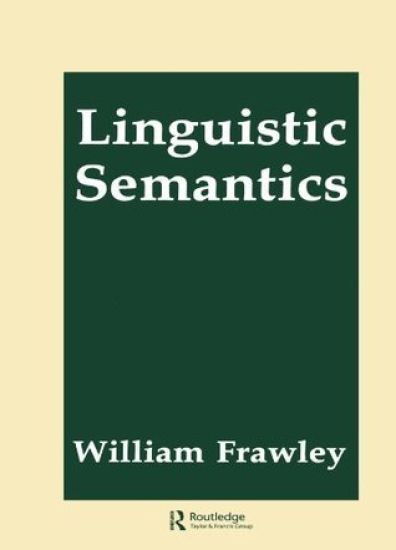
Linguistic Semantics

Linguistic Semantics

William Frawley

Routledge Member of the Taylor and Francis Group
1992
sidottu
This volume is a comprehensive, up-to-date, and readable introduction to linguistic meaning. While partial to conceptual and typological approaches, the book also presents results from formal approaches. Throughout, the focus is on grammatical meaning -- the way languages delineate universal semantic space and encode it in grammatical form. Subjects covered by the author include: the domain of linguistic semantics and the basic tools, assumptions, and issues of semantic analysis; semantic properties of entities, events, and thematic roles; language and space; tense, aspect, and the internal structure and temporal ordering of events; modality, negation, and the epistemology of the speaker; and modification and attribution. In contrast to most current treatments of semantics, this book is accessible to the beginning student of semantics and linguistics and also useful to the advanced practitioner. A textbook and reference work in a single volume, it can be used in a number of disciplines: psychology, computer science, and anthropology as well as linguistics.
Linguistic Semantics

Linguistic Semantics

William Frawley

Routledge Member of the Taylor and Francis Group
1992
nidottu
This volume is a comprehensive, up-to-date, and readable introduction to linguistic meaning. While partial to conceptual and typological approaches, the book also presents results from formal approaches. Throughout, the focus is on grammatical meaning -- the way languages delineate universal semantic space and encode it in grammatical form. Subjects covered by the author include: the domain of linguistic semantics and the basic tools, assumptions, and issues of semantic analysis; semantic properties of entities, events, and thematic roles; language and space; tense, aspect, and the internal structure and temporal ordering of events; modality, negation, and the epistemology of the speaker; and modification and attribution. In contrast to most current treatments of semantics, this book is accessible to the beginning student of semantics and linguistics and also useful to the advanced practitioner. A textbook and reference work in a single volume, it can be used in a number of disciplines: psychology, computer science, and anthropology as well as linguistics.