Kirjojen hintavertailu. Mukana 12 390 323 kirjaa ja 12 kauppaa.

Kirjahaku

Etsi kirjoja tekijän nimen, kirjan nimen tai ISBN:n perusteella.

4 kirjaa tekijältä William G. Roy

Socializing Capital

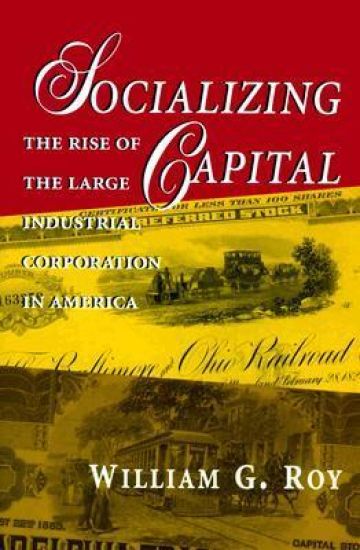
Socializing Capital

William G. Roy

Princeton University Press
1999
pokkari
Ever since Adolph Berle and Gardiner Means wrote their classic 1932 analysis of the American corporation, The Modern Corporation and Private Property, social scientists have been intrigued and challenged by the evolution of this crucial part of American social and economic life. Here William Roy conducts a historical inquiry into the rise of the large publicly traded American corporation. Departing from the received wisdom, which sees the big, vertically integrated corporation as the result of technological development and market growth that required greater efficiency in larger scale firms, Roy focuses on political, social, and institutional processes governed by the dynamics of power. The author shows how the corporation started as a quasi-public device used by governments to create and administer public services like turnpikes and canals and then how it germinated within a system of stock markets, brokerage houses, and investment banks into a mechanism for the organization of railroads. Finally, and most particularly, he analyzes its flowering into the realm of manufacturing, when at the turn of this century, many of the same giants that still dominate the American economic landscape were created. Thus, the corporation altered manufacturing entities so that they were each owned by many people instead of by single individuals as had previously been the case.
Reds, Whites, and Blues

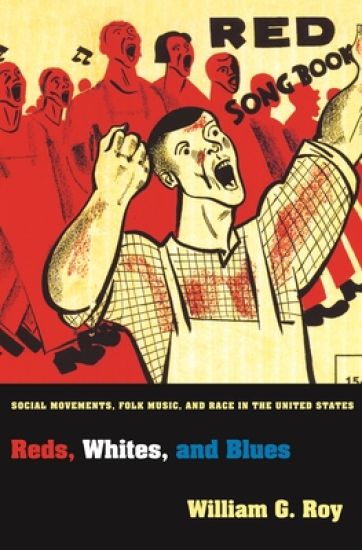
Reds, Whites, and Blues

William G. Roy

Princeton University Press
2010
sidottu
Music, and folk music in particular, is often embraced as a form of political expression, a vehicle for bridging or reinforcing social boundaries, and a valuable tool for movements reconfiguring the social landscape. Reds, Whites, and Blues examines the political force of folk music, not through the meaning of its lyrics, but through the concrete social activities that make up movements. Drawing from rich archival material, William Roy shows that the People's Songs movement of the 1930s and 40s, and the Civil Rights Movement of the 1950s and 60s implemented folk music's social relationships--specifically between those who sang and those who listened--in different ways, achieving different outcomes. Roy explores how the People's Songsters envisioned uniting people in song, but made little headway beyond leftist activists. In contrast, the Civil Rights Movement successfully integrated music into collective action, and used music on the picket lines, at sit-ins, on freedom rides, and in jails. Roy considers how the movement's Freedom Songs never gained commercial success, yet contributed to the wider achievements of the Civil Rights struggle. Roy also traces the history of folk music, revealing the complex debates surrounding who or what qualified as "folk" and how the music's status as racially inclusive was not always a given. Examining folk music's galvanizing and unifying power, Reds, Whites, and Blues casts new light on the relationship between cultural forms and social activity.
Reds, Whites, and Blues

Reds, Whites, and Blues

William G. Roy

Princeton University Press
2013
pokkari
Music, and folk music in particular, is often embraced as a form of political expression, a vehicle for bridging or reinforcing social boundaries, and a valuable tool for movements reconfiguring the social landscape. Reds, Whites, and Blues examines the political force of folk music, not through the meaning of its lyrics, but through the concrete social activities that make up movements. Drawing from rich archival material, William Roy shows that the People's Songs movement of the 1930s and 40s, and the Civil Rights Movement of the 1950s and 60s implemented folk music's social relationships--specifically between those who sang and those who listened--in different ways, achieving different outcomes. Roy explores how the People's Songsters envisioned uniting people in song, but made little headway beyond leftist activists. In contrast, the Civil Rights Movement successfully integrated music into collective action, and used music on the picket lines, at sit-ins, on freedom rides, and in jails. Roy considers how the movement's Freedom Songs never gained commercial success, yet contributed to the wider achievements of the Civil Rights struggle. Roy also traces the history of folk music, revealing the complex debates surrounding who or what qualified as "folk" and how the music's status as racially inclusive was not always a given. Examining folk music's galvanizing and unifying power, Reds, Whites, and Blues casts new light on the relationship between cultural forms and social activity.
Making Societies

Making Societies

William G. Roy

SAGE Publications Inc
2001
nidottu
The only book written for undergraduates about the social construction of reality that is also historical and comparative. In addition, it includes chapters on the social construction of time and space, as well as the more traditional chapters on race, class, and gender. This book shows how these social constructions of time, space, race, gender and class intersect with each other to produce particular social phenomena that are enduring and significant for our society. No other book for undergraduate teaching has ever done this … this is a real first! "If the goal of this series is to broaden the students'' vision, no book is more ambitious toward attaining that goal than Making Societies. Roy helps students question the most ''natural'' of categories: time, space, gender, race, and class. Leading them through examples drawn from around the world, he shows how these categories are social constructions; historically formed, ideologically loaded, and subject to change. This may be profoundly unsettling, for students will be encouraged to question not only what they know but also the conceptual frameworks they use when they claim to understand anything. As Series Editors, it is our belief that this provocation will open new ways of thinking about the social world, how it is, and how it might be." —Wendy Griswold, Series Editor, Northwestern University, from the foreword "I love the organizing concept of the social construction of reality and using a cross-cultural historical comparative approach to analyzing key themes: space, time, race, gender, and class. I particularly like the focus on space and time first because it illustrates how deeply embedded the social construction of reality is." —Joanne Defiore, University of Washington, Bothel "The book is intellectually strong; it is driven by ideas and engages important processes of social life." —Lisa Brush, University of Pittsburgh Contributor to the SAGE Teaching Innovations and Professional Development Award