Kirjojen hintavertailu. Mukana 12 016 292 kirjaa ja 12 kauppaa.

Kirjahaku

Etsi kirjoja tekijän nimen, kirjan nimen tai ISBN:n perusteella.

5 kirjaa tekijältä William Graebner

Patty's Got a Gun

Patty's Got a Gun

William Graebner

University of Chicago Press
2008
sidottu
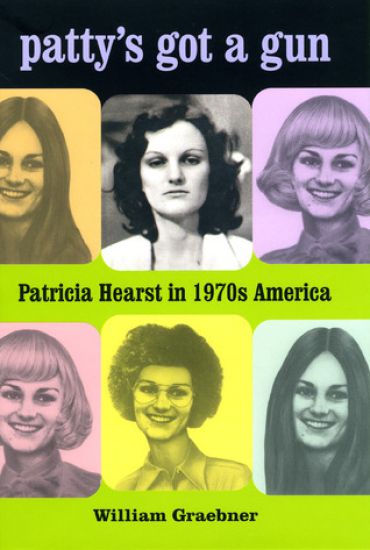
It was a story so bizarre it defied belief: in April 1974, twenty-year-old newspaper heiress Patricia Hearst robbed a San Francisco bank in the company of members of the Symbionese Liberation Army - who had kidnapped her a mere nine weeks earlier. But the robbery - and the spectacular 1976 trial that ended with Hearst's criminal conviction - seemed oddly appropriate to the troubled mood of the nation, an instant exemplar of a turbulent era.With "Patty's Got a Gun", the first substantial reconsideration of Hearst's story in more than twenty-five years, William Graebner vividly recreates the atmosphere of uncertainty and frustration of mid-1970s America. Drawing on copious media accounts of the robbery and trial - as well as cultural artifacts from glam rock to "Invasion of the Body Snatchers" - Graebner paints a compelling portrait of a nation confused and frightened by the upheavals of 1960s liberalism and beginning to tip over into what would become Reagan-era conservatism, with its invocations of individual responsibility and the heroic. Trapped in the middle of that shift, the affectless, zombielike, 'brainwashed' Patty Hearst was a ready-made symbol of all that seemed to have gone wrong with the sixties - the inevitable result, some said, of rampant permissiveness, feckless elitism, the loss of moral clarity, and feminism run amok.By offering a fresh look at Patty Hearst and her trial - for the first time free from the agendas of the day, yet set fully in their cultural context - "Patty's Got a Gun" delivers a nuanced portrait of both an unforgettable moment and an entire era, one whose repercussions continue to be felt today.
Patty's Got a Gun

Patty's Got a Gun

William Graebner

University of Chicago Press
2015
nidottu
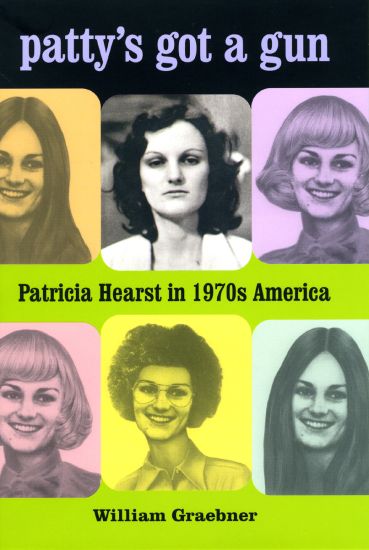
It was a story so bizarre it defied belief: in April 1974, twenty-year-old newspaper heiress Patricia Hearst robbed a San Francisco bank in the company of members of the Symbionese Liberation Army-who had kidnapped her a mere nine weeks earlier. But the robbery-and the spectacular 1976 trial that ended with Hearst's criminal conviction-seemed oddly appropriate to the troubled mood of the nation, an instant exemplar of a turbulent era. With Patty's Got a Gun, the first substantial reconsideration of Patty Hearst's story in more than twenty-five years, William Graebner vividly re-creates the atmosphere of uncertainty and frustration of mid-1970s America. Drawing on copious media accounts of the robbery and trial-as well as cultural artifacts from glam rock to Invasion of the Body Snatchers-Graebner paints a compelling portrait of a nation confused and frightened by the upheavals of 1960s liberalism and beginning to tip over into what would become Reagan-era conservatism, with its invocations of individual responsibility and the heroic. Trapped in the middle of that shift, the affectless, zombielike, brainwashed Patty Hearst was a ready-made symbol of all that seemed to have gone wrong with the sixties-the inevitable result, some said, of rampant permissiveness, feckless elitism, the loss of moral clarity, and feminism run amok. By offering a fresh look at Patty Hearst and her trial-for the first time free from the agendas of the day, yet set fully in their cultural context-Patty's Got a Gun delivers a nuanced portrait of both an unforgettable moment and an entire era, one whose repercussions continue to be felt today.
Coming Of Age In Buffalo

Coming Of Age In Buffalo

William Graebner

Temple University Press,U.S.
1989
sidottu
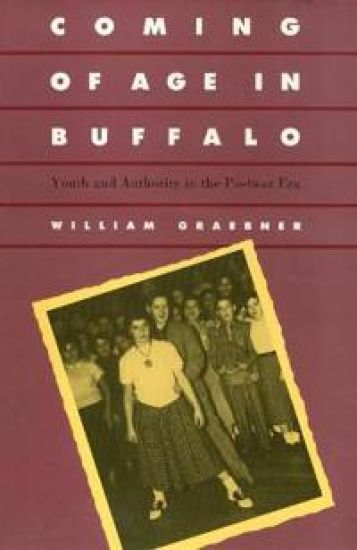
Pegged pants poodle skirts, record hops, rock 'n' roll, soda shops: in the interval between the bombing of Hiroshima and the assassination of John F. Kennedy, these were distinguishing marks of the "typical" postwar teenager-if there was a "typical" teenager. In this richly illustrated account of Youth in postwar Buffalo, William Graebner argues that the so-called Youth culture was really a variety of "disparate subcultures, united by age but in conflict over class, race, ethnicity, and gender." Using scrap books, oral histories, school Yearbooks, and material culture, he shows how Buffalo teenagers were products of diverse and often antagonistic subcultures. The innocuous strains of "Rock Around the Clock" muffled the seething gang loyalties and countercultural influence of James Dean, Marlon Brando, and Buffalo's own "Hound Dog" Lorenz. Racial antipathies once held in check spilled out on Memorial Day, 1956, when white and black Youth clashed on board a take Erie pleasure boat in a "riot" that recast the city's race relations for decades to come. While exploring the diversity within Youth subcultures, Graebner examines the ways in which adults-educators, clergy, representatives of the media, and other authorities-sought to contain this generation. The Hi-Teen Club, Buffalo Plan dress code, record hops, graduation ceremonies, film censorship, and restrictions on secret societies and on corner lounging were all forms of social engineering that reinforced social and economic boundaries that were at the heart of the dominant culture. The prevailing adult influence on activities, attitudes, and style served to redirect the "misguided Youth" of the fifties and to obliterate their image from public memory. Although the media still portrays this decade as the golden age of cultural homogeneity, the diversity in musical preferences, hair and clothing styles, and allegiances to disc jockeys suggest the wide diversity of Youth experiences and challenges to adult authority that were part of coming of age in postwar America.
Coming Of Age In Buffalo

Coming Of Age In Buffalo

William Graebner

Temple University Press,U.S.
1993
pokkari
Pegged pants poodle skirts, record hops, rock 'n' roll, soda shops: in the interval between the bombing of Hiroshima and the assassination of John F. Kennedy, these were distinguishing marks of the "typical" postwar teenager-if there was a "typical" teenager. In this richly illustrated account of Youth in postwar Buffalo, William Graebner argues that the so-called Youth culture was really a variety of "disparate subcultures, united by age but in conflict over class, race, ethnicity, and gender." Using scrap books, oral histories, school Yearbooks, and material culture, he shows how Buffalo teenagers were products of diverse and often antagonistic subcultures. The innocuous strains of "Rock Around the Clock" muffled the seething gang loyalties and countercultural influence of James Dean, Marlon Brando, and Buffalo's own "Hound Dog" Lorenz. Racial antipathies once held in check spilled out on Memorial Day, 1956, when white and black Youth clashed on board a take Erie pleasure boat in a "riot" that recast the city's race relations for decades to come. While exploring the diversity within Youth subcultures, Graebner examines the ways in which adults-educators, clergy, representatives of the media, and other authorities-sought to contain this generation. The Hi-Teen Club, Buffalo Plan dress code, record hops, graduation ceremonies, film censorship, and restrictions on secret societies and on corner lounging were all forms of social engineering that reinforced social and economic boundaries that were at the heart of the dominant culture. The prevailing adult influence on activities, attitudes, and style served to redirect the "misguided Youth" of the fifties and to obliterate their image from public memory. Although the media still portrays this decade as the golden age of cultural homogeneity, the diversity in musical preferences, hair and clothing styles, and allegiances to disc jockeys suggest the wide diversity of Youth experiences and challenges to adult authority that were part of coming of age in postwar America.
Coal-Mining Safety in the Progressive Period

Coal-Mining Safety in the Progressive Period

William Graebner

The University Press of Kentucky
2014
nidottu
Through the first decade of the twentieth century, Americans looked upon industrial accidents with callous disregard; they were accepted as an unfortunate but necessary adjunct to industrial society. A series of mine disasters in December 1907 (including one in Monongah, West Virginia, which took a toll of 361 lives) shook the public, at least temporarily, out of its lethargy. In this award-winning study, author William Graebner traces the development of mine safety reform in the years immediately following these tragic events. Reform activities during the Progressive period centered on the Bureau of Mines and an effort to obtain uniform state legislation; the effect of each was minimal. Mr. Graebner concludes that these idealistic solutions of the time were at once the great hope and the great failure of the Progressive coal-mining safety movement.