Kirjojen hintavertailu. Mukana 12 390 323 kirjaa ja 12 kauppaa.

Kirjahaku

Etsi kirjoja tekijän nimen, kirjan nimen tai ISBN:n perusteella.

9 kirjaa tekijältä William H. Calvin

A Brief History of the Mind

A Brief History of the Mind

William H. Calvin

Oxford University Press Inc
2007
nidottu
Traces the evolution of the mind, from apes, Neanderthals, and human ancestors to a burst of creativity that began about fifty thousand years ago, suggesting that the mind will continue to evolve, with enhanced reasoning abilities, ethics, and other changes.
A Brain for All Seasons

A Brain for All Seasons

William H. Calvin

University of Chicago Press
2002
sidottu
One of the most shocking realizations of all time has slowly been dawning on us: the Earth's climate does great flip-flops every few thousand years, and with breathtaking speed. In just a few years, the climate suddenly cools worldwide. With only half the rainfall, severe dust storms whirl across vast areas. Lightning strikes ignite giant forest fires. For most mammals, including our ancestors, populations crash. Our ancestors lived through hundreds of such abrupt episodes since the more gradual Ice Age began two and a half million years ago - but abrupt cooling produced a population bottleneck each time, one that eliminated most of their relatives. We are the improbable descendants of those who survived - and later thrived. William H. Calvin's marvellous "A Brain for All Seasons" argues that such cycles of cool, crash and burn powered the pump for the enormous increase in brain size and complexity in human beings. Driven by the imperative to adapt within a generation to "whiplash" climate changes where only grass did well for a while, our ancestors learned to cooperate and innovate in hunting large grazing animals. Calvin's book is structured as a travelogue that takes us around the globe and back in time. Beginning at Darwin's home in England, Calvin sits under an oak tree and muses on what controls the speed of evolutionary "progress". The Kalahari desert and the Sterkfontein caves in South Africa serve as the backdrop for a discussion of our ancestors' changing diets. A drought-shrunken lake in Kenya shows how grassy mudflats become great magnets for grazing animals. And in Copenhagen, we learn what ice cores have told us about abrupt jumps in past climates. Perhaps the most dramatic discovery of all, though, awaits us as we fly with Calvin over the Gulf Stream and Greenland: global warming caused by human-made pollution could paradoxically trigger another sudden episode of global "cooling". Because of the accumulation of greenhouse gases in the atmosphere, the oceanic "conveyor belt" that sends warmer water into the North Atlantic could abruptly shut down. If that happens again, much of the Earth could be plunged into a deep chill within a few years. Europe would become as cold and dry as Siberia. Agriculture could not adapt quickly enough to avoid worldwide famine and wars over the dwindling food supplies - a crash from which it would take us many centuries to recover. With this warming, Calvin connects us directly to evolution and the surprises it holds. Highly illustrated, conversational and learned, "A Brain for All Seasons" is a fascinating view of where we came from and where we're going.
A Brain for All Seasons

A Brain for All Seasons

William H. Calvin

University of Chicago Press
2003
nidottu
Winner of the 2002 Phi Beta Kappa Award in ScienceMankind has recently come to the shocking realization that our ancestors survived hundreds of abrupt and severe changes to Earth's climate. In this unique travelogue, William H. Calvin takes us around the globe and back in time, showing us how such cycles of cool, crash, and burn provided the impetus for enormous increases in the intelligence and complexity of human beings—and warning us of human activities that could trigger similarly massive shifts in the planet's climate.
Global Fever

Global Fever

William H. Calvin

University of Chicago Press
2008
sidottu
Every decade since 1950 has seen more floods and more wildfires on every continent. Deserts are expanding, coral reefs are dying, fisheries are declining, and hurricanes are strengthening. The debate about climate change is over: there's no question that global warming has made the Earth sick, and the outlook for the future calls for ever-warmer temperatures and deadlier results. Something must be done - but how quickly?With "Global Fever", William H. Calvin delivers both a clear-eyed diagnosis and a strongly worded prescription. In striking, straightforward language, he first sets out the current state of the Earth's warming climate and the disastrous possibilities ahead should we continue on our current path. Increasing temperatures will kill off vegetation and dry up water resources, and their loss will lead, in an increasingly destructive feedback loop, to even more warming. Resource depletion, drought, and disease will follow, leading to socioeconomic upheaval - and accompanying violence - on a scale barely conceivable.It is still possible, Calvin argues, to avoid such a dire fate. But we must act now, aggressively funneling resources into jump-starting what would amount to a third industrial revolution, this one of clean technologies - while simultaneously expanding our use of existing low-emission technologies, from nuclear power to plug-in hybrid vehicles, until we achieve the necessary scientific breakthroughs.Passionately written, yet thoroughly grounded in the latest climate science, "Global Fever" delivers both a stark warning and an ambitious blueprint for saving the future of our planet.
The Cerebral Code

The Cerebral Code

William H. Calvin

Bradford Books
1998
pokkari
The Cerebral Code is a new understanding of how Darwinian processes could operate in the brain to shape mental images in only seconds, starting with shuffled memories no better than the jumble of our nighttime dreams, but evolving into something of quality, such as a sentence to speak aloud. Jung said that dreaming goes on continuously but you can't see it when you are awake, just as you can't see the stars in the daylight because it is too bright. Calvin's is a theory for what goes on, hidden from view by the glare of waking mental operations, that produces our peculiarly human type of consciousness with its versatile intelligence.As Piaget emphasized in 1929, intelligence is what we use when we don't know what to do, when we have to grope rather than using a standard response. Calvin tackles a mechanism for doing this exploration and improvement offline, as we think before we act or practice the art of good guessing.Surprisingly, the subtitle's mosaics of the mind is not a literary metaphor. For the first time, it is a description of a mechanism of what appears to be an appropriate level of explanation for many mental phenomena, that of hexagonal mosaics of electrical activity that compete for territory in the association cortex of the brain. This two-dimensional mosaic is predicted to grow and dissolve much as the sugar crystals do in the bottom of a supersaturated glass of iced tea.A Bradford Book
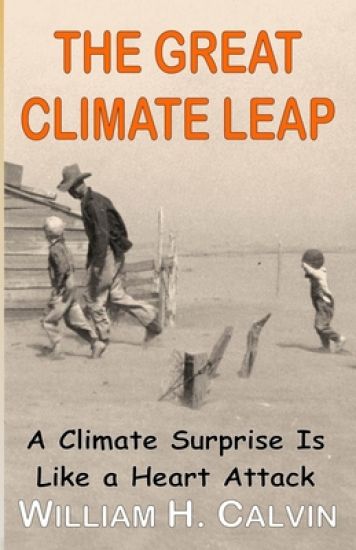
The Great Climate Leap: A Climate Surprise Is Like a Heart Attack

The Great Climate Leap: A Climate Surprise Is Like a Heart Attack

William H. Calvin

Createspace Independent Publishing Platform
2012
nidottu
The world's climate has become unstable from global warming. Even though global overheating did not take any leaps, there have been six abrupt shifts since 1976 in other aspects of climate, global in extent. For example, global drought acreage suddenly doubled in 1982 and stayed there. And there have been at least six near-misses. That 12-years-in-36 track record, not computer forecasts, is why we now need a CO2 cleanup that is big and quick. Climate surprises are like heart attacks. They occur with little warning. In severity, they range unpredictably from minor to catastrophic-say, failing ecosystems and a human population crash from war, famine, pestilence, and genocide. Compared to the climate creep from global warming, climate leaps are both sudden and sooner. So our primary concern is no longer about our grandchildren's world, or even our children's. It's about our future-including that of today's seniors.
The Great CO2 Cleanup: Backing Out of the Danger Zone

The Great CO2 Cleanup: Backing Out of the Danger Zone

William H. Calvin

Createspace Independent Publishing Platform
2012
nidottu
Most of our climate problems could be repaired by cleaning up the excess CO2 in the air and so cooling things off. However, because of abrupt climate flips, the cleanup must be big, quick, and secure. Doubling all forests might satisfy the first two but it would be quite insecure-currently even rain forests are burning and rotting, releasing additional CO2. However, our escape route is not yet closed off. We can still do the equivalent of plowing under a cover crop, using perhaps one percent of the ocean surface for the next twenty years. A sustained bloom of algae is fertilized by pumping up seawater from the depths-whereupon another wind-driven pump flushes the surface water back into even deeper depths before its new biomass becomes CO2 again. When the sunken biomass does decompose, its CO2 is smeared out over 6,000 years. Such a slow return of excess CO2 can be countered by forestry practices. Putting current and past emissions back into secure storage would lower the global overheating, relieve deluge and drought, reverse ocean acidification, reverse half of sea level rise as the oceans cool, and reduce the chance of abrupt climate shifts. The plankton plantations could then be kept in readiness for cooling the planet in a methane emergency.
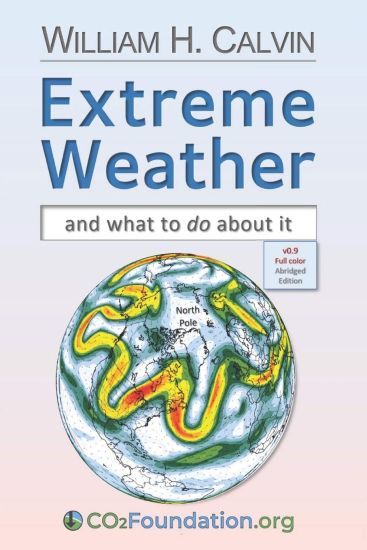
Extreme Weather: and what to do about it

Extreme Weather: and what to do about it

William H. Calvin

Independently Published
2019
nidottu
This is the full color, abridged edition 0.9. The Q&A and Endnotes are at CO2Foundation.org. You probably share the author's frustration that fifty years of climate warnings have been ineffective-and, even if they were working, that the proposed climate actions are now unlikely to be quick enough. He has been trying to reframe how scientists talk to the public about the climate problem-and about how to back ourselves out of its danger zone. Considering how the extreme weather disruptions might play out, we may only have twenty years to finish a CO2 cleanup. Even if the most ambitious of cleanup proposals were implemented on the fastest possible schedule, it would still be eight years before the cooling began.Here he emphasizes the 2000-2012 surges in extreme weather and then the need for a big, fast, and secure drawdown of the 50% excess of atmospheric CO2. There are 120 color illustrations, mostly scientific ones adapted for general readers.As a medical school professor, he brings to the climate discussion the perspective of those who teach physicians how to think about risk, good-enough evidence, diagnosis, prognosis, and the proposed treatment, where side-effects must be folded into the big picture explained to the patient. Nothing like that process happens for the climate threat.A climate version of this medical mindset could supplement the usual emphasis on root causes of climate change. In the reframing, one can talk about surges in extreme weather where the numbers are far bigger than those fractional degrees of further overheating (for the top five types: 100x, 24x, 8x, 4x, and 3.6 times the 20th-century baselines for severity or annual numbers--and sustained). They are also what makes it urgent to quickly draw down the excess CO2 before our ability to respond is compromised.He wrote the first big cover story on climate instability, "The Great Climate Flip-flop," for The Atlantic in 1998. His book Global Fever was published by the University of Chicago Press in 2008. In his 16 books, translated into 17 languages, he has woven cutting-edge science about complex subjects into a meaningful narrative for general readers and policymakers. Dr. Calvin is a professor emeritus at the University of Washington (Ph.D. in Physiology & Biophysics, from a physics background) who has been following abrupt climate change closely since 1983. That's because he works on how evolution managed to enlarge the human brain three-fold during the Pleistocene. Climate change usually speeds up evolution; in search of an augmenting feedback loop, he needed to understand that interaction in close detail. After 2003, he was following global warming per se. Our situation is not hopeless, he says, as those exaggerated reader-grabbing headlines are starting to suggest. Doing something big should bring hope during the minimum 10-15 years it will take to begin reducing extreme weather. Our situation may be bad, but it is not too late. There are effective actions we can still take to repel the extreme weather invasion, if we only get our act together in a hurry. Like war, it is risky and uncertain. But properly focused actions can greatly improve our chances. The trip to Hell is not a sure thing.