Kirjojen hintavertailu. Mukana 11 244 527 kirjaa ja 12 kauppaa.

Kirjahaku

Etsi kirjoja tekijän nimen, kirjan nimen tai ISBN:n perusteella.

18 kirjaa tekijältä William H. F. Altman

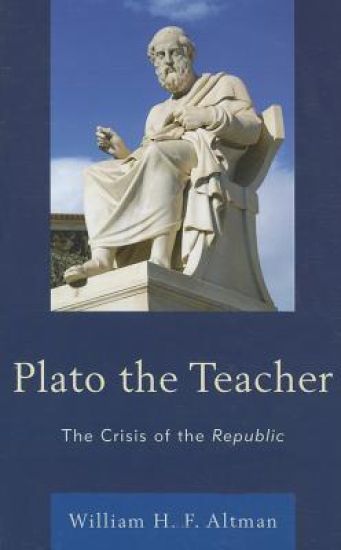
Plato the Teacher

Plato the Teacher

William H. F. Altman

Lexington Books
2012
sidottu
In this unique and important book, William Altman shines a light on the pedagogical technique of the playful Plato, especially his ability to create living discourses that directly address the student. Reviving an ancient concern with reconstructing the order in which Plato intended his dialogues to be taught as opposed to determining the order in which he wrote them, Altman breaks with traditional methods by reading Plato’s dialogues as a multiplex but coherent curriculum in which the Allegory of the Cave occupies the central place. His reading of Plato's Republic challenges the true philosopher to choose the life of justice exemplified by Socrates and Cicero by going back down into the Cave of political life for the sake of the greater Good.
Friedrich Wilhelm Nietzsche

Friedrich Wilhelm Nietzsche

William H. F. Altman

Lexington Books
2012
sidottu
When careful consideration is given to Nietzsche’s critique of Platonism and to what he wrote about Bismarck, Kaiser Wilhelm, and to Germany’s place in “international relations” (die Große Politik), the philosopher’s carefully cultivated “pose of untimeliness” is revealed to be an imposture. As William H. F. Altman demonstrates, Nietzsche should be recognized as the paradigmatic philosopher of the Second Reich, the short-lived and equally complex German Empire that vanished in World War One. Since Nietzsche is a brilliant stylist whose seemingly disconnected aphorisms have made him notoriously difficult for scholars to analyze, Friedrich Wilhelm Nietzsche is presented in Nietzsche’s own style in a series of 155 brief sections arranged in five discrete “Books,” a structure modeled on Daybreak. All of Nietzsche’s books are considered in the context of the close and revealing relationship between “Friedrich Wilhelm Nietzsche” (named by his patriotic father after the King of Prussia) and the Second Reich. In “Preface to ‘A German Trilogy,’” Altman joins this book to two others already published by Lexington Books: Martin Heidegger and the First World War: Being and Time as Funeral Oration and The German Stranger: Leo Strauss and National Socialism.
Martin Heidegger and the First World War

Martin Heidegger and the First World War

William H. F. Altman

Lexington Books
2012
sidottu
In a 1934 speech, marking the Twenty-fifth Reunion of his high school class, Martin Heidegger spoke eloquently of classmates killed in the Great War and called on his audience to recognize that the national rebirth now occuring in Hitler’s Germany must continue to draw inspiration from the war dead. In this process, he refers to the war of 1914–1918 as “the First World War.” Since the condition for the possibility of “the First” is a Second World War, Martin Heidegger and the First World War raises the question: how could Heidegger have already known in 1934 that another war was coming? The answer is to be found by reading Being and Time (1927) as a funeral oration for the warriors of the Great War, a reading that validates Heidegger’s paradoxical claim that the genuinely historical must emerge from the future. By using Lincoln’s “Gettysburg Address” as an archetype of the genre, William H. F. Altman shows that Heidegger’s concept of temporality in Being and Time replicates the way past, present, and future interweave in the classic funeral oration and argues that if there is a visible path connecting Being and Time to its author’s subsequent decision for National Socialism, it runs through the trenches of the Great War and its author’s successful attempt to evade them. The analysis and conclusions in this book will be of great value to students and scholars interested in philosophy, history, intellectual history, German studies, and political science.
Plato the Teacher

Plato the Teacher

William H. F. Altman

Lexington Books
2013
nidottu
In this unique and important book, William Altman shines a light on the pedagogical technique of the playful Plato, especially his ability to create living discourses that directly address the student. Reviving an ancient concern with reconstructing the order in which Plato intended his dialogues to be taught as opposed to determining the order in which he wrote them, Altman breaks with traditional methods by reading Plato’s dialogues as a multiplex but coherent curriculum in which the Allegory of the Cave occupies the central place. His reading of Plato's Republic challenges the true philosopher to choose the life of justice exemplified by Socrates and Cicero by going back down into the Cave of political life for the sake of the greater Good.
Friedrich Wilhelm Nietzsche

Friedrich Wilhelm Nietzsche

William H. F. Altman

Lexington Books
2014
nidottu
When careful consideration is given to Nietzsche’s critique of Platonism and to what he wrote about Bismarck, Kaiser Wilhelm, and to Germany’s place in “international relations” (die Große Politik), the philosopher’s carefully cultivated “pose of untimeliness” is revealed to be an imposture. As William H. F. Altman demonstrates, Nietzsche should be recognized as the paradigmatic philosopher of the Second Reich, the short-lived and equally complex German Empire that vanished in World War One. Since Nietzsche is a brilliant stylist whose seemingly disconnected aphorisms have made him notoriously difficult for scholars to analyze, Friedrich Wilhelm Nietzsche is presented in Nietzsche’s own style in a series of 155 brief sections arranged in five discrete “Books,” a structure modeled on Daybreak. All of Nietzsche’s books are considered in the context of the close and revealing relationship between “Friedrich Wilhelm Nietzsche” (named by his patriotic father after the King of Prussia) and the Second Reich. In “Preface to ‘A German Trilogy,’” Altman joins this book to two others already published by Lexington Books: Martin Heidegger and the First World War: Being and Time as Funeral Oration and The German Stranger: Leo Strauss and National Socialism.
The Relay Race of Virtue

The Relay Race of Virtue

William H. F. Altman

STATE UNIVERSITY OF NEW YORK PRESS
2022
sidottu
Demonstrates that Plato and Xenophon ought to be regarded less as rivals and more as engaged in a dialogue advancing a common goal of preserving the Socratic legacy.The ancient view that Plato and Xenophon were rivals at least had the merit of allowing them to respond to each other; in modern times, the view that Plato wrote first eliminates the possibility of an exchange between the only two Socratics whose writings are preserved intact. Challenging the chronological assumptions on which Plato's across-the-board priority currently rests, the purpose of The Relay Race of Virtue is to show that Plato and Xenophon were responding to each other and that we can gain a greater appreciation for both by recognizing the back-and-forth nature of their friendly dialogue. Instead of regarding Xenophon as Plato's inept copyist, William H. F. Altman presents him as first blazing the trail for his fellow Socratic and then learning from Plato in return. By emphasizing "Plato's Debts to Xenophon," Altman is charitable to both, justifying Socrates' belief (Memorabilia 1.2.8) "that those of his companions who adopted his principles of conduct would throughout life be good friends to him and to each other."
The Relay Race of Virtue

The Relay Race of Virtue

William H. F. Altman

STATE UNIVERSITY OF NEW YORK PRESS
2023
pokkari
Demonstrates that Plato and Xenophon ought to be regarded less as rivals and more as engaged in a dialogue advancing a common goal of preserving the Socratic legacy.The ancient view that Plato and Xenophon were rivals at least had the merit of allowing them to respond to each other; in modern times, the view that Plato wrote first eliminates the possibility of an exchange between the only two Socratics whose writings are preserved intact. Challenging the chronological assumptions on which Plato's across-the-board priority currently rests, the purpose of The Relay Race of Virtue is to show that Plato and Xenophon were responding to each other and that we can gain a greater appreciation for both by recognizing the back-and-forth nature of their friendly dialogue. Instead of regarding Xenophon as Plato's inept copyist, William H. F. Altman presents him as first blazing the trail for his fellow Socratic and then learning from Plato in return. By emphasizing "Plato's Debts to Xenophon," Altman is charitable to both, justifying Socrates' belief (Memorabilia 1.2.8) "that those of his companions who adopted his principles of conduct would throughout life be good friends to him and to each other."
Martin Heidegger and the First World War

Martin Heidegger and the First World War

William H. F. Altman

Lexington Books
2015
nidottu
In a 1934 speech, marking the Twenty-fifth Reunion of his high school class, Martin Heidegger spoke eloquently of classmates killed in the Great War and called on his audience to recognize that the national rebirth now occuring in Hitler’s Germany must continue to draw inspiration from the war dead. In this process, he refers to the war of 1914–1918 as “the First World War.” Since the condition for the possibility of “the First” is a Second World War, Martin Heidegger and the First World War raises the question: how could Heidegger have already known in 1934 that another war was coming? The answer is to be found by reading Being and Time (1927) as a funeral oration for the warriors of the Great War, a reading that validates Heidegger’s paradoxical claim that the genuinely historical must emerge from the future. By using Lincoln’s “Gettysburg Address” as an archetype of the genre, William H. F. Altman shows that Heidegger’s concept of temporality in Being and Time replicates the way past, present, and future interweave in the classic funeral oration and argues that if there is a visible path connecting Being and Time to its author’s subsequent decision for National Socialism, it runs through the trenches of the Great War and its author’s successful attempt to evade them. The analysis and conclusions in this book will be of great value to students and scholars interested in philosophy, history, intellectual history, German studies, and political science.
The Guardians in Action

The Guardians in Action

William H. F. Altman

Lexington Books
2016
sidottu
If you’ve ever wondered why Plato staged Timaeus as a kind of sequel to Republic, or who its unnamed missing fourth might be; or why he joined Critias to Timaeus, and whether or not that strange dialogue is unfinished; or what we should make of the written critique of writing in Phaedrus, and of that dialogue’s apparent lack of unity; or what is the purpose of the long discussion of the One in the second half of Parmenides, and how it relates to the objections made to the Theory of Forms in its first half; or if the revisionists or unitarians are right about Philebus, and why its Socrates seems less charming than usual, or whether or not Cratylus takes place after Euthyphro, and whether its far-fetched etymologies accomplish any serious philosophical purpose; or why the philosopher Socrates describes in the central digression of Theaetetus is so different from Socrates himself; then you will enjoy reading the continuation of William H. F. Altman’s Plato the Teacher: The Crisis of the Republic (Lexington; 2012), where he considers the pedagogical connections behind “the post-Republic dialogues” from Timaeus to Theaetetus in the context of “the Reading Order of Plato’s dialogues.”
The Guardians in Action

The Guardians in Action

William H. F. Altman

Lexington Books
2019
nidottu
If you’ve ever wondered why Plato staged Timaeus as a kind of sequel to Republic, or who its unnamed missing fourth might be; or why he joined Critias to Timaeus, and whether or not that strange dialogue is unfinished; or what we should make of the written critique of writing in Phaedrus, and of that dialogue’s apparent lack of unity; or what is the purpose of the long discussion of the One in the second half of Parmenides, and how it relates to the objections made to the Theory of Forms in its first half; or if the revisionists or unitarians are right about Philebus, and why its Socrates seems less charming than usual, or whether or not Cratylus takes place after Euthyphro, and whether its far-fetched etymologies accomplish any serious philosophical purpose; or why the philosopher Socrates describes in the central digression of Theaetetus is so different from Socrates himself; then you will enjoy reading the continuation of William H. F. Altman’s Plato the Teacher: The Crisis of the Republic (Lexington; 2012), where he considers the pedagogical connections behind “the post-Republic dialogues” from Timaeus to Theaetetus in the context of “the Reading Order of Plato’s dialogues.”
The Revival of Platonism in Cicero's Late Philosophy

The Revival of Platonism in Cicero's Late Philosophy

William H. F. Altman

Lexington Books
2016
sidottu
Less than two years before his murder, Cicero created a catalogue of his philosophical writings that included dialogues he had written years before, numerous recently completed works, and even one he had not yet begun to write, all arranged in the order he intended them to be read, beginning with the introductory Hortensius, rather than in accordance with order of composition. Following the order of the De divinatione catalogue, William H. F. Altman considers each of Cicero’s late works as part of a coherent philosophical project determined throughout by its author’s Platonism. Locating the parallel between Plato’s Allegory of the Cave and Cicero’s “Dream of Scipio” at the center of Cicero’s life and thought as both philosopher and orator, Altman argues that Cicero is not only “Plato’s rival” (it was Quintilian who called him Platonis aemulus) but also a peerless guide to what it means to be a Platonist, especially since Plato’s legacy was as hotly debated in his own time as it still is in ours. Distinctive of Cicero’s late dialogues is the invention of a character named “Cicero,” an amiable if incompetent adherent of the New Academy whose primary concern is only with what is truth-like (veri simile). Following Augustine’s lead, Altman reveals the deliberate inadequacy of this pose and argues that Cicero himself, the writer of dialogues who used “Cicero” as one of many philosophical personae, must always be sought elsewhere: in direct dialogue with the dialogues of Plato, the teacher he revered and whose Platonism he revived. The Revival of Platonism in Cicero’s Late Philosophy: Platonis aemulus and the Invention of Cicero is a must read for anyone working in classical studies, ancient philosophy, ancient history, or the history of philosophy.
The Revival of Platonism in Cicero's Late Philosophy

The Revival of Platonism in Cicero's Late Philosophy

William H. F. Altman

Lexington Books
2018
nidottu
This book argues that Cicero deserves to be spoken of with more respect and to be studied with greater care. Using Plato’s influence on Cicero’s life and writings as a clue, Altman reveals the ineffable combination of qualities—courage, originality, intelligence, sparkling wit, subtlety, deep respect for his teacher, and deadly seriousness of purpose—that enabled Cicero not only to revive Platonism, but also to rival Plato himself.
The Guardians on Trial

The Guardians on Trial

William H. F. Altman

Lexington Books
2016
sidottu
Based on a conception of Reading Order introduced and developed in his Plato the Teacher: The Crisis of the Republic (Lexington; 2012) and The Guardians in Action: Plato the Teacher and the Post-Republic Dialogues from Timaeus to Theaetetus (Lexington; 2016), William H. F. Altman now completes his study of Plato’s so-called “late dialogues” by showing that they include those that depict the trial and death of Socrates. According to Altman, it is not Order of Composition but Reading Order that makes Euthyphro, Apology of Socrates, Crito, and Phaedo “late dialogues,” and he shows why Plato’s decision to interpolate the notoriously “late” Sophist and Statesman between Euthyphro and Apology deserves more respect from interpreters. Altman explains this interpolation—and another, that places Laws between Crito and Phaedo—as part of an ongoing test Plato has created for his readers that puts “the Guardians on Trial.” If we don’t recognize that Socrates himself is the missing Philosopher that the Eleatic Stranger never actually describes—and also the antithesis of the Athenian Stranger, who leaves Athens in order to create laws for Crete—we pronounce ourselves too sophisticated to be Plato’s Guardians, and unworthy of the Socratic inheritance.
Ascent to the Good

Ascent to the Good

William H. F. Altman

Lexington Books
2018
sidottu
At the crisis of his Republic, Plato asks us to imagine what could possibly motivate a philosopher to return to the Cave voluntarily for the benefit of others and at the expense of her own personal happiness. This book shows how Plato has prepared us, his students, to recognize that the sun-like Idea of the Good is an infinitely greater object of serious philosophical concern than what is merely good for me, and thus why neither Plato nor his Socrates are eudaemonists, as Aristotle unquestionably was. With the transcendent Idea of Beauty having been made manifest through Socrates and Diotima, the dialogues between Symposium and Republic—Lysis, Euthydemus, Laches, Charmides, Gorgias, Theages, Meno, and Cleitophon— prepare the reader to make the final leap into Platonism, a soul-stirring idealism that presupposes the student’s inborn awareness that there is nothing just, noble, or beautiful about maximizing one’s own good. While perfectly capable of making the majority of his readers believe that he endorses the harmless claim that it is advantageous to be just and thus that we will always fare well by doing well, Plato trains his best students to recognize the deliberate fallacies and shortcuts that underwrite these claims, and thus to look beyond their own happiness by the time they reach the Allegory of the Cave, the culmination of a carefully prepared Ascent to the Good.
Plato and Demosthenes

Plato and Demosthenes

William H. F. Altman

BLOOMSBURY PUBLISHING PLC
2022
sidottu
Universally regarded as Plato’s student in antiquity, it is the eloquent and patriotic orator Demosthenes—not the pro-Macedonian Aristotle who tutored Alexander the Great—who returned to the dangerous Cave of political life, and thus makes it possible to recover the Old Academy. In Plato and Demosthenes: Recovering the Old Academy, William H. F. Altman explores how Demosthenes—along with Phocion, Lycurgus, and Hyperides—add external and historical evidence for the hypothesis that Plato’s brilliant and challenging dialogues constituted the Academy’s original curriculum. Altman rejects the facile view that the eloquent Plato, a master speech-writer as well as the proponent of the transcendent and post-eudaemonist Idea of the Good, was rhetoric’s enemy. He shows how Demosthenes acquired the discipline necessary to become a great orator, first by shouting at the sea and then by summoning the Athenians to self-sacrifice in defense of their waning freedom. Demosthenes thus proved Socrates’ criticism of democracy and the democratic man wrong, just as Plato the Teacher had intended that his best students would, and as he continues to challenge us to do today.
Plato and Demosthenes

Plato and Demosthenes

William H. F. Altman

BLOOMSBURY PUBLISHING PLC
2024
nidottu
Universally regarded as Plato’s student in antiquity, it is the eloquent and patriotic orator Demosthenes—not the pro-Macedonian Aristotle who tutored Alexander the Great—who returned to the dangerous Cave of political life, and thus makes it possible to recover the Old Academy. In Plato and Demosthenes: Recovering the Old Academy, William H. F. Altman explores how Demosthenes—along with Phocion, Lycurgus, and Hyperides—add external and historical evidence for the hypothesis that Plato’s brilliant and challenging dialogues constituted the Academy’s original curriculum. Altman rejects the facile view that the eloquent Plato, a master speech-writer as well as the proponent of the transcendent and post-eudaemonist Idea of the Good, was rhetoric’s enemy. He shows how Demosthenes acquired the discipline necessary to become a great orator, first by shouting at the sea and then by summoning the Athenians to self-sacrifice in defense of their waning freedom. Demosthenes thus proved Socrates’ criticism of democracy and the democratic man wrong, just as Plato the Teacher had intended that his best students would, and as he continues to challenge us to do today.
Plotinus the Master and the Apotheosis of Imperial Platonism

Plotinus the Master and the Apotheosis of Imperial Platonism

William H. F. Altman

BLOOMSBURY PUBLISHING PLC
2024
sidottu
Unlike other recent studies, Plotinus the Master and the Apotheosis of Imperial Platonism is critical of Plotinus, and in particular of his version of Platonism, here described as “Imperial.” It is in contrast with Plato—a teacher whose dialogues challenge his students to think for themselves—that William H. F. Altman presents Plotinus as a master, who uses a seductive form of rhetoric throughout the Enneads to persuade his disciples to ignore his self-contradictions and decontextualized quotations from Plato while instead regarding his spiritual experiences, combined with a gift for the creative synthesis of previous thinkers, as the principal basis of their faithful and uncritical allegiance. While setting Plotinus in the context of the Roman Empire and his own critique of the Gnostics, this book grapples throughout with his current and virtually uncritical reception.
Ascent to the Beautiful

Ascent to the Beautiful

William H. F. Altman

Rowman Littlefield
2020
sidottu
With Ascent to the Beautiful, William H. F. Altman completes his five-volume reconstruction of the Reading Order of the Platonic dialogues. Although published last, this book covers Plato’s elementary dialogues, grappling from the start with F. D. E. Schleiermacher, who created an enduring prejudice against the works Plato wrote for beginners. Recognized in antiquity as the place to begin, Alcibiades Major was banished from the canon but it was not alone: with the exception of Protagoras and Symposium, Schleiermacher rejected as inauthentic all seven of the dialogues this book places between them. In order to prove their authenticity, Altman illuminates their interconnections and shows how each prepares the student to move beyond self-interest to gallantry, and thus from the doctrinal intellectualism Aristotle found in Protagoras to the emergence of philosophy as intermediate between wisdom and ignorance in Symposium en route to Diotima’s ascent to the transcendent Beautiful. Based on the hypothesis that it was his own eminently teachable dialogues that Plato taught—and bequeathed to posterity as his Academy’s eternal curriculum—Ascent to the Beautiful helps the reader to imagine the Academy as a school and to find in Plato the brilliant teacher who built on Homer, Thucydides, and Xenophon.