Kirjojen hintavertailu. Mukana 11 627 363 kirjaa ja 12 kauppaa.

Kirjahaku

Etsi kirjoja tekijän nimen, kirjan nimen tai ISBN:n perusteella.

6 kirjaa tekijältä William Hare

Open-Mindedness and Education

Open-Mindedness and Education

William Hare

McGill-Queen's University Press
1993
nidottu
Professor Hare provides a systematic and detailed examination of what is meant by calling a person open-minded, and an inquiry into the place and importance of this comparatively neglected idea in education. "[Hare] provides us with a clear concept of open-mindedness and shows why that attitude is central to our view of education ... for those who are interested in the concept of education or values or moral education, and those who want to see how open-mindedness relates to important concepts such as rationality, neutrality, indoctrination ... recommended to all who are concerned with education, not just teachers and teacher educators. The language is absolutely clear and free of pretentious jargon, the arguments are rigorous, cogent, and easy to follow, and the organization of the book is truly exemplary." Canadian Journal of Education.
In Defence of Open-Mindedness

In Defence of Open-Mindedness

William Hare

McGill-Queen's University Press
1985
nidottu
William Hare believes that open-mindedness - the disposition to form a belief, and if necessary to revise or reject it, in the light of available evidence and arguement - stands in need of a defence because it is under widespread attack. In this sequel to his highly regarded Open-mindedness and Education [1979], he examines the numerous ways in which opposition to open-mindedness is expressed, and shows how these criticisms can be countered. He argues that the general indictment of open-mindedness as a habit of mind leading to nihilism and scepticism, as well as to neglect of the emotions, is based upon a misunderstanding of the nature of the concept, which in his opinion is by no means incompatible with personal commitment and confidence. Similar confusions are exposed in such areas as elementary schooling, moral education, educational standards, methods of teaching, the administration of schools, and the teaching of science. In each of these areas, examples are taken from the writings of influential critics to illustrate the nature of the doubts concerning open-mindedness - doubts that are carefully analysed and show to rest ultimately upon erroneous assumptions. And since he believes that many who set out to champion open-mindedness manage to confuse this ideal with other notions, Hare undertakes in a concluding chapter to protect the ideal from its would-be friends and supporters.
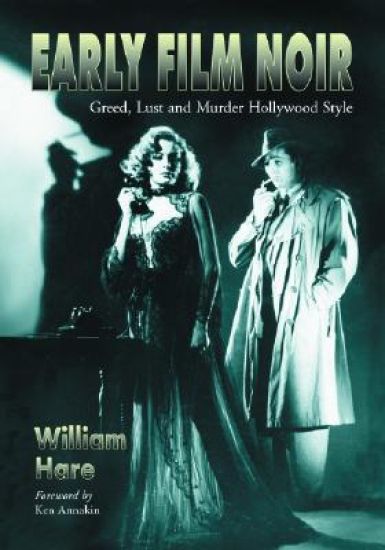
Early Film Noir

Early Film Noir

William Hare

McFarland Co Inc
2003
pokkari
The name is French and it has connections to German expressionist cinema, but film noir was inspired by the American Raymond Chandler, whose prose was marked by the gripping realism of seedy hotels, dimly lit bars, main streets, country clubs, mansions, cul-de-sac apartments, corporate boardrooms, and flop houses of America. Chandler and the other writers and directors, including James M. Cain, Dashiell Hammett, Jane Greer, Ken Annakin, Rouben Mamoulian and Mike Mazurki, who were primarily responsible for the creation of the film noir genre and its common plots and themes, are the main focus of this work. It correlates the rise of film noir with the new appetites of the American public after World War II and explains how it was developed by smaller studios and filmmakers as a result of the emphasis on quality within a deliberately restricted element of cities at night. The author also discusses how RKO capitalized on films such as Murder, My Sweet and Out of the Past--two of film noir's most famous titles--and film noir's connection to British noir and the great international triumph of Sir Carol Reed in The Third Man.
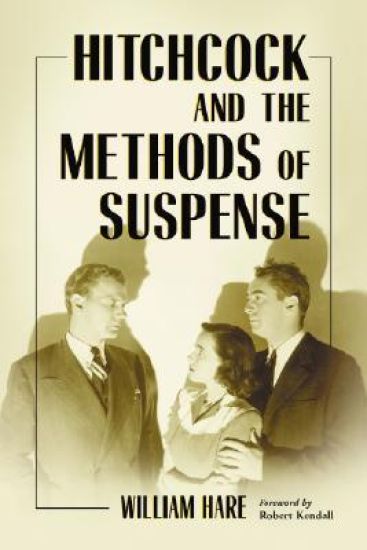
Hitchcock and the Methods of Suspense

Hitchcock and the Methods of Suspense

William Hare

McFarland Co Inc
2007
pokkari
Alfred Hitchcock had a gift for turning the familiar into the unfamiliar, the mundane into the unexpected. A director known for planning the entire movie before the first day of filming began by using the storyboard approach, Hitchcock was renowned for his relaxed directing style, resulting in an excellent rapport with his actors. Decades later, Hitchcock's films stand as sterling examples of innovative technique, infused with meaning that only repeated viewing can reveal. This work examines themes, techniques, and the filmmaking process in 15 of Hitchcock's best known films: The 39 Steps, Rebecca, Shadow of a Doubt, Spellbound, Notorious, Rope, Strangers on a Train, Rear Window, The Man Who Knew Too Much, Vertigo, North by Northwest, Psycho, The Birds, Frenzy and Family Plot. It explores the auteur's treatments of psychoanalysis, voyeurism, and collective fears during the Cold War. Also presented are key stories behind several Hitchcock classics, such as the director's stormy relationships with Raymond Chandler and David O. Selznick that resulted in synergetic success for some of his most successful films. The book includes numerous photographs and an extensive bibliography.
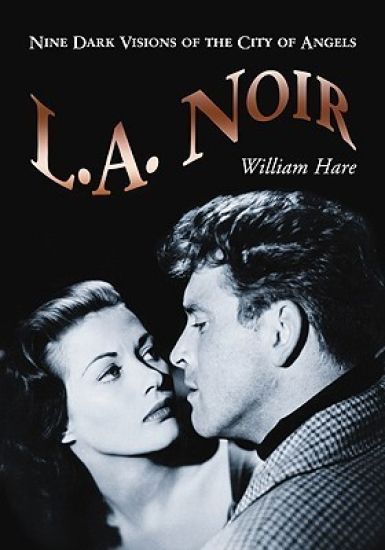
L.A. Noir

L.A. Noir

William Hare

McFarland Co Inc
2008
pokkari
Los Angeles is an ideal city for film noir for both economic and aesthetic reasons. The largest metropolitan area in the country, home to an ever-changing population of the disillusioned and in close proximity to city, mountains, ocean, and desert, the City of Angels became a center of American film noir. This detailed discussion of nine films explores such topics as why certain settings are appropriate for film noir, why L.A. has been a favorite of authors such as Raymond Chandler, and relevant political developments in the area. The films are also examined in terms of story content as well as how they developed in the project stage. Utilizing a number of quotes from interviews, the work examines actors, directors, and others involved with the films, touching on their careers and details of their time in L.A. The major films covered are The Big Sleep, Criss Cross, D.O.A., In A Lonely Place, The Blue Gardenia, Kiss Me Deadly, The Killing, Chinatown, and L.A. Confidential.
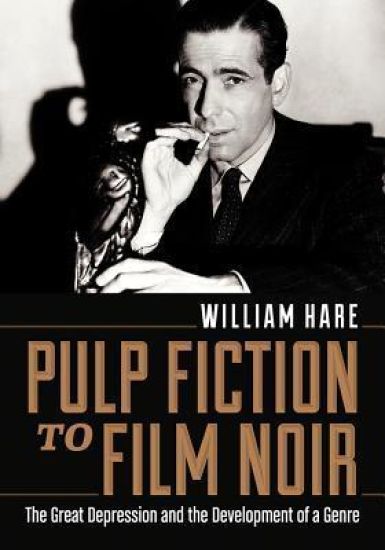
Pulp Fiction to Film Noir

Pulp Fiction to Film Noir

William Hare

McFarland Co Inc
2012
pokkari
During the Great Depression, pulp fiction writers created a new, distinctly American detective story, one that stressed the development of fascinating, often bizarre characters rather than the twists and turns of clever plots. This new crime fiction adapted brilliantly to the screen, birthing a cinematic genre that French cinema intellectuals following World War II christened "film noir." Set on dark streets late at night, in cheap hotels and bars, and populated by the dangerous people who frequented these locales, these films introduced a new antihero, a tough, brooding, rebellious loner, embodied by Humphrey Bogart as Sam Spade in The Maltese Falcon and Philip Marlowe in The Big Sleep. This volume provides a detailed exploration of film noir, tracing its evolution, the influence of such legendary writers as Dashiell Hammett and Raymond Chandler, and the films that propelled this dark genre to popularity in the mid-20th century.