Kirjojen hintavertailu. Mukana 12 390 323 kirjaa ja 12 kauppaa.

Kirjahaku

Etsi kirjoja tekijän nimen, kirjan nimen tai ISBN:n perusteella.

5 kirjaa tekijältä William L. Cleveland

Islam against the West

Islam against the West

William L. Cleveland

University of Texas Press
1985
pokkari
This book gives a unique perspective on the interwar history of the Middle East. By telling the life story of one man, it illuminates the political and cultural struggles of an era. Shakib Arslan (1869–1946) was a leading member of the generation of Ottoman Arabs who came to professional maturity just before the final defeat of the Ottoman Empire. Born to a powerful Lebanese Druze family, Arslan grew up perfectly suited to his time and place in history. He was one of the leading writers of his day and a dexterous, ambitious politician. But, by the end of World War I, Arslan and others of his generation found themselves adrift in a world no longer of their choosing, as the once great Ottoman state lay broken before the West. Rather than retreating from public life in those dark days, however, Arslan emerged militant in his opposition to Western encroachment on Islamic lands and tireless in his crusade to bring the organizing principles of a universalist Islam to the age of emerging nation-states. Organizer, pamphleteer, diplomat, spokesman, and symbol, Arslan became one of the dominant, and most controversial, Muslim political figures in the two decades between the wars. His involvements were so varied and intense that to study his life is to bring into focus all the major political issues and intellectual currents of the era. By the end of his career he was both praised and vilified, but he was arguably the most widely read Arab author of his day. Curiously, Arslan has received relatively little attention in English-language research. This may well be due less to his contemporary importance than to the perspective from which Western scholarship has viewed Middle Eastern intellectual history. Arslan was not one of the winners. For many his evocation of the old imperial ideal and his insistence on the strategic importance of Islamic ideals seemed to be simply archaic protest in a secular age. But this impeccably researched and beautifully written biography demonstrates the power and importance of Arslan’s activist heritage, reinterpreting it for its own time and showing its importance for ours.

The Making of an Arab Nationalist

The Making of an Arab Nationalist

William L. Cleveland

Princeton University Press
2015
pokkari
A loyal servant of the Ottoman Empire in his early career, Sati' al-Husri (1880-1968) became one of Arab nationalism's most articulate and influential spokesmen. His shift from Ottomanism, based on religion and the multi-national empire, to Arabism, defined by secular loyalties and the concept of an Arab nation, is the theme of William Cleveland's account of "the making of an Arab nationalist." Originally published in 1972. The Princeton Legacy Library uses the latest print-on-demand technology to again make available previously out-of-print books from the distinguished backlist of Princeton University Press. These editions preserve the original texts of these important books while presenting them in durable paperback and hardcover editions. The goal of the Princeton Legacy Library is to vastly increase access to the rich scholarly heritage found in the thousands of books published by Princeton University Press since its founding in 1905.
The Making of an Arab Nationalist

The Making of an Arab Nationalist

William L. Cleveland

Princeton University Press
2016
sidottu
A loyal servant of the Ottoman Empire in his early career, Sati' al-Husri (1880-1968) became one of Arab nationalism's most articulate and influential spokesmen. His shift from Ottomanism, based on religion and the multi-national empire, to Arabism, defined by secular loyalties and the concept of an Arab nation, is the theme of William Cleveland's account of "the making of an Arab nationalist." Originally published in 1972. The Princeton Legacy Library uses the latest print-on-demand technology to again make available previously out-of-print books from the distinguished backlist of Princeton University Press. These editions preserve the original texts of these important books while presenting them in durable paperback and hardcover editions. The goal of the Princeton Legacy Library is to vastly increase access to the rich scholarly heritage found in the thousands of books published by Princeton University Press since its founding in 1905.
A History of the Modern Middle East

A History of the Modern Middle East

William L. Cleveland; Martin Bunton

TAYLOR FRANCIS LTD
2024
sidottu
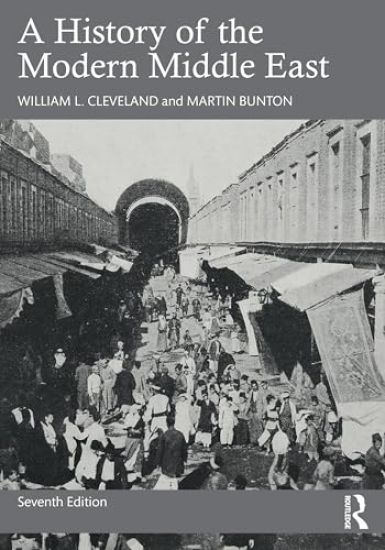
A History of the Modern Middle East examines the profound and often dramatic transformations of the region in the past two centuries, from the Ottoman and Egyptian reforms, through the challenge of Western imperialism, to the impact of US foreign policies. Built around a framework of political history, while also carefully integrating social, cultural, and economic developments, this expertly crafted account provides readers with the most comprehensive, balanced, and penetrating analysis of the modern Middle East.The seventh edition has been substantially revised to reflect the significance of the 2011 Arab Uprisings as a major turning point in the modern history of the region. A new chapter considers how regional powers, especially in the Gulf, are now asserting themselves more forcefully, seeking to push their own interests while Russia and China contest America’s position. Including an annotated and updated bibliography that offers guidance to readers seeking more in-depth information and incorporating an online companion website featuring quizzes, timelines, and instructor resources, A History of the Modern Middle East remains the quintessential text for courses on Middle Eastern history.
A History of the Modern Middle East

A History of the Modern Middle East

William L. Cleveland; Martin Bunton

TAYLOR FRANCIS LTD
2024
nidottu
A History of the Modern Middle East examines the profound and often dramatic transformations of the region in the past two centuries, from the Ottoman and Egyptian reforms, through the challenge of Western imperialism, to the impact of US foreign policies. Built around a framework of political history, while also carefully integrating social, cultural, and economic developments, this expertly crafted account provides readers with the most comprehensive, balanced, and penetrating analysis of the modern Middle East.The seventh edition has been substantially revised to reflect the significance of the 2011 Arab Uprisings as a major turning point in the modern history of the region. A new chapter considers how regional powers, especially in the Gulf, are now asserting themselves more forcefully, seeking to push their own interests while Russia and China contest America’s position. Including an annotated and updated bibliography that offers guidance to readers seeking more in-depth information and incorporating an online companion website featuring quizzes, timelines, and instructor resources, A History of the Modern Middle East remains the quintessential text for courses on Middle Eastern history.