Kirjojen hintavertailu. Mukana 12 016 292 kirjaa ja 12 kauppaa.

Kirjahaku

Etsi kirjoja tekijän nimen, kirjan nimen tai ISBN:n perusteella.

4 kirjaa tekijältä William L. Hamilton

A Social Experiment in Program Administration

A Social Experiment in Program Administration

William L. Hamilton

University Press of America
1984
sidottu
This monograph, originally published in 1979 by Abt Books, reports the findings of a social experiment to examine how local agencies might administer a housing allowance program. The unique aspect of the Administrative Agency Experiment was its focus on program administration, and its central purpose was to identify viable means by which local agencies could carry out the necessary administrative functions in a public program of this type. Involving nearly 6,000 beneficiary families, the effort was conducted by Abt Associates Inc. for the Department of Housing and Urban Development.
The Spiritual Quest of a Scientific Mind: An engineer's search for meaning beyond science

The Spiritual Quest of a Scientific Mind: An engineer's search for meaning beyond science

William L. Hamilton

Createspace Independent Publishing Platform
2015
nidottu
The theme of the book is that the world of the spirit is real and can be learned, to some extent at least. And that spiritual kinowledge based on fact is truly power, and it brings satisfaction and contentment beyond all else to those who seek it. It is about the teaching of "The Ancient Wisdom". Jesus came to teach this as did others before him and others after. There is nothing new about the basic facts. What is new is the more effective way that it can be explained in this modern era. There is no plot---just 50 essays, most of them based on spiritual experiences of the author, each one illustrating some aspect of the world of the spirit. Simple enough for the beginner to get started, yet deep enough to interest for a lifetime. Some aspects are approached from more than one perspective for clarity, inluding metaphysics and a New Testament outlook with remarkable conclusions. Not totally a how-to book, rather a way to select appropriate how-to books. Crammed with valuable insights, it can be a captivating guide for anyone seeking the ancient eternal wisdom. The author, a mechanical engineer, began a spiritual quest at age 37. Adept in the world of science and machines, he was an unlikely personality type to get very far in this type of endeavor. But it soon became apparent to him that there is no real conflict between proven science and true religion. Although this realization is contrary to some long-held popular beliefs, it simplified his religious studies immensely. He met some qualified teachers who knew that the great religious truths are meant for 'here and now' in this lifetime as well as any afterlife, and could teach it well. The eternal wisdom (some of it anyway) 'came through' even to the literal scientific mind of the engineer. And (some of it anyway) can be passed on to the reader.
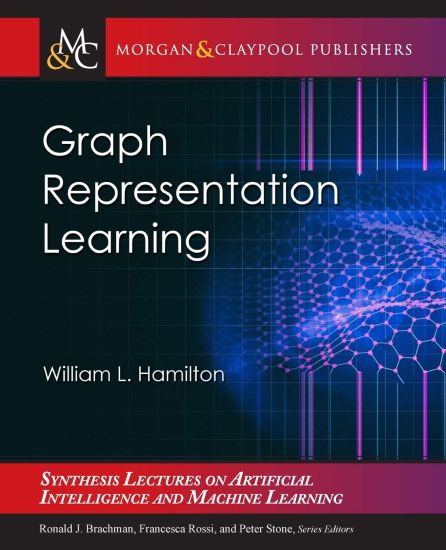
Graph Representation Learning

Graph Representation Learning

William L. Hamilton

Morgan Claypool Publishers
2020
nidottu
This book is a foundational guide to graph representation learning, including state-of-the art advances, and introduces the highly successful graph neural network (GNN) formalism. Graph-structured data is ubiquitous throughout the natural and social sciences, from telecommunication networks to quantum chemistry. Building relational inductive biases into deep learning architectures is crucial for creating systems that can learn, reason, and generalize from this kind of data. Recent years have seen a surge in research on graph representation learning, including techniques for deep graph embeddings, generalizations of convolutional neural networks to graph-structured data, and neural message-passing approaches inspired by belief propagation. These advances in graph representation learning have led to new state-of-the-art results in numerous domains, including chemical synthesis, 3D vision, recommender systems, question answering, and social network analysis.It begins with a discussion of the goals of graph representation learning as well as key methodological foundations in graph theory and network analysis. Following this, the book introduces and reviews methods for learning node embeddings, including random-walk-based methods and applications to knowledge graphs. It then provides a technical synthesis and introduction to the highly successful graph neural network (GNN) formalism, which has become a dominant and fast-growing paradigm for deep learning with graph data. The book concludes with a synthesis of recent advancements in deep generative models for graphs -- a nascent but quickly growing subset of graph representation learning.
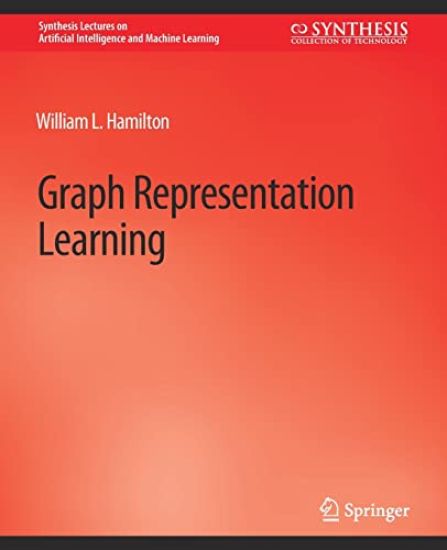
Graph Representation Learning

Graph Representation Learning

William L. Hamilton

Springer International Publishing AG
2020
nidottu
Graph-structured data is ubiquitous throughout the natural and social sciences, from telecommunication networks to quantum chemistry. Building relational inductive biases into deep learning architectures is crucial for creating systems that can learn, reason, and generalize from this kind of data. Recent years have seen a surge in research on graph representation learning, including techniques for deep graph embeddings, generalizations of convolutional neural networks to graph-structured data, and neural message-passing approaches inspired by belief propagation. These advances in graph representation learning have led to new state-of-the-art results in numerous domains, including chemical synthesis, 3D vision, recommender systems, question answering, and social network analysis. This book provides a synthesis and overview of graph representation learning. It begins with a discussion of the goals of graph representation learning as well as key methodological foundations in graph theory and network analysis. Following this, the book introduces and reviews methods for learning node embeddings, including random-walk-based methods and applications to knowledge graphs. It then provides a technical synthesis and introduction to the highly successful graph neural network (GNN) formalism, which has become a dominant and fast-growing paradigm for deep learning with graph data. The book concludes with a synthesis of recent advancements in deep generative models for graphs—a nascent but quickly growing subset of graph representation learning.