Kirjojen hintavertailu. Mukana 12 083 983 kirjaa ja 12 kauppaa.

Kirjahaku

Etsi kirjoja tekijän nimen, kirjan nimen tai ISBN:n perusteella.

9 kirjaa tekijältä William T. Cavanaugh

The Uses of Idolatry

The Uses of Idolatry

William T. Cavanaugh

OXFORD UNIVERSITY PRESS INC
2024
sidottu
In The Uses of Idolatry, William T. Cavanaugh offers a sustained and interdisciplinary argument that worship has not waned in our supposedly “secular” world. Rather, the target of worship has changed, migrating from the explicit worship of God to the implicit worship of things. Cavanaugh examines modern idolatries and the ways in which humans become dominated by our own creations. While Cavanaugh is critical of modern idolatries, his argument is also sympathetic, seeing in idolatry a deep longing in the human heart for the transformation of our lives. We all believe in something, he argues: we are worshipping creatures whose devotion alights on all sorts of things, in part because we are material creatures, and the material world is beautiful. Following an invisible God is hard for material creatures, so we-those who profess belief in God and those who don't-fixate on things that are closer to hand. Ranging widely across the fields of history, philosophy, political science, sociology, and cultural studies, Cavanaugh develops an account of modernity as not the condition of being disenchanted but the condition of having learned to describe the world as disenchanted. For a better description of the world, Cavanaugh turns to scriptural, theological, and phenomenological accounts of idolatry as inordinate devotion to created things. Through deep explorations of nationalism and consumer culture, The Uses of Idolatry presents a sympathetic but critical account of how and why we sacrifice ourselves and others to gods of our own design.
The Uses of Idolatry

The Uses of Idolatry

William T. Cavanaugh

OXFORD UNIVERSITY PRESS INC
2024
nidottu
In The Uses of Idolatry, William T. Cavanaugh offers a sustained and interdisciplinary argument that worship has not waned in our supposedly “secular” world. Rather, the target of worship has changed, migrating from the explicit worship of God to the implicit worship of things. Cavanaugh examines modern idolatries and the ways in which humans become dominated by our own creations. While Cavanaugh is critical of modern idolatries, his argument is also sympathetic, seeing in idolatry a deep longing in the human heart for the transformation of our lives. We all believe in something, he argues: we are worshipping creatures whose devotion alights on all sorts of things, in part because we are material creatures, and the material world is beautiful. Following an invisible God is hard for material creatures, so we-those who profess belief in God and those who don't-fixate on things that are closer to hand. Ranging widely across the fields of history, philosophy, political science, sociology, and cultural studies, Cavanaugh develops an account of modernity as not the condition of being disenchanted but the condition of having learned to describe the world as disenchanted. For a better description of the world, Cavanaugh turns to scriptural, theological, and phenomenological accounts of idolatry as inordinate devotion to created things. Through deep explorations of nationalism and consumer culture, The Uses of Idolatry presents a sympathetic but critical account of how and why we sacrifice ourselves and others to gods of our own design.

Theopolitical Imagination

Theopolitical Imagination

William T. Cavanaugh

T. T.Clark Ltd
2003
nidottu
A critique of modern Western civilization, including contemporary concerns of consumerism, capitalism, globalization, and poverty, from the perspective of a believing Catholic. Responding to Enlightenment and Postmodernist views of the social and economic realities of our time, Cavanaugh engages with contemporary concerns--consumerism, late capitalism, globalization, poverty--in a way reminiscent of Rowan Williams (Lost Icons), Nicholas Boyle (Who Are We Now?) and Michel de Certeau. "Consumption of the Eucharist," he argues, "consumes one into the narrative of the pilgrim City of God, whose reach extends beyond the global to embrace all times and places." He develops the theme of the Eucharist as the basis for Christian resistance to the violent disciplines of state, civil society and globalization.
Being Consumed

Being Consumed

William T. Cavanaugh

William B Eerdmans Publishing Co
2008
nidottu
Should Christians be for or against the free market? For or against globalization? How are we to live in a world of scarcity? William Cavanaugh uses Christian resources to incisively address basic economic matters -- the free market, consumer culture, globalization, and scarcity -- arguing that we should not just accept these as givens but should instead change the terms of the debate.Among other things, Cavanaugh discusses how God, in the Eucharist, forms us to consume and be consumed rightly. Examining pathologies of desire in contemporary -free market- economies, Being Consumed puts forth a positive and inspiring vision of how the body of Christ can engage in economic alternatives. At every turn, Cavanaugh illustrates his theological analysis with concrete examples of Christian economic practices.
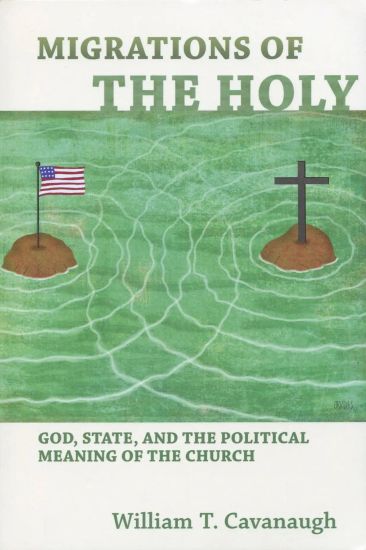
Migrations of the Holy

Migrations of the Holy

William T. Cavanaugh

William B Eerdmans Publishing Co
2011
nidottu
Whether one thinks that -religion- continues to fade or has made a comeback in the contemporary world, there is a common notion that -religion- went away somewhere, at least in the West. But William Cavanaugh argues that religious fervor never left -- it has only migrated toward a new object of worship. In Migrations of the Holy he examines the disconcerting modern transfer of sacred devotion from the church to the nation-state. In these chapters Cavanaugh cautions readers to be wary of a rigid separation of religion and politics that boxes in the church and sends citizens instead to the state for hope, comfort, and salvation as they navigate the risks and pains of mortal life. When nationality becomes the primary source of identity and belonging, he warns, the state becomes the god and idol of its own religion, the language of nationalism becomes a liturgy, and devotees willingly sacrifice their lives to serve and defend their country. Cavanaugh urges Christians to resist this form of idolatry, to unthink the inevitability of the nation-state and its dreary party politics, to embrace radical forms of political pluralism that privilege local communities -- and to cling to an incarnational theology that weaves itself seamlessly and tangibly into all aspects of daily life and culture. Read more about the book in a blog post by Cavanaugh on EerdWord.
Field Hospital

Field Hospital

William T. Cavanaugh

William B Eerdmans Publishing Co
2016
nidottu
In a 2013 interview, Pope Francis famously likened the church to a field hospital, saying that his vision of the ideal church is one that attends to the overwhelming suffering of the world before concerning itself with smaller matters. In this book William Cavanaugh adopts Pope Francis's metaphor to show how the church can help heal both the spiritual and the material wounds of the world.As he examines the intersection of theology with themes of religious freedom, economic injustice, religious violence, and other pressing topics, Cavanaugh emphasizes that the church cannot condemn the evils of the world from a position of superiority. Rather, he says, its practices of solidarity with humanity must be based on a profound recognition that the church shares in the guilt of human sin. Cavanaugh's Field Hospital provides guideposts for a church that is willing to go outside of itself onto the battlefields of today - both metaphorical and literal - not to inflict wounds but to bind them up and heal them.
Migrationen Des Heiligen: Gott, Der Staat Und Die Politische Bedeutung Der Kirche
William T. Cavanaugh ist ein international viel beachteter US-amerikanischer katholischer Theologe, dessen Rezeption in der deutschen Sprachwelt erst beginnt. In Migrationen des Heiligen weist er nach, wie sich in beunruhigender Weise die auf Gott, den Heiligen, gerichtete Verehrung auf den modernen Nationalstaat verlagert hat. Wenn Menschen ihre Hoffnung auf die Erfullung ihrer Bedurfnisse und Wunsche in den Staat setzen, dann ist dieser Staat der Gotze seiner eigenen Religion, und die Sprach- und Zeichenwelt des Nationalismus wird zur Liturgie. Seit das Buch 2011 erstmals erschien, haben sich die von Cavanaugh analysierten Phanomene im Kontext weltweiter Migrationsbewegungen und nationalistischer Gewalt dramatisch verscharft. Der Autor befahigt Burger und Burgerinnen, den Staat nicht zu sakralisieren. Insbesondere wendet er sich an Christen: Als Leib Christi ist die Kirche ein politischer Korper, der sich liturgisch konstituiert und sich in die korperschaftlichen Gebilde des Staates wie auch des Marktes aus eigenen, transzendenten Quellen subversiv einmischen kann. An anderer Stelle nennt Cavanaugh die Kirche mit einem Ausdruck von Papst Franziskus ein Feldlazarett. In ihrem inkarnatorischen Zeugnis konnen Christen durch die lokale, liturgisch gefeierte Leibwerdung der Gemeinschaft einen radikalen, wahrhaft demokratischen Pluralismus fordern. Ihre sakramentale Lebensform erweist sich als eminent politisch. William T. Cavanaugh ist Professor fur katholische Studien und Direktor des Zentrums fur Weltkatholizismus und interkulturelle Theologie an der DePaul University in Chicago. Sein Forschungsinteresse bezieht sich auf die Begegnung der Kirche mit sozialen, politischen und wirtschaftlichen Realitaten sowie auf die sozialen Auswirkungen traditioneller katholischer Glaubensvollzuge, wie etwa der Eucharistie. Seine Bucher und Artikel wurden in zehn Sprachen veroffentlicht. Barbara Hallensleben, Professorin fur Dogmatik und Theologie der Okumene an der Theologischen Fakultat der Universitat Fribourg Schweiz, ubersetzte das Buch aus dem Englischen.