Kirjojen hintavertailu. Mukana 11 244 527 kirjaa ja 12 kauppaa.

Kirjahaku

Etsi kirjoja tekijän nimen, kirjan nimen tai ISBN:n perusteella.

6 kirjaa tekijältä William Weber

The Great Transformation of Musical Taste

The Great Transformation of Musical Taste

William Weber

Cambridge University Press
2009
pokkari
Grounded in knowledge of thousands of programs, this book examines how musical life in London, Leipzig, Vienna, Boston, and other cities underwent a fundamental transformation in relationship with movements in European politics. William Weber traces how musical taste evolved in European concert programs from 1750 to 1870, as separate worlds arose around classical music and popular songs. In 1780 a typical program accommodated a variety of tastes through a patterned 'miscellany' of genres, held together by diplomatic musicians. This framework began weakening around 1800 as new kinds of music appeared, from string quartets to quadrilles to ballads, which could not easily coexist on the same programs. Utopian ideas and extravagant experiments influenced programming as ideological battles were fought over who should govern musical taste. More than a hundred illustrations or transcriptions of programs enable readers to follow Weber's analysis in detail.
The Great Transformation of Musical Taste

The Great Transformation of Musical Taste

William Weber

Cambridge University Press
2008
sidottu
Grounded in knowledge of thousands of programs, this book examines how musical life in London, Leipzig, Vienna, Boston, and other cities underwent a fundamental transformation in relationship with movements in European politics. William Weber traces how musical taste evolved in European concert programs from 1750 to 1870, as separate worlds arose around classical music and popular songs. In 1780 a typical program accommodated a variety of tastes through a patterned 'miscellany' of genres, held together by diplomatic musicians. This framework began weakening around 1800 as new kinds of music appeared, from string quartets to quadrilles to ballads, which could not easily coexist on the same programs. Utopian ideas and extravagant experiments influenced programming as ideological battles were fought over who should govern musical taste. More than a hundred illustrations or transcriptions of programs enable readers to follow Weber's analysis in detail.

Music and the Middle Class

Music and the Middle Class

William Weber

Ashgate Publishing Limited
2003
sidottu
First published in 1975, Music and the Middle Class made a trail-blazing contribution to the social history of music, bringing together sociological and historical methods that have subsequently become accepted as central to the discipline of musicology. Moreover, the major themes of the book are ones which scholars today continue to grapple with: the nature of the middle class(es) and their role in cultural definition; the concept of taste publics distinct from social status; and the establishment of the musical canon. This classic text is reissued here in Ashgate's Music in Nineteenth-Century Britain series, though of course the book ranges beyond its study of London to discuss in detail the contrasting concert life of Paris and Vienna. This edition features a substantial new preface which takes into account the significant work that has been done in this field since the book first appeared, and provides a unique opportunity to assess the impact the book has had on our thinking about the European middle class and its role in musical life.
Music and the Middle Class

Music and the Middle Class

William Weber

Routledge
2017
nidottu
First published in 1975, Music and the Middle Class made a trail-blazing contribution to the social history of music, bringing together sociological and historical methods that have subsequently become accepted as central to the discipline of musicology. Moreover, the major themes of the book are ones which scholars today continue to grapple with: the nature of the middle class(es) and their role in cultural definition; the concept of taste publics distinct from social status; and the establishment of the musical canon. This classic text is reissued here in Ashgate's Music in Nineteenth-Century Britain series, though of course the book ranges beyond its study of London to discuss in detail the contrasting concert life of Paris and Vienna. This edition features a substantial new preface which takes into account the significant work that has been done in this field since the book first appeared, and provides a unique opportunity to assess the impact the book has had on our thinking about the European middle class and its role in musical life.
Neither Victor nor Vanquished

Neither Victor nor Vanquished

William Weber

Potomac Books Inc
2013
sidottu
In 1812, less than forty years after breaking from Britain, the United States found itself in another war with its former colonial master. Now, during the two hundredth anniversary of the War of 1812 comes Neither Victor nor Vanquished, William Weber’s reappraisal of this critical but frequently misunderstood conflict. In the first half of the book, Weber reexamines the war’s military aspects, highlighting the asymmetric nature of the conflict as the world’s foremost naval power with a credible professional army stood against an idealist republic with commercial and agricultural aspirations but without an adequate navy and army. Weber also attempts to recalibrate popular conceptions of the U.S. forces’ generally poor performance during “Mr. Madison’s War,” and frames the War of 1812 in the context of both the Jeffersonian Revolution that preceded the war and the accelerated territorial expansion and consolidation of the United States that eventually led to the American Civil War. The book’s thought-provoking second half presents alternative outcomes for the War of 1812, reminding us that history is made, not predetermined. Various scenarios arise from differences in two key factors-the quality of generalship in both armies and the direction of the Napoleonic Wars, which Britain was simultaneously fighting. Weber imagines a worst case scenario for the young republic, an ending worse than a simple military defeat. Indeed, history might have provided a different answer to Francis Scott Key’s central question, “O, say does that star-spangled banner yet wave / O’er the land of the free and the home of the brave?” A final what-if explores a nineteenth-century America that chooses to avoid the War of 1812 and, consequently, the rise of Andrew Jackson.
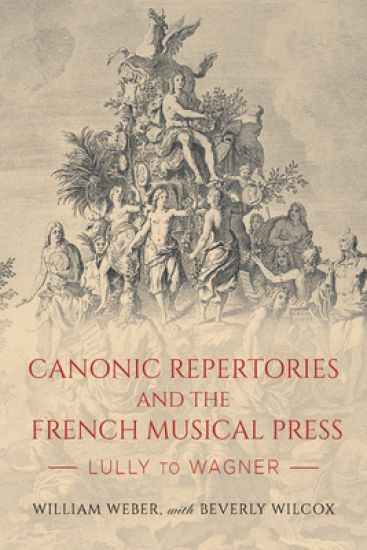
Canonic Repertories and the French Musical Press

Canonic Repertories and the French Musical Press

William Weber

University of Rochester Press
2021
sidottu
A bold application of the concept of "canonical" works to the development of French operatic and concert life in the eighteenth and nineteenth centuries. This long-awaited book by a leading historian of European music life offers a fresh reading of concert and operatic life by showing how certain musical works in eighteenth- and nineteenth-century France came to be considered "canonic": that is, admirable and worthy of being taken as models. In a series of interlinked essays, William Weber draws particular attention to the ways in which such reputations could shift in different eras and circumstances. The first chapter outlines how such a surge of reputation came about for Jean-Baptiste Lully after his death in 1687, followed a century later by one for the operas of Christoph-Willibald Gluck and Niccolò Piccinni. Next, Beverly Wilcox contributes a crucial chapter exploring how a canon of sacred works evolved at the Concert Spirituel between 1725 and 1790. Subsequent chapters detail the rise of an "incipient canon" for Joseph Haydn's music in the 1780s; a new operatic canon centered on works of Gioachino Rossini and Giacomo Meyerbeer; a century-long canonic repertory at the theater of the Opéra-Comique; and, between 1860 and 1914, frequent concert performances of excerpts from Wagner's operas, sometimes along with excerpts from Meyerbeer's. Throughout, Weber and Wilcox demonstrate how the French musical press reflected musical taste, and also shaped it, across two centuries.