Kirjahaku
Etsi kirjoja tekijän nimen, kirjan nimen tai ISBN:n perusteella.
20 kirjaa tekijältä Wilson Harris
Everyman Masters, sixty-five, begins a spiritual journey through the mysterious Caribbean carnival of masks.
Set like his first novel in The Guyana Quartet in the former colony of British Guiana, the second novel The Far Journey of Oudin is further proof of the intensity and originality of Wilson Harris's imaginative power and literary skill. Against a background of swamp, jungle and savannah a strange drama is played out in which the chief characters are the money-lender Ram - an evil, presiding genius - the illegitimate Beti whom all men desire, and Oudin the beggar who works for several masters and belongs to none. Focusing on the traumatising effects of slavery on West Indian society, the novel depicts how the new-found freedoms and perceived social progress experienced by former peasants mask the fact that the old master-slave structure is reasserting itself among the descendants of an exploited people.

Set in British Guyana, the final two books (first published in 1962 and 1963) of The Guyana Quartet continue Wilson Harris's literary exploration of the legacy and future of the former colony, which began with The Palace of the Peacock.The Whole Armour tells the story of Christo, accused of a murder he didn't commit, and on the run in the jungle swamplands of the Pomeroon River. When the man who is harbouring him dies, and when it becomes clear that his resourceful mother, Magda, doesn't believe he is innocent in either case, Christo stages his own death and steps into a dangerous otherworld, where hallucinatory premonitions keep pace with dreamlike reality. The Secret Ladder, the final book of the Guyana Quartet, follows the government surveyor Russell Fenwick, an unwilling and diffident captain of a strong-willed crew - all of them uneasy in one another's company - on a journey along the Canje River. When they encounter Poseidon, the oldest inhabitant of the area - descendent, so it is rumoured, of an escaped slave - his accusations of unfair dealings and the threat of rebellion that he carries with him upset the group further. As Fenwick, a scientist in a near-magical world, awaits the rain so that he can take his measurements, the clash between interlopers and rebels builds to a nightmarish climax.
Da Silva Da Silva's Cultivated Wilderness and Genesis of the Clowns
Wilson Harris
Faber Faber
2011
nidottu
The first of these two novels is about a painter, Brazilian by birth and British by adoption, living and working in London with his wife, whose equally varied spiritual and cultural inheritance complements his. Wilson Harris evokes with vividness and characteristic imaginative power the daily life and landscape of the city. The setting of Genesis of the Clowns returns to the jungle hinterland of its author's native Guyana. A government surveyor and his gang, for whose work and well-being he is responsible, are exploring and recording the course and currents of the remote upper reaches of the ancient rivers. Unexpected incidents and tensions in the formal and personal relationships between the surveyor and his men have mysterious consequences with effects and implications far beyond the immediate time and place.

'I was obsessed - let me confess - by cities and settlements in the Central and South Americas that are an enigma to many scholars. I dreamt of their abandonment, their bird-masks, their animal-masks ... Did their inhabitants rebel against the priests, did obscure holocausts occur, civil strife, famine, plague? Was Jonestown the latest manifestation...?' Jonestown (1996), one of Wilson Harris's most acclaimed creations, is a fictional re-imagining of the real-life ritual mass suicide orchestrated by Reverend Jim Jones in the remote Guyana forest in 1978. The novel's narrator, Francisco Bone, has survived the suicide albeit in a traumatized condition. By way of a dream-book he tries to heal his psychic wound, under the influence of the Mayan concept of time that twins past and future. Faber Finds is devoted to restoring to readers a wealth of lost or neglected classics and authors of distinction. The range embraces fiction, non-fiction, the arts and children's books. For a full list of available titles visit www.faberfinds.co.uk. To join the dialogue with fellow book-lovers please see our blog, www.faberfindsblog.co.uk.

Wilson Harris's tenth novel, first published in 1972, is set in Edinburgh but, like much of his subsequent work, bridges continents by its imaginative reach.''Doctor Black Marsden', tramp, shaman, and conjurer, is an ambivalent Merlin-figure representing both the hero's personal (and archetypal) shadow, and the creative, magus-like activity of the author himself.' Michael Gilkes, Journal of Commonwealth Literature'... my many visits to Scotland, and books I have read, have given me the sensation of a tone or inner vibrancy that may be due to the languages (English, Scottish, Gaelic) that are present in the subconscious imagination of sensitive Scots... [These] make for the cross-culturality (not mono-cultural) that came into play in Black Marsden.' Wilson Harris, 2008
In this 1967 novel Wilson Harris explores the spiritual and psychic realities beyond the mundane facts of relationships, boldly constructing his story on the basis of fragments.When the Forrestals died in an explosion that wrecked their home and destroyed most of its contents, there survived a disjointed diary - or 'log book', as Susan Forrestal called it. She had suffered from an affliction of the eyes which, after three operations, left her almost blind. Abandoned by her lover, who disappeared without a trace, she eventually married a kind and solicitous husband; nevertheless her lover continued to haunt her in such a way that his presence had an almost living reality.'I admire Wilson Harris's novels greatly; he is one of the very few living novelists whose works are too brief for my tastes.' Anthony Burgess
'He ascended, eyes riveted, nailed to the steps leading up to the top of the pyramid of the sun. How many human hearts he wondered had been plucked from bodies there to feed the dying light of the sun and create an obsession with royal sculptures, echoing stone?... It was time to take stock of others as hollow bodies and shelters into which one fell...'In Companions of the Day and Night (first published in 1975) Wilson Harris revives figures from his earlier Black Marsden - chiefly Clive Goodrich, the 'editor' of this text, who constructs a narrative from the papers of a figure known as Idiot Nameless: a wanderer between present and past, taking an Easter sojourn in Mexico that lasts both for days and for centuries. The results have the strangely hypnotic power characteristic of Wilson Harris's fiction.
The Tree of the Sun, first published in 1978, begins where Wilson Harris's previous novel Da Silva da Silva's Cultivated Wilderness ended, and thus forms a sequel.The London-dwelling Brazilian painter Da Silva is deeply moved by his wife's pregnancy after eight years of marriage. As he contemplates the child to be born he recalls a painting he began on the very morning he and his wife made love and conception occurred: a painting that contained a growing image. This becomes the evolving 'foetus' of imagination through which Da Silva begins to relate himself and his wife to the former (childless) tenants of their Kensington flat. 'I must admire the imagination and force of Wilson Harris' writing.' Kevin Cully, Tribune
'What [Wilson] Harris is doing is to extend the boundaries of our very conception of fiction.' Robert Nye. First published in 1982, The Angel at the Gate is offered to readers as Wilson Harris's analysis and interpretation of the 'automatic writing' of 'Mary Stella Holiday': an assumed name for the secretary and patient of the late Father Joseph Marsden. 'Mary suffered from a physical and nervous malaise as The Angel at the Gate makes clear. Through Marsden - the medical care he arranged for her and the sessions he provided in Angel Inn which gave scope to her 'automatic talents' - that illness became a catalyst of compassion through which she penetrated layers of social and psychical deprivation to create a remarkable fictional life for 'Stella' (apart from 'Mary') in order to unravel the thread that runs through a diversity of association in past and present 'fictional lives.''(From Harris's introductory 'Note.')

This volume, introduced by the author, brings together three novels first published separately. 'The trilogy comprises Carnival (1985), The Infinite Rehearsal (1987) and The Four Banks of the River of Space (1990), novels linked by metaphors borrowed from theatre, traditional carnival itself and literary mythology. The characters make Odyssean voyages through time and space, witnessing and re-enacting the calamitous history of mankind, sometimes assuming sacrificial roles in an attempt to save modern civilisation from self-destruction.' Independent on Sunday 'The Four Banks of the River of Space is a kind of quantum Odyssey... in which the association of ideas is not logical but... a 'magical imponderable dreaming'. The dreamer is Anselm, another of Harris's alter egos, like Everyman Masters in Carnival and Robin Redbreast Glass in The Infinite Rehearsal... Together, they represent one of the most remarkable fictional achievements in the modern canon.' Listener
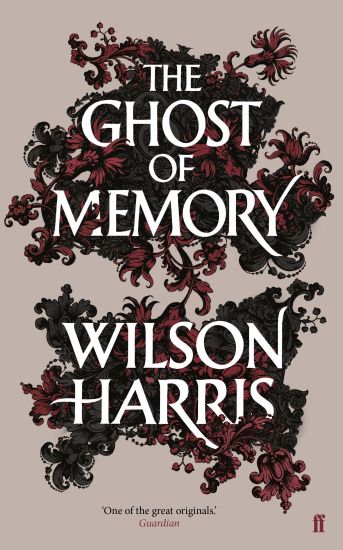
I had been shot. A bullet in my back. I fell. Where did I fall? I fell from a great height, it seemed, into a painting in a gallery in a great City. I found myself returning across centuries and generations to the end of my age. I had been caught by the Artist in what seemed the womb of unexpected being in which one becomes sensitive to the end one has reached and to a new beginning. It was an end, it was a new beginning one was called upon to probe and discover.We may dream, while still alive, of dying. But the dream is soon forgotten as are the edges and corners of a re-lived life of which we dream. It is buried in the unconscious. We know that life fades into death but, in what degree, does life re-live itself as it dreams of dying?The Ghost of Memory is a novel about life and death or rather - to put it somewhat differently - about the close, almost indefinable cross-culturalities between moments of life and death. This is played out through a man who is mistakenly shot as a terrorist - he sees himself
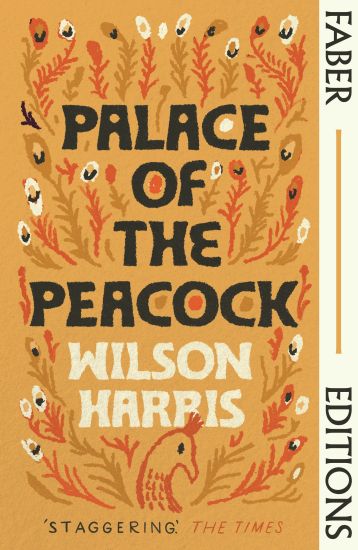
The visionary masterpiece, tracing a riverboat crew's dreamlike jungle voyage ...'My new all time favourite book ... A magnificent, breathtaking and terrifying novel.' Tsitsi Dangarembga'An exhilarating experience ... Makes visions real and reality visions ... Genius.' Jamaica Kincaid'A masterpiece: I love this book for its language, adventure and wisdoms.' Monique Roffey'Revel in the inviolate, ever-deepening mystery of Wilson Harris's work.' Jeet Thayil'The Guyanese William Blake . Such poetic intensity.' Angela CarterI dreamt I awoke with one dead seeing eye and one living closed eye ...A crew of men are embarking on a voyage up a turbulent river through the rainforests of Guyana. Their domineering leader, Donne, is the spirit of a conquistador, obsessed with hunting for a mysterious woman and exploiting indigenous people as plantation labour. But their expedition is plagued by tragedies, haunted by drowned ghosts: spectres of the crew themselves, inhabiting a blurred shadowland between life and death. As their journey into the interior - their own hearts of darkness - deepens, it assumes a spiritual dimension, guiding them towards a new destination: the Palace of the Peacock ... A modernist fever dream; prose poem; modern myth; elegy to victims of colonial conquest: Wilson Harris' masterpiece has defied definition for over sixty years, and is reissued for a new generation of readers.'One of the great originals ... Visionary ... Dazzlingly illuminating.' Guardian'Amazing ... Masterly ... Near-miraculous.' Observer'Staggering ... Both brilliant and terrifying.' The Times'The most inimitable [writer] produced in the English-speaking Caribbean.' Fred D'Aguiar'Extraordinary ... Courageous and visionary ... It speaks to us in tongues.' Pauline Melville
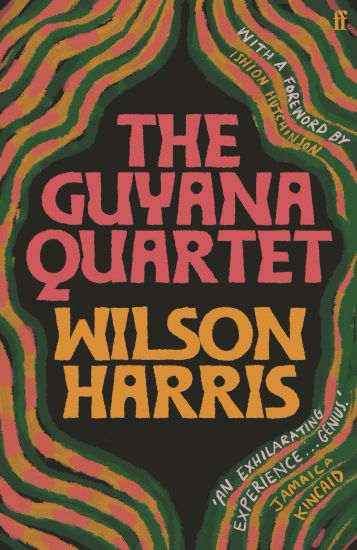
This epic masterpiece is a radical landmark in modern literature, reissued with a foreword by poet Ishion Hutchinson to mark Wilson Harris' centenary.'An exhilarating experience ... Genius.' Jamaica KincaidI dreamt I awoke with one dead seeing eye and one living closed eye ...Guyana. An ancient landscape of rainforests and swamplands, haunted by the legacy of slavery and colonial conquest. It is the site of dangerous journeys through the Amazonian interior, where riverboat crews embark on spiritual quests and government surveys are sabotaged by indigenous uprisings. It is a universe of complex moralities, where the conspiracies of a sinister money-lender and the faked death of a murderer question innocence and inheritance. It is a place where life and death, myth and history, philosophy and metaphysics blur. And it is the birthplace of an epic masterpiece. Wilson Harris' The Guyana Quartet consists of four incandescent novels: Palace of the Peacock, The Far Journey of Oudin, The Whole Armour and The Secret Ladder. It is a landmark of twentieth-century literature, as revolutionary today as it was over half a century ago.'The Guyanese William Blake . [Such] poetic intensity.' Angela Carter'One of the great originals ... Visionary ... Dazzlingly illuminating.' Guardian'Amazing ... Masterly ... Near-miraculous.' Observer'Perhaps the most inimitable [writer] produced in the English-speaking Caribbean.' Fred D'Aguiar'An extraordinary writer ... Courageous and visionary ... It speaks to us in tongues.' Pauline Melville'Staggering ... Both brilliant and terrifying.' The Times

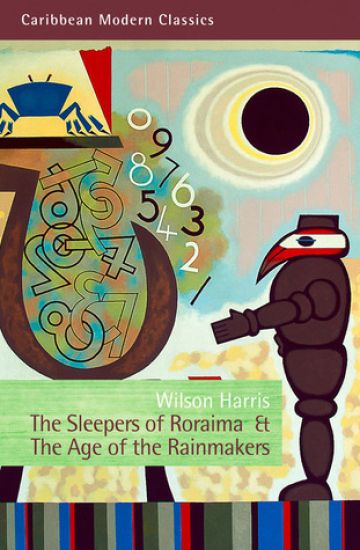
In 1970 and 1971, Wilson Harris published two short story collections that explored the myths, fables and fragments of history of the Amerindian peoples of Guyana and the Caribbean. These are brought together in the current volume. The Sleepers of Roraima, subtitled "A Carib Trilogy" focuses on the ironic fate of the Caribs, the feared conquerors of other Amerindian peoples, the cannibals of European legend, but in the present the most vanished, almost extinct of all these groups. In The Age of the Rainmakers, each of the stories focuses on one of the groups still present in Guyana: the Macusi, Arecuna, Wapisiana and Arawaks. In the absence of reliable history, and in the face of the stereotypes attached to these people (such as stoicism or a propensity for laughter), Harris makes no attempt to write conventional fictional reconstructions of an ethnographic kind, but subjects the fragments of tribal lore to imaginative revision. His stories work towards the discovery of what is "original" in the sense of primordial in these narratives, in discovering such common patterns as the loss of innocence, the connections between sacrifice and transcendence, or even the shared identities of cannibal and Eucharistic consumption.
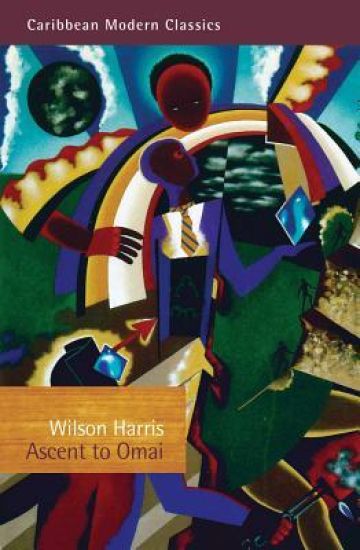
In Ascent to Omai time and space are truly elastic, so that events in recent time become part of remote geological time and the boundaries between events and remembering, individual persons and different locations are fluid and permeable. Victor is in search of his father, Adam, once a revolutionary worker who was sent to prison many years ago for burning down the factory he works in. Since then Victor has lost touch with him, but suspects he is living as a pork-knocker (gold prospector) in the remote Cuyuni-Mazaruni district of Guyana – now the site of one of the largest open-cast goldmines in the world and the site of immense environmental degradation. Prophetically, the clash between the material/technological and the primordial/spiritual is one of the intercutting themes of the novel, connecting to the El Doradean myth so central to the Guyanese imagining.As he climbs in search of his father, Victor both revisits his past relationship with him and replays his father’s trial, which also becomes his own, in a way that echoes the "Nighttown" episode of Ulysses, though unlike Bloom’s. Victor’s offences are not sexual, but represent blockages in the openness of his thinking. Victor’s search is for spiritual grace, for the compensations of love and the glimmerings of a true understanding of the world he exists in, though Harris refuses to “impose a false coherency upon material one had to digest” and the reader is invited to share in Victor’s struggling ascent to consciousness, knowing that it can never be other than provisional.