Kirjojen hintavertailu. Mukana 11 342 296 kirjaa ja 12 kauppaa.

Kirjahaku

Etsi kirjoja tekijän nimen, kirjan nimen tai ISBN:n perusteella.

3 kirjaa tekijältä Wyndham Thomas

Robert Saxton: Caritas

Robert Saxton: Caritas

Wyndham Thomas

Ashgate Publishing Limited
2012
sidottu
Caritas relates the 'true', yet largely undocumented story of Christine Carpenter, a 14th-century anchoress who moves towards insanity as her desire for a divine revelation continues to be unfulfilled after a period of three years locked in her cell. Although physically isolated, she is aware of the worldly life and love that she has abandoned. The very essence of the drama is the dogmatic refusal of her Bishop to release her from her vows. Set against the backcloth of the Peasants' Uprising (1381), the libretto/play juxtaposes sacred and secular worlds, the relative power and servitude of rulers and serfs, and the terrifying ordeal of Christine who is caught between the inflexibility of the established church and her personal religious expectations. Such a narrative was to offer rich opportunities for musical characterization and evocation of the historical context of the action, as well as substantial challenges in pacing and integrating the sequence of dramatic 'snap-shots' that culminate in a scene of total despair. The colourful juxtaposition of secular life and that of a recluse in Act One culminates in a Second Act finale of immense dramatic power in which Saxton's vocal and instrumental writing reaches new heights - a landmark both in his output and in late 20th century opera. Caritas - first performed in 1991 - occupies an important position in Robert Saxton's output and, as Thomas argues, in British opera during the closing decades of the 20th century. Thomas provides a detailed contextual setting in which to evaluate Caritas, as well as presenting an analytical commentary on the structure, musical language, instrumentation, staging and production of the opera. Thomas concludes with a reflection on the reception of Caritas as well as looking forward to Saxton's later and future works. A downloadable resource of the first performance is included.
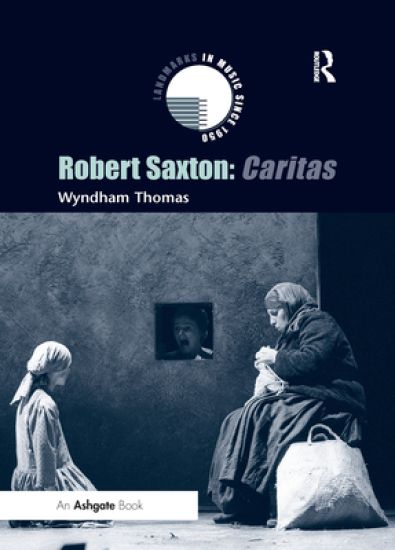
Robert Saxton: Caritas

Robert Saxton: Caritas

Wyndham Thomas

Routledge
2017
nidottu
Caritas relates the 'true', yet largely undocumented story of Christine Carpenter, a 14th-century anchoress who moves towards insanity as her desire for a divine revelation continues to be unfulfilled after a period of three years locked in her cell. Although physically isolated, she is aware of the worldly life and love that she has abandoned. The very essence of the drama is the dogmatic refusal of her Bishop to release her from her vows. Set against the backcloth of the Peasants' Uprising (1381), the libretto/play juxtaposes sacred and secular worlds, the relative power and servitude of rulers and serfs, and the terrifying ordeal of Christine who is caught between the inflexibility of the established church and her personal religious expectations. Such a narrative was to offer rich opportunities for musical characterization and evocation of the historical context of the action, as well as substantial challenges in pacing and integrating the sequence of dramatic 'snap-shots' that culminate in a scene of total despair. The colourful juxtaposition of secular life and that of a recluse in Act One culminates in a Second Act finale of immense dramatic power in which Saxton's vocal and instrumental writing reaches new heights - a landmark both in his output and in late 20th century opera. Caritas - first performed in 1991 - occupies an important position in Robert Saxton's output and, as Thomas argues, in British opera during the closing decades of the 20th century. Thomas provides a detailed contextual setting in which to evaluate Caritas, as well as presenting an analytical commentary on the structure, musical language, instrumentation, staging and production of the opera. Thomas concludes with a reflection on the reception of Caritas as well as looking forward to Saxton's later and future works. A downloadable resource of the first performance is included.
Medieval Music-Drama

Medieval Music-Drama

Wyndham Thomas

Routledge
2026
sidottu
2018 will mark the 800th anniversary of the consecration of the Abbey of St Benoît-sur-Loire - or Fleury Abbey - the previous home and namesake of the Fleury Playbook, a collection of 10 medieval music-dramas that has long held been a source of fascination, and not a little perplexity, for scholars in a variety of disciplines: history, music history, literary studies, art history in particular. The Fleury Playbook has been justly celebrated as the most comprehensive extant collection of medieval music-dramas, containing in a single manuscript examples of non-biblical miracle plays, and settings of the Nativity and Resurrection stories, together with accounts of the conversion of Paul and Mary Magdalene. In this the first full-length monograph on the Playbook, Wyndham Thomas places the collection in its historical, cultural and musical context. The first three chapters introduce and then explore the issues raised by the collection: following an introduction, chapter 2 is devoted to the history and traditions of the Abbey, making a persuasive argument for that institution as the original home of the collection, and perhaps the venue in which the plays were first performed. Chapter 3 discusses medieval saints’ cults, placing the dramas, and particularly the four devoted to St Nicholas, in this context. The remaining chapters are devoted to a close musical and dramatic analysis of the 10 plays themselves.