Kirjojen hintavertailu. Mukana 12 494 751 kirjaa ja 12 kauppaa.

Kirjahaku

Etsi kirjoja tekijän nimen, kirjan nimen tai ISBN:n perusteella.

4 kirjaa tekijältä Yelena Baraz

Cicero

Cicero

Yelena Baraz

Oxford University Press
2025
nidottu
Very Short Introductions: Brilliant, Sharp, Inspiring Marcus Tullius Cicero (106-43 BCE) was one of the most influential figures in late republican Rome, a moment of great social, political, and cultural unrest that would lead to the transition from republic to empire. Cicero was a statesman who held the highest political office, the consulship, and then suffered politically motivated exile. His career was grounded in his continued success as an orator: his speeches were famous during his lifetime and, together with his rhetorical treatises, shaped the practice and theory of public speaking for centuries to come. His ideas influenced early church fathers, Renaissance humanists, and Enlightenment thinkers and his dramatic death captured imagination of his contemporaries, who saw it as standing for the death of the republic and eloquence. In this Very Short Introduction, Yelena Baraz presents a concise and integrated account of Cicero's life and accomplishments, locating him within the political and intellectual contexts of his time. It shows that in all his pursuits Cicero saw himself as a mediating figure: between theory and practice, philosophy and politics, Greek and Roman, and among political interest groups. Baraz tackles each area of Cicero's activity on its own terms while showing how overarching ideas and priorities permeate the apparently separate endeavours. ABOUT THE SERIES: The Very Short Introductions series from Oxford University Press contains hundreds of titles in almost every subject area. These pocket-sized books are the perfect way to get ahead in a new subject quickly. Our expert authors combine facts, analysis, perspective, new ideas, and enthusiasm to make interesting and challenging topics highly readable.
Reading Roman Pride

Reading Roman Pride

Yelena Baraz

Oxford University Press Inc
2020
sidottu
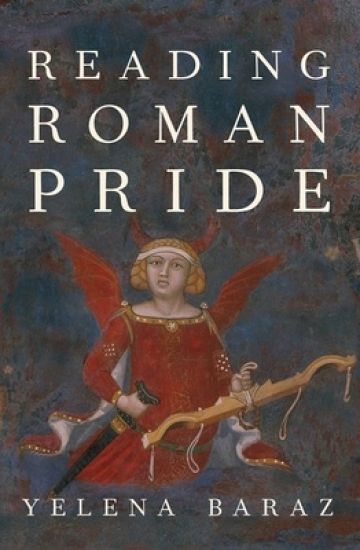
Pride is pervasive in Roman texts, as an emotion and a political and social concept implicated in ideas of power. This study examines Roman discourse of pride from two distinct complementary perspectives. The first is based on scripts, mini-stories told to illustrate what pride is, how it arises and develops, and where it fits within the Roman emotional landscape. The second is semantic, and draws attention to differences between terms within the pride field. The peculiar feature of Roman pride that emerges is that it appears exclusively as a negative emotion, attributed externally and condemned, up to the Augustan period. This previously unnoticed lack of expression of positive pride in republican discourse is a result of the way the Roman republican elite articulates its values as anti-monarchical and is committed, within the governing class, to power-sharing and a kind of equality. The book explores this uniquely Roman articulation of pride attributed to people, places, and institutions and traces the partial rehabilitation of pride that begins in the texts of the Augustan poets at the time of great political change. Reading for pride produces innovative readings of texts that range from Plautus to Ausonius, with major focus on Cicero, Livy, Vergil, and other Augustan poets.
A Written Republic

A Written Republic

Yelena Baraz

Princeton University Press
2012
sidottu
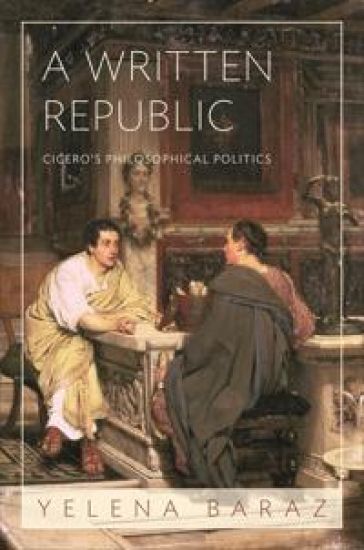
In the 40s BCE, during his forced retirement from politics under Caesar's dictatorship, Cicero turned to philosophy, producing a massive and important body of work. As he was acutely aware, this was an unusual undertaking for a Roman statesman because Romans were often hostile to philosophy, perceiving it as foreign and incompatible with fulfilling one's duty as a citizen. How, then, are we to understand Cicero's decision to pursue philosophy in the context of the political, intellectual, and cultural life of the late Roman republic? In A Written Republic, Yelena Baraz takes up this question and makes the case that philosophy for Cicero was not a retreat from politics but a continuation of politics by other means, an alternative way of living a political life and serving the state under newly restricted conditions. Baraz examines the rhetorical battle that Cicero stages in his philosophical prefaces--a battle between the forces that would oppose or support his project. He presents his philosophy as intimately connected to the new political circumstances and his exclusion from politics. His goal--to benefit the state by providing new moral resources for the Roman elite--was traditional, even if his method of translating Greek philosophical knowledge into Latin and combining Greek sources with Roman heritage was unorthodox. A Written Republic provides a new perspective on Cicero's conception of his philosophical project while also adding to the broader picture of late-Roman political, intellectual, and cultural life.
A Written Republic

A Written Republic

Yelena Baraz

PRINCETON UNIVERSITY PRESS
2024
pokkari
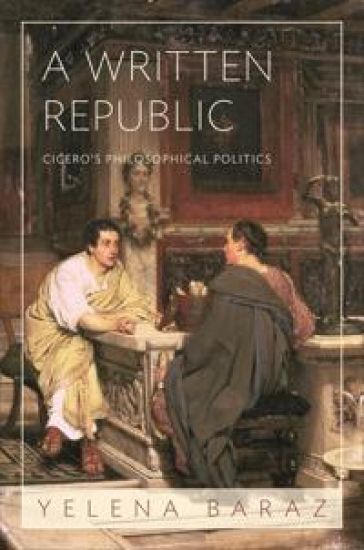
Why philosophy was politics by other means for Rome's greatest statesmanIn the 40s BCE, during his forced retirement from politics under Caesar's dictatorship, Cicero turned to philosophy, producing a massive and important body of work. As he was acutely aware, this was an unusual undertaking for a Roman statesman because Romans were often hostile to philosophy, perceiving it as foreign and incompatible with fulfilling one's duty as a citizen. How, then, are we to understand Cicero's decision to pursue philosophy in the context of the political, intellectual, and cultural life of the late Roman republic? In A Written Republic, Yelena Baraz takes up this question and makes the case that philosophy for Cicero was not a retreat from politics but a continuation of politics by other means, an alternative way of living a political life and serving the state under newly restricted conditions.Baraz examines the rhetorical battle that Cicero stages in his philosophical prefaces—a battle between the forces that would oppose or support his project. He presents his philosophy as intimately connected to the new political circumstances and his exclusion from politics. His goal—to benefit the state by providing new moral resources for the Roman elite—was traditional, even if his method of translating Greek philosophical knowledge into Latin and combining Greek sources with Roman heritage was unorthodox.A Written Republic provides a new perspective on Cicero's conception of his philosophical project while also adding to the broader picture of late-Roman political, intellectual, and cultural life.