Kirjojen hintavertailu. Mukana 12 111 374 kirjaa ja 12 kauppaa.

Kirjahaku

Etsi kirjoja tekijän nimen, kirjan nimen tai ISBN:n perusteella.

7 kirjaa tekijältä Yoram Solomon

Can I Trust You?

Can I Trust You?

Yoram Solomon

Independently Published
2019
pokkari
When 14-time author and top-20 global organizational culture thought leader Dr. Yoram Solomon conducted a study asking, "what is the most important quality for you in other people?" Five out of six types of participants answered: Trustworthiness (66% of the time). Only one type didn't: Leaders. Apparently, the quality most important to leaders in their employees is their willingness to work hard. This is the new leadership failure. Leaders are not willing to trust their employees. Leaders are 67% less likely to want their employees to take risks than their employees want to see them accept risk. As a result, employees don't trust leaders. Being a trustworthy leader makes your entire organization 64% more productive, effective, and innovative. Do you care about any of those?In this short book in the series Can I TRUST You? Dr. Solomon explains how trust gets built between a leader and his/her employees and offers 70+1 habits that will make you a more trusted leader.
Can I TRUST You?

Can I TRUST You?

Yoram Solomon

Independently Published
2019
pokkari
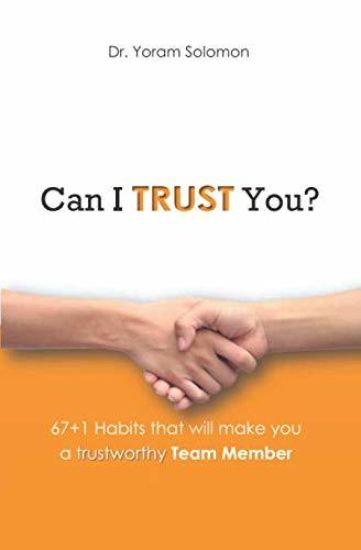
In his research, 14-time author and top-20 global organizational culture thought leader Dr. Yoram Solomon found that the ability to hold a constructive disagreement within a team was a key component of a company's creativity and productivity culture.That ability depends on three things: the willingness of each member of the team to be vulnerable, to provide direct feedback, and to be receptive to feedback. The existence of any of those three heavily depends on the team trust level. When trust is high, the willingness to be vulnerable is 240% higher, the willingness to provide direct feedback is 106% higher, and receptivity to feedback is 76% higher. He also found that team members value their peers' trustworthiness the most, more than the next four qualities combined. In this third book in the series Can I TRUST You? Dr. Solomon explains how trust gets built between team members and offers 67+1 habits that will make you a more trusted member.
Business plan through investors' eyes WORKBOOK

Business plan through investors' eyes WORKBOOK

Yoram Solomon

Createspace Independent Publishing Platform
2017
nidottu
Business plan through investors' eyes WORKBOOK accompanies the udemy class by the same name, or the workshop given by Dr. Yoram Solomon. Find one near you. Yoram is the founder of several startup companies, who wrote many business plans that raised tens of millions of dollars in investments, and got projects funded in large companies. He sold and bought companies. He wrote books about it, and taught this in universities. But more important, Dr. Solomon is an investor, and was part of several angel investor networks from Silicon Valley to Texas and Israel, where he made personal investments in startups. He also evaluated business plans for the State of Texas and the State of Israel, and made project funding decisions in large and public companies. As such, he only has a few minutes to snap-judge a business plan that comes across his desk. He will share with you what makes him (and other investors) decide whether to invest in a new business or not. In the course, you will learn the four rules of a successful business plan: - Create something fundamentally different; - Find the unique value to a specific market segment; - Establish and maintain competitive advantage; and- - Calculate the return on investment for your customer, your company, and your investor. You will learn how to assess your business, create the business plan, and present it to investors. At the end of this course, you will have an inside track on how investors and budget managers think, what are they looking for in a business plan, and what will make them invest in you You will learn what Yoram knows now, but wish he knew when he started. Are you ready to learn this? Enroll in the udemy class, or find a workshop near you. (Remember that this is only the WORKBOOK that includes all the worksheets that accompany the course).
Can I Trust You?

Can I Trust You?

Yoram Solomon

Independently Published
2019
pokkari
Do you feel that the traditional sales "tricks" are simply not working anymore? Well, you are right to feel that. Your customers have become desensitized to those. They know all the tricks, and they don't buy them anymore. After more than a decade of research and based on his work in The Book of Trust, 14-time author, and top 20 Global Thought Leader on Culture Dr. Yoram Solomon found that customers are more influenced by one thing, and it's something you may have been ignoring all those years of trying to persuade your customer to make a purchase decision: your trustworthiness. He found that trustworthy salespeople can sell the same product or service for a 29.6% higher price, and that untrustworthy salespeople must discount their offerings by 22.8% before they can be considered. In this short book, Dr. Solomon explains how trust gets built between a salesperson and a customer and suggests 50+1 habits that will make you a more trusted salesperson.
Cause of Death: Political Correctness [IN COLOR]: How and why P.C. kills creativity, productivity, and children, and what the future might be
Seven-time author Yoram Solomon, a corporate culture and creativity expert, and three-time author Lori Vann, a teen self-injury and suicide expert, team up to address one of the biggest problems of our times: Political Correctness. In the first part of the book they address the psychological effects of political correctness and the devastating consequences of it to corporate creativity, productivity, political polarization, and the increase in teen self-injury and suicide. In the second part they describe the surprising causes of political correctness, tracking it down to a life-altering event that happened almost 50 years ago, and to a new kind of investment, for the first time named in this book: litigation-based securities. Finally, in the third part, "2034," the authors offer two fictional, albeit plausible alternate futures: one that might take place if America continues on the current path of political correctness, and the other if it breaks out of this vicious cycle. This timely book is based on vast amounts of data collected and research conducted over several decades, and includes many stories ripped from the headlines, and had already led to a TED talk. The book is non-political, and anything but politically correct.