Kirjojen hintavertailu. Mukana 12 016 292 kirjaa ja 12 kauppaa.

Kirjahaku

Etsi kirjoja tekijän nimen, kirjan nimen tai ISBN:n perusteella.

5 kirjaa tekijältä Yuri Pines

Zhou History Unearthed

Zhou History Unearthed

Yuri Pines

Columbia University Press
2020
sidottu
There is a stark contrast between the overarching importance of history writing in imperial China and the meagerness of historical texts from the centuries preceding the imperial unification of 221 BCE. However, recently discovered bamboo manuscripts from the Warring States period (453–221 BCE) have changed this picture, leading to reappraisals of early Chinese historiography. These manuscripts shed new light on questions related to the production, circulation, and audience of historical texts in early China; their different political, ritual, and ideological usages; and their roles in the cultural and intellectual dynamics of China’s vibrant pre-imperial age.Zhou History Unearthed offers both a novel understanding of early Chinese historiography and a fully annotated translation of Xinian (String of Years), the most notable historical manuscript from the state of Chu. Yuri Pines elucidates the importance of Xinian and other recently discovered texts for our understanding of history writing in Zhou China (1046–255 BCE), as well as major historical events and topics such as Chu’s cultural identity. Pines explores how Xinian challenges existing interpretations of the nature and reliability of canonical historical texts on the Zhou era, such as Zuo zhuan (Zuo Tradition/Commentary) and Records of the Historian (Shiji). A major work of scholarship and translation, Zhou History Unearthed sheds new light on early Chinese history and historiography, demonstrating how new archaeological findings are changing our knowledge of China’s pre-imperial days.
Zhou History Unearthed

Zhou History Unearthed

Yuri Pines

Columbia University Press
2020
pokkari
There is a stark contrast between the overarching importance of history writing in imperial China and the meagerness of historical texts from the centuries preceding the imperial unification of 221 BCE. However, recently discovered bamboo manuscripts from the Warring States period (453–221 BCE) have changed this picture, leading to reappraisals of early Chinese historiography. These manuscripts shed new light on questions related to the production, circulation, and audience of historical texts in early China; their different political, ritual, and ideological usages; and their roles in the cultural and intellectual dynamics of China’s vibrant pre-imperial age.Zhou History Unearthed offers both a novel understanding of early Chinese historiography and a fully annotated translation of Xinian (String of Years), the most notable historical manuscript from the state of Chu. Yuri Pines elucidates the importance of Xinian and other recently discovered texts for our understanding of history writing in Zhou China (1046–255 BCE), as well as major historical events and topics such as Chu’s cultural identity. Pines explores how Xinian challenges existing interpretations of the nature and reliability of canonical historical texts on the Zhou era, such as Zuo zhuan (Zuo Tradition/Commentary) and Records of the Historian (Shiji). A major work of scholarship and translation, Zhou History Unearthed sheds new light on early Chinese history and historiography, demonstrating how new archaeological findings are changing our knowledge of China’s pre-imperial days.
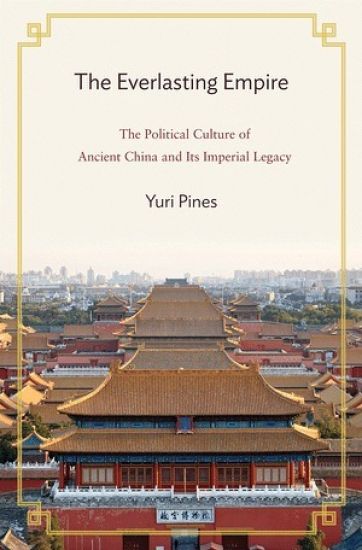
The Everlasting Empire

The Everlasting Empire

Yuri Pines

Princeton University Press
2012
sidottu
Established in 221 BCE, the Chinese empire lasted for 2,132 years before being replaced by the Republic of China in 1912. During its two millennia, the empire endured internal wars, foreign incursions, alien occupations, and devastating rebellions--yet fundamental institutional, sociopolitical, and cultural features of the empire remained intact. The Everlasting Empire traces the roots of the Chinese empire's exceptional longevity and unparalleled political durability, and shows how lessons from the imperial past are relevant for China today. Yuri Pines demonstrates that the empire survived and adjusted to a variety of domestic and external challenges through a peculiar combination of rigid ideological premises and their flexible implementation. The empire's major political actors and neighbors shared its fundamental ideological principles, such as unity under a single monarch--hence, even the empire's strongest domestic and foreign foes adopted the system of imperial rule. Yet details of this rule were constantly negotiated and adjusted. Pines shows how deep tensions between political actors including the emperor, the literati, local elites, and rebellious commoners actually enabled the empire's basic institutional framework to remain critically vital and adaptable to ever-changing sociopolitical circumstances. As contemporary China moves toward a new period of prosperity and power in the twenty-first century, Pines argues that the legacy of the empire may become an increasingly important force in shaping the nation's future trajectory.
China's Aristocratic Age

China's Aristocratic Age

Yuri Pines

PRINCETON UNIVERSITY PRESS
2026
sidottu
A new perspective on the Springs-and-Autumns period, China’s longest experiment with polycentrism The Springs-and-Autumns period (770–453 BCE)—the longest aristocratic age in Chinese history—marks a break from what is often associated with the normative orientations of Chinese political life. During this era, political fragmentation was regarded as acceptable, many states transitioned to oligarchic forms of rule, political participation by lower strata was allowed, pedigree mattered more than ability in determining an individual’s career, and the concept of the Mandate of Heaven had little to do with the notion of universal rule. Indeed, in many respects, the politics of this period inverted traditional Chinese political values. In China’s Aristocratic Age, Yuri Pines offers a new history of the Springs-and-Autumns period, arguing that it should be considered on its own terms rather than simply as a precursor for the centralized and bureaucratized Warring States era that followed. Pines draws on textual, archaeological, and paleographic sources, many of them newly discovered, to examine the political dynamics of the era, which he terms China’s longest experiment with a polycentric world and society. Efforts during this period to establish a viable multistate order, overcome the weaknesses of monarchial rule, and moderate coercive methods of governance have been largely regarded as unsuccessful. Pines explores the consequences of these perceived failures and analyzes the ways negative views of China’s polycentrism contributed to its later quest for political unity and centralization. Pines’s account sheds new light on the Springs-and-Autumns period both within its own contemporaneous context and within the long durée of Chinese history.
L'Invention de la Chine Eternelle

L'Invention de la Chine Eternelle

Yuri Pines

Les Belles Lettres
2013
nidottu
Cet ouvrage est une etude de la pensee politique de la periode precedant la fondation de l'empire chinois en 221 av. J.-C., l'epoque dite des Royaumes combattants (453-221 av. J.-C.), L'auteur a pour objectif de determiner les principales racines ideologiques de l'empire et les cadres intellectuels qui ont contribue a la formation et a la stabilite d'un systeme imperial s'etant maintenu pendant plus de deux mille ans en Chine. Loin de faire un simple inventaire des idees politiques, l'auteur depasse les clivages entre ecoles, se degage des filiations philosophiques et choisit le plus souvent de mettre en lumiere le fond commun aux penseurs, en articulant son etude autour de trois grands themes: 1. la vision du pouvoir et du monarque; 2. les activites et la place des intellectuels face a ce pouvoir; et 3. les discours de ces derniers sur le peuple. L'approche est celle d'un historien: Yuri Pines analyse des textes aussi bien transmis par la tradition que decouverts recemment en contexte archeologique, en les replacant autant que possible dans le contexte politique, social et economique qui les a vus naitre. Yuri Pines est professeur en etudes chinoises a l'universite hebraique de Jerusalem. Ses recherches portent sur l'histoire et la pensee politique de la Chine antique. Il est l'auteur de Foundations of Confucian Thought: Intellectuel Life in the Chunqiu Period, 722-453 B.C.E., (2002) et de The Everlasting Empire: The Political Culture of Ancient China and Its Imperial Legacy (2012).