Kirjojen hintavertailu. Mukana 12 595 353 kirjaa ja 12 kauppaa.

Kirjahaku

Etsi kirjoja tekijän nimen, kirjan nimen tai ISBN:n perusteella.

27 kirjaa tekijältä Yves Bonnefoy

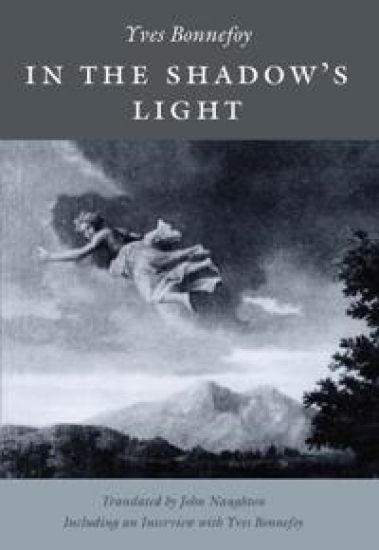
In the Shadow's Light

In the Shadow's Light

Yves Bonnefoy

University of Chicago Press
1991
nidottu
This bilingual edition of the contemporary master's fifth work, Ce qui fut sans lumi, re, will delight, engage, and stir all lovers of poetry. Included here is an extensive new interview with the poet in English translation. "Included here is a very helpful and touchingly personal interview with the poet. . . . For readers with no prior knowledge of Bonnefoy's work, this volume would be an excellent place to start."—Stephen Romer, Times Literary Supplement
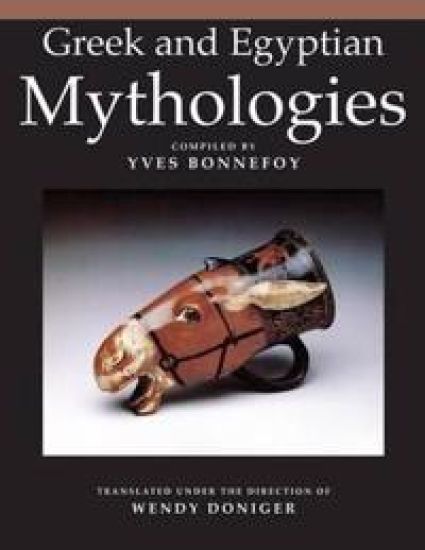
Greek and Egyptian Mythologies

Greek and Egyptian Mythologies

Yves Bonnefoy

University of Chicago Press
1992
nidottu
The seventy-two entries in this volume explore, among other topics, the history, geography, and religion of Greece, Plato's mythology and philosophy, the powers of marriage in Greece, heroes and gods of war in the Greek epic, and origins of mankind in Greek myths. Ancient Egyptian cosmology, anthropology, rituals, and religion--closely linked to Greek mythology--are also discussed. "In a world that remains governed by powerful myths, we must deepen our understanding of ourselves and others by considering more carefully the ways in which the mythological systems to which we cling and social institutions and movements to which we are committed nourish each other. Yves Bonnefoy's Mythologies not only summarizes the progress that has already been made toward this end, but also lays the foundation for the difficult work that lies ahead."--Mark C. Taylor, New York Times Book Review "The almost 100 contributors combine, with characteristic precision and ilan, the arts of science and poetry, of analysis and translation. The result is a treasury of information, brilliant guesswork, witty asides, and revealing digressions. This is a work of genuine and enduring excitement." --Thomas D'Evelyn, Christian cience Monitor
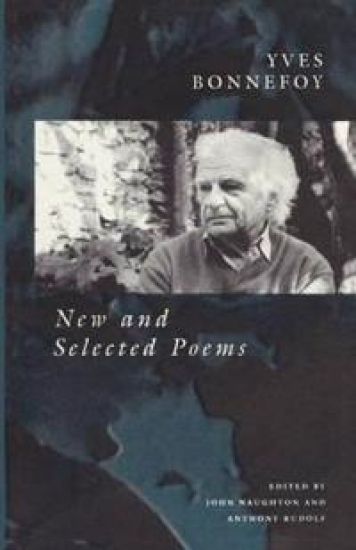
New and Selected Poems

New and Selected Poems

Yves Bonnefoy

University of Chicago Press
1995
nidottu
This selection spans four decades and draws on all of Bonnefoy's major collections. The translations, many of them new, are presented alongside the original French. Naughton's introduction looks at the evolution of Bonnefoy's poetry from 1953 to 1993.
The Curved Planks

The Curved Planks

Yves Bonnefoy

Farrar, Straus and Giroux
2007
nidottu
For decades readers and critics have acclaimed Yves Bonnefoy as France's greatest living poet. His most recent book of verse, The Curved Planks, crowns an oeuvre that has won him the highest international honors. More than any other single work, this sequence embodies the astonishing variety of Bonnefoy's art. A rich fabric of themes, styles, and genres, it balances aesthetic complexity with heartfelt directness. This bilingual edition of The Curved Planks sets the French texts alongside English versions by the noted translator Hoyt Rogers, who has collaborated closely with Bonnefoy in crafting poems that re-create the freshness and vision of the originals. This volume also includes a preface by the renowned poet and critic Richard Howard and essays by the translator that situate The Curved Planks in the author's body of work. All assist in introducing the English-language reader to Bonnefoy's profound poetic gift.
The Arrière-Pays

The Arrière-Pays

Yves Bonnefoy

Seagull Books London Ltd
2012
sidottu
Since the publication of his first book in 1953, Yves Bonnefoy has become one of the most important French poets of the postwar years. At last, we have the long-awaited English translation of his celebrated work "L'Arriere-Pays", which takes us to the heart of his creative process and to the very core of his poetic spirit. In his poem "The Convex Mirror," Bonnefoy writes: "Look at them down there, at that crossroads, / They seem to hesitate, then go on." The idea of the crossroads haunts Bonnefoy's work, as he is troubled by the idea that the path not taken may lead to the arriere-pays, a place of greater plenitude, and of more authentic being - an "elsewhere in the absolute." Seized by this fear that what he terms "presence" exists always somewhere else, a little further on, Bonnefoy here sets out on a labyrinthine quest to find traces of this "original place," which he locates not only in objects of knowledge and experience as diverse as the deserts of Asia, a hill fort in India, a church in Armenia, and the paintings of Piero della Francesca but also, crucially, in the undivided intensity of his experiences as a child. Written with a visionary grace, "The Arriere-Pays" is a spiritual testament to art, philosophy, and poetry. Enriched by a new preface by the poet, this volume also includes three recent essays in which he returns to his original account of an ethical and aesthetic haunting, one that recounts the struggle between our instinct to idealize - what he deems our eternal Platonism - and the equally strong need to combat this and to be reconciled with our nature as finite beings, made of flesh and blood, in the world of the here and now.
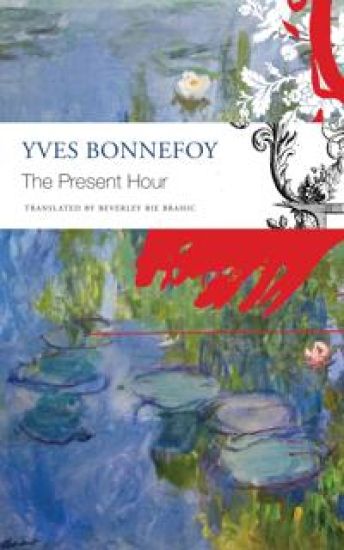
The Present Hour

The Present Hour

Yves Bonnefoy

Seagull Books London Ltd
2013
sidottu
From the publication of his first book in 1953, Yves Bonnefoy has been considered the most important and influential French poet since World War II. A prolific writer, critic, and translator, Bonnefoy continues to compose groundbreaking new work sixty years later, constantly offering his readers what Paul Auster has called "the highest level of artistic excellence." In The Present Hour, Bonnefoy's latest collection, a personal narrative surfaces in splinters and shards. Every word from Bonnefoy is multifaceted, like the fragmented figures seen from different angles in cubist painting-as befits a poet who has written extensively about artists such as Goya, Picasso, Braque, and Gris. Throughout this moving collection, Bonnefoy's poems echo each other, returning to and elaborating upon key images, thoughts, feelings, and people. Intriguing and enigmatic, this mixture of sonnet sequences and prose poems - or, as Bonnefoy sees them, "dream texts" - moves from his meditations on friendship and friends like Jorge Luis Borges to a long, discursive work in free verse that is a reflection on his thought and process. These poems are the ultimate condensation of Bonnefoy's life in writing, and they will be a valuable addition to the canon of his writings available in English.
The Digamma

The Digamma

Yves Bonnefoy

Seagull Books London Ltd
2014
sidottu
Heralded as one of France's greatest poets, Yves Bonnefoy has been dazzling readers since the publication of his first book in 1953. He remains influential and relevant, continuing to compose groundbreaking new work. Though Bonnefoy recently celebrated his ninetieth birthday, many are calling these past two decades his most impressive yet. His latest book of poetry and prose, The Digamma, fits wonderfully into his impressive oeuvre, offering his signature style of simplistic but powerful language with fresh new grace. A key passage of the title piece of the book depicts the figures of Nicolas Poussin's The Shepherds of Arcadia, which Bonnefoy has identified as crucial to the artist's evolution. The sustained reference to Poussin's iconography serves to ground the text in the lost civilizations of antiquity. Subtly, it brings out the underlying theme of the entire collection-in the ambivalent world we inhabit, being and nonbeing is fundamentally one. As a leading translator of Shakespeare in France, Bonnefoy's fascination with the master playwright is displayed in "God in Hamlet" and "For a Staging of Othello," two poems in prose which belong to an ongoing series of meditations on the plays. The collection also includes haunting reflections on children, nature, the origins of art, and vanished cultures.
Rue Traversière

Rue Traversière

Yves Bonnefoy

Seagull Books London Ltd
2015
sidottu
Praised by Paul Auster as "one of the rare poets in the history of literature to have sustained the highest level of artistic excellence throughout an entire lifetime," Yves Bonnefoy is widely considered the foremost French poet of his generation. Proving that his prose is just as lyrical, Rue Traversiere, written in 1977, is one of his most harmonious works. Each of the fifteen discrete or linked texts, whose lengths range from brief notations to long, intense, self-questioning pages, is a work of art in its own right: brief and richly suggestive as haiku, or long and intricately wrought in syntax and thought; and all are as rewarding in their sounds and rhythms, and their lightning flashes of insight, as any sonnet. "I can write all I like; I am also the person who looks at the map of the city of his childhood, and doesn't understand," says the section that gives the book its title, as he revisits childhood cityscapes and explores the tricks memory plays on us. A mixture of genres - the prose poem, the personal essay, quasi-philosophical reflections on time, memory, and art - this is a book of both epigrammatic concision and dreamlike narratives that meander with the poet's thought as he struggles to understand and express some of the undercurrents of human life. The book's layered texts echo and elaborate on one another, as well as on aspects of Bonnefoy's own poetics and thought.
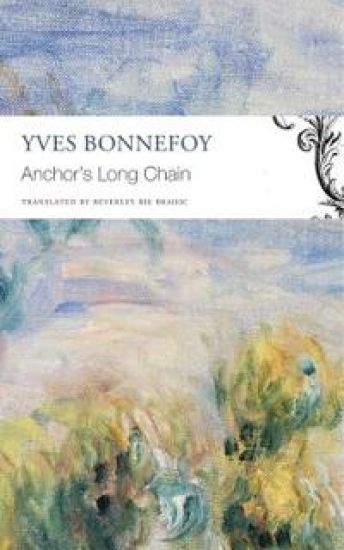
The Anchor's Long Chain

The Anchor's Long Chain

Yves Bonnefoy

Seagull Books London Ltd
2015
sidottu
Widely considered the foremost French poet of his generation, Yves Bonnefoy has wowed the literary world for decades with his diffuse volumes. First published in France in 2008, The Anchor's Long Chain is an indispensable addition to his oeuvre. Enriching Bonnefoy's earlier work, the volume, translated by Beverley Bie Brahic, also innovates, including an unprecedented sequence of nineteen sonnets. These sonnets combine the strictness of the form with the freedom to vary line length and create evocative fragments. Compressed, emotionally powerful, and allusive, the poems are also autobiographical-but only in glimpses. Throughout, Bonnefoy conjures up life's eternal questions with each new poem. Longer, discursive pieces, including the title poem's meditation on a prehistoric stone circle and a legend about a ship, are also part of this volume, as are a number of poetic prose pieces in which Bonnefoy, like several of his great French predecessors, excels. Long-time fans will find much to praise here, while newer readers will quickly find themselves under the spell of Bonnefoy's powerful, discursive poetry. Praise for Bonnefoy "Few exceptions of contemporary French letters deserve the attention of the reading public in America more than Bonnefoy...His writings are an important lighthouse on the contemporary cultural coastline."-Hudson Review "Bonnefoy's poems, prose, texts, and penetrating essays have never ceased to stimulate both the writing of French poetry and the discussion of what its deepest purpose should be...He is one of the rare contemporary authors for whom writing does not-or should not-conclude in utter despair, but rather in the tendering of hope."- France Magazine
Ursa Major

Ursa Major

Yves Bonnefoy

Seagull Books London Ltd
2017
sidottu
Yves Bonnefoy is one of the greatest living voices of contemporary French poetry. In this, his sixth book published by Seagull Books, he explores in profound new ways the mysteries of human consciousness. Readers find snatches of conversations overheard, dropped without any possible conclusion each pregnant with half-hidden, half-visible meaning. Limpid, punctuated with silences, the poems of Ursa Major are like stones picked up, turned over and set back down on the edge of life."Countless voices traverse us; endless, almost, as the meanders of dreams or the starry scintillations of summer nights. Only listen, and a few words rise from the murmur, referring to precise things, making allusions one would like to understand, offering opinions perhaps worth mulling over." With these words Bonnefoy introduces the collection, newly available in English by the master translator Beverly Bie Brahic. This deeply moving sequence of prose poems invites readers to attend to the multitudinous voices that carry on their conversations within us, to trust them "just as on summer nights we would lie down in the grass of the meadow, behind our houses, to go forth among the millions of stars with a feeling of falling."
Together Still

Together Still

Yves Bonnefoy

Seagull Books London Ltd
2017
sidottu
The international community of letters mourns the recent death of Yves Bonnefoy, universally acclaimed as one of France's greatest poets of the last half-century. A prolific author, he was often considered a candidate for the Nobel Prize and published a dozen major collections of poetry in verse and prose, several books of dream-like tales, and numerous studies of literature and art. His oeuvre has been translated into scores of languages, and he himself was a celebrated translator of Shakespeare, Yeats, Keats, and Leopardi.Together Still is his final poetic work, composed just months before his death. The book is nothing short of a literary testament, addressed to his wife, his daughter, his friends, and his readers throughout the world. In these pages, he ruminates on his legacy to future generations, his insistence on living in the present, his belief in the triumphant lessons of beauty, and, above all, his courageous identification of poetry with hope.
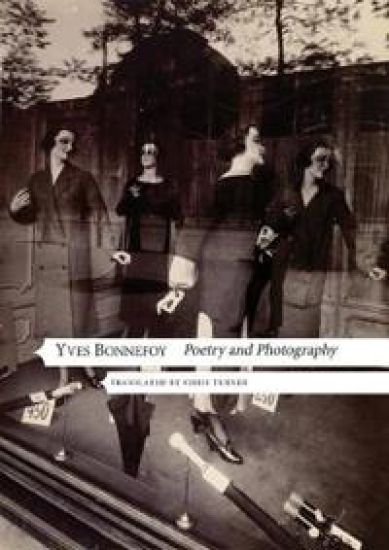
Poetry and Photography

Poetry and Photography

Yves Bonnefoy

Seagull Books London Ltd
2017
sidottu
The international community of letters mourns the recent death of Yves Bonnefoy, universally acclaimed as one of France's greatest poets of the last half-century. A prolific author, he was often considered a candidate for the Nobel Prize and published a dozen major collections of poetry in verse and prose, several books of dream-like tales, and numerous studies of literature and art. His oeuvre has been translated into scores of languages, and he himself was a celebrated translator of Shakespeare, Yeats, Keats, and Leopardi.Poetry and Photography is Bonnefoy's seminal essay on the intricate connections between the two fields as they play out against a background of major works in the history of literature. Bonnefoy is concerned not just with new concepts that photography introduces to the world of images, but also with the ways in which works like Maupassant's "The Night" perpetuate these concepts. A short, critical text on different forms of artistic creation, masterfully translated by Chris Turner, the volume is an invigorating read.
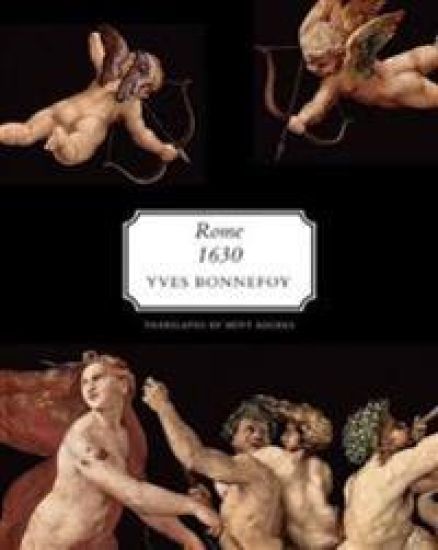
Rome, 1630

Rome, 1630

Yves Bonnefoy

Seagull Books London Ltd
2018
sidottu
Velazquez. Poussin. Carvaggio. Bernini. Despite their disparate backgrounds, these greats of European Baroque art converged at one remarkable place in time: Rome, 1630. In response to the Protestant Reformation, the Catholic Church turned to these masters of Baroque art to craft works celebrating the glories of the heavens manifested on earth. And so, with glittering monuments like Bernini’s imposing bronze columns in St. Peter’s Basilica, Rome, 1630 came to be the crossroads of seventeenth-century art, religion, and power. In Rome, 1630, the renowned French poet and critic Yves Bonnefoy devotes his attention to this single year in the Baroque period in European art. Richly illustrated with artwork that reveals the unique, yet instructive, place of Rome in 1630 in European art history, Bonnefoy dives deep into this transformative movement. The inclusion of five additional essays on seventeenth-century art situate Bonnefoy’s analysis within a lively debate on Baroque art and art history. Translator Hoyt Rogers's afterword pays homage to the author himself, situating Rome, 1630 in Bonnefoy’s productive career as a premier French poet and critic.
The Red Scarf

The Red Scarf

Yves Bonnefoy

Seagull Books London Ltd
2021
sidottu
An intensely personal and profoundly moving review of Bonnefoy’s childhood memories. In December 2015, six months before his death at the age of 93, Yves Bonnefoy concluded what was to be his last major text in prose, L’écharpe rouge, translated here as The Red Scarf. In this unique book, described by the poet as "an anamnesis"—a formal act of commemoration—Bonnefoy undertakes, at the end of his life, a profoundly moving exegesis of some fragments written in 1964. These fragments lead him back to an unspoken, lifelong anxiety: “My most troubling memory, when I was between ten and twelve years old, concerns my father, and my anxiety about his silence.” Bonnefoy offers an anatomy of his father’s silence, and of the melancholy that seemed to take hold some years into his marriage to the poet’s mother. At the heart of this book is the ballad of Elie and Hélène, the poet’s parents. It is the story of their lives together in the Auvergne, and later in Tours, seen through the eyes of their son—the solitary boy’s intense but inchoate experience, reviewed through memories of the now elderly man. What makes The Red Scarf indispensable is the intensely personal nature of the material, casting its slant light, a setting sun, on all that has gone before.
The Present Hour

The Present Hour

Yves Bonnefoy

Seagull Books London Ltd
2020
nidottu
In The Present Hour, a personal narrative surfaces in splinters and shards. Every word from Yves Bonnefoy is multifaceted, like the fragmented figures seen from different angles in cubist painting-as befits a poet who has written extensively about artists such as Goya, Picasso, Braque and Gris. Throughout this moving collection, Bonnefoy's poems echo each other, returning to and elaborating upon key images, thoughts, feelings and people. Intriguing and enigmatic, this mixture of sonnet sequences and prose poems - or, as Bonnefoy sees them, 'dream texts'-move from his meditations on friendship and friends like Jorge Luis Borges to a long, discursive work in free verse that is a self-reflection on his thought and process. These poems are the ultimate condensation of Bonnefoy's ninety years of life and writing and they will be a valuable addition to the canon of his writings available in English.'Beverley Bie Brahic does a splendid job of translating the latest work of Yves Bonnefoy. She catches his unique combination of human detail and a groping for the beyond [. . .] Brahic does full justice to the profoundly moving text-with its frequent shifts between the personal and the searchingly philosophical.' - Joseph Frank, author of Responses to Modernity
Beginning and End of the Snow

Beginning and End of the Snow

Yves Bonnefoy

Bucknell University Press
2012
nidottu
Yves Bonnefoy’s book of poems, Beginning and End of the Snow followed by Where the Arrow Falls, combines two meditations in which the poet’s thoughts and a landscape reflect each other. In the first, the wintry New England landscape he encountered while teaching at Williams College evokes the dance of atoms in the philosophical poem of Lucretius as well as the Christian doctrine of death and resurrection. In the second, Bonnefoy uses the luminous woods of Haute Provence as the setting for a parable of losing one’s way.
Poems

Poems

Yves Bonnefoy

Fyfield Books
2017
nidottu
France’s greatest poet of the last half century, Yves Bonnefoy wrote many books of poetry and poetic prose, as well as celebrated critical essays on literature and art (to which a second volume will be devoted). At his death in 2016 aged ninety-three, he was Emeritus Professor of Comparative Poetics at the Collège de France. The selection for this volume (and the second one) was made in close collaboration with the poet. The lengthy introduction by John Naughton is a significant assessment of Bonnefoy’s importance in French literature. Bonnefoy started out as a young surrealist poet at the end of the Second World War and, for seven decades, he produced poetry and prose of great, and changing, depth and richness. In his lines we encounter `the horizon of a voice where stars are falling, / Moon merging with the chaos of the dead’. Fellow poet Philippe Jaccottet spoke of his abiding gravité enflammée. Bonnefoy knew what translation demands, having himself translated Shakespeare, Donne, Yeats, and Keats; Petrarch and Leopardi from Italian; and, from Greek, George Seferis. This volume is edited and translated by three of Bonnefoy’s long-time translators –Anthony Rudolf, John Naughton, and Stephen Romer – with contributions from Galway Kinnell, Richard Pevear, Beverley Bie Brahic, Emily Grosholz, Susanna Lang, and Hoyt Rogers.
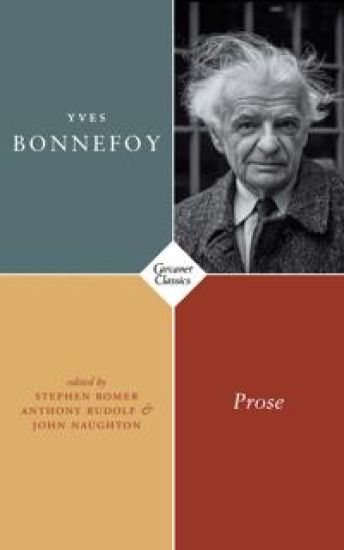
Prose

Prose

Yves Bonnefoy

Carcanet Classics
2020
nidottu
Yves Bonnefoy (1923-2016), a major poet, was equally a seminal essayist and thinker. This companion volume to Yves Bonnefoy: Poems contains what he regarded as his foundational essays, as well as a generous selection from all periods. In his art criticism, as in his literary essays, Bonnefoy manages that rare thing: to impart metaphysical urgency to each discreet encounter with a painting or a poem, born of his constant quest for intensity, for 'presence'. Whether he is examining an early Byzantine fresco, a Shakespeare play, a Bernini angel, a drawing by Blake, a poem by Rimbaud, the exigency, the high seriousness and the challenge is the same: to affirm presence, and finitude, against all forms of life-sapping conceptual thought. If they cannot always deliver ecstasy or hope, the great poets, argues Bonnefoy, are pledged to 'intensity as such', sustained by 'une mélancolie ardente'.
The Anchor’s Long Chain

The Anchor’s Long Chain

Yves Bonnefoy

SEAGULL BOOKS LONDON LTD
2023
nidottu
An experiment with the sonnet form by one of the foremost French poets of his generation. Yves Bonnefoy has wowed the literary world for decades with his diffuse volumes. First published in France in 2008, The Anchor’s Long Chain is an indispensable addition to his oeuvre. Enriching Bonnefoy’s earlier work, the volume, translated by Beverley Bie Brahic, also innovates, including an unprecedented sequence of nineteen sonnets. These sonnets combine the strictness of the form with the freedom to vary line length and create evocative fragments. Compressed, emotionally powerful, and allusive, the poems are also autobiographical—but only in glimpses. Throughout, Bonnefoy conjures up life’s eternal questions with each new poem. Longer, discursive pieces, including the title poem’s meditation on a prehistoric stone circle and a legend about a ship, are also part of this volume, as are a number of poetic prose pieces in which Bonnefoy, like several of his great French predecessors, excels. Long-time fans will find much to praise here, while newer readers will quickly find themselves under the spell of Bonnefoy’s powerful, discursive poetry.
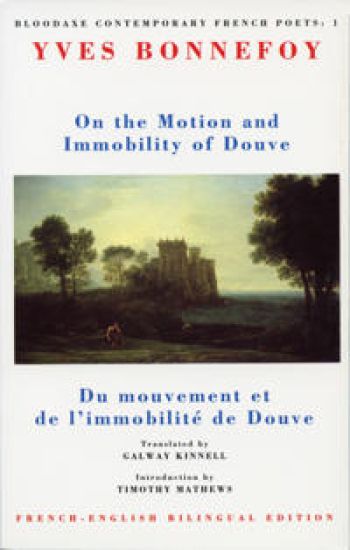
On the Motion & Immobility of Douve

On the Motion & Immobility of Douve

Yves Bonnefoy

Bloodaxe Books Ltd
1992
nidottu
Yves Bonnefoy (1923-2016) was a central figure in post-war French culture, with a lifelong fascination with the problems of translation. Language, for him, was a visceral, intensely material element in our existence, and yet the abstract quality of words distorts the immediate, material quality of our contact with the world. This concern with what separates words from an essential truth hidden in objects involved him in wide-ranging philosophical and theological investigations of the spiritual and the sacred. But for all his intellectual drive and rigour, Bonnefoy's poetry is essentially of the concrete and the tangible, and addresses itself to our most familiar and intimate experiences of objects and of each other. In his first book of poetry, published in France in 1953, Bonnefoy reflects on the value and mechanism of language in a series of short variations on the life and death of a much loved woman, Douve. Douve, though, is the French word for a moat, that uncrossable body which separates us from safety and from danger. With this undercurrent at work we read the poems as if they are about the divide between us and death as much as they are about the divide between us and the untouchable reality of text. This is dangerous writing, fulfilling Derrida's "fatal necessity" by making us substitute the textual sign for reality. In his introduction, Timothy Mathews shows how Bonnefoy's poetics are enmeshed with his philosophical, religious and critical thought.