

Kirjahaku
Etsi kirjoja tekijän nimen, kirjan nimen tai ISBN:n perusteella.
6 kirjaa tekijältä Yves Engler
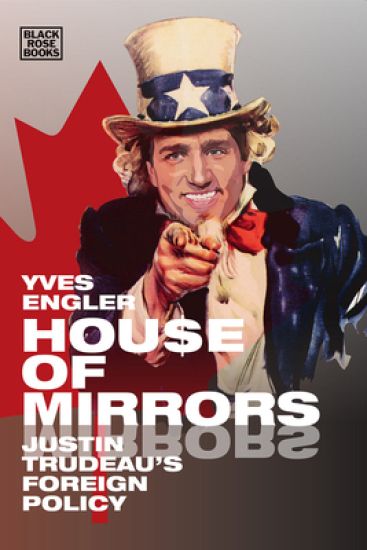
Canadian Prime Minister Justin Trudeau presents himself as progressive on foreign affairs. According to Trudeau, he and his Liberals have brought Canada back after the disastrous Conservative government under Stephen Harper. In House of Mirrors, Yves Engler asks probing questions and demonstrates that the opposite is true: Trudeau, he argues, largely continued Harper's foreign policy. House of Mirrors outlines how Trudeau's government has expanded the military while ignoring international efforts to restrict nuclear weapons proliferation. The Liberals, Engler shows, have launched an unprecedented effort to overthrow Venezuela's government while siding with an assortment of reactionary governments. Flouting their climate commitments, the Trudeau government also failed to follow through on its promise to rein in Canada's controversial mining sector. With heavily documented analysis, House of Mirrors gives insight into the Liberals' rhetorical skills that whitewash their pro-corporate and conservative policies with progressive slogans.

Stand on Guard for Whom? - A People's History of the Canadian Military
Yves Engler
Black Rose Books
2021
nidottu
We Stand on Guard for Whom? is the first book to present a history of the Canadian military from the perspective of its victims. In his eleventh book, Yves Engler, the prolific author and critic of Canadian politics, exposes the reality of Canadian wars, repression, and military culture despite the mythologies of Canada as an agent for international peacekeeping and humanitarianism. Originating as a British force that brutally dispossessed First Nations, the Canadian Forces regularly quelled labor unrest in the decades after Confederation. It would go on to participate in military occupations or invasions in Sudan, South Africa, Europe, Korea, Iraq, Serbia, Afghanistan, and Libya, as well as Canadian gunboat diplomacy and UN deployments that have ousted elected governments. As the federal government department with by far the greatest budget, staff, PR machine, and intelligence-gathering capacities, this book shows how the Canadian military is a key developer of military technology, including chemical, biological, and nuclear weapons. It also has an immense ecological footprint and a toxic patriarchal, racist, and anti-democratic culture. However, as this book shows, Canadian militarism has always been contested, as early as opposition to conscription during World War I and as especially during peace activism against the US war in Indochina. More recently, city councils have declared themselves nuclear weapons free zones and prevented hosting of weapons bazaars and, in 2003, antiwar activists stopped Prime Minister Jean Chr tien from leading Canada into the US-led invasion of Iraq. This book reveals the hidden militarism in Canadian life and reminds us that the first step to contest it is to recognize its pervasiveness and power.

Stand on Guard for Whom? - A People's History of the Canadian Military
Yves Engler
Black Rose Books
2021
sidottu
We Stand on Guard for Whom? is the first book to present a history of the Canadian military from the perspective of its victims. In his eleventh book, Yves Engler, the prolific author and critic of Canadian politics, exposes the reality of Canadian wars, repression, and military culture despite the mythologies of Canada as an agent for international peacekeeping and humanitarianism. Originating as a British force that brutally dispossessed First Nations, the Canadian Forces regularly quelled labor unrest in the decades after Confederation. It would go on to participate in military occupations or invasions in Sudan, South Africa, Europe, Korea, Iraq, Serbia, Afghanistan, and Libya, as well as Canadian gunboat diplomacy and UN deployments that have ousted elected governments. As the federal government department with by far the greatest budget, staff, PR machine, and intelligence-gathering capacities, this book shows how the Canadian military is a key developer of military technology, including chemical, biological, and nuclear weapons. It also has an immense ecological footprint and a toxic patriarchal, racist, and anti-democratic culture. However, as this book shows, Canadian militarism has always been contested, as early as opposition to conscription during World War I and as especially during peace activism against the US war in Indochina. More recently, city councils have declared themselves nuclear weapons free zones and prevented hosting of weapons bazaars and, in 2003, antiwar activists stopped Prime Minister Jean Chr tien from leading Canada into the US-led invasion of Iraq. This book reveals the hidden militarism in Canadian life and reminds us that the first step to contest it is to recognize its pervasiveness and power.

In contrast to the common opinion that Canada's primary role has been peacekeeper in several historic disputes, this study sheds light on several dark corners of the country's foreign policy. From participation in the U.N. mission that killed Patrice Lumumba in the Congo to support for South African apartheid, Zionism, and the U.S. wars in Vietnam as well as Iraq and Afghanistan today, this investigation provides a comprehensive critique of how Canadian foreign policy is not independent but solidly linked with that of the United States. Revealing how the country has used its good reputation to open doors that have been inaccessible to the U.S., this analysis is a clarion call for Canadians to challenge their government's established procedures.