Kirjojen hintavertailu. Mukana 12 459 402 kirjaa ja 12 kauppaa.

Kirjahaku

Etsi kirjoja tekijän nimen, kirjan nimen tai ISBN:n perusteella.

56 kirjaa tekijältä Alan MacFarlane

The Science of Life

The Science of Life

Alan Macfarlane

TAYLOR FRANCIS LTD
2022
sidottu
The Science of Life: Andrew Huxley, Richard Keynes and Horace Barlow is part of the series Creative Lives and Works. It is a collection of interviews conducted by one of England’s leading social anthropologists and historians, Professor Alan Macfarlane. Filmed over a period of 40 years, the three conversations in this volume are part of a larger set of interviews that cut across various disciplines—from the social sciences, the sciences, to the performing and visual arts. The current volume on two of England’s foremost physiologists and a vision scientist is yet another addition to the series of several such books.These Cambridge men of science, Sir Andrew Huxley, Richard Keynes and Horace Barlow, apart from shaping certain very fundamental and critical elements in the disciplines of Physiology and Neuroscience also belong to illustrious lineages. Sir Andrew Huxley, for instance is a direct descendant of T.H. Huxley, while Richard Keynes and Horace Barlow are both the great grandsons of Charles Darwin. Their conversations greatly expand our understanding of physiology and neuroscience. The book will be of very great value not just to those interested in Physiology, Medicine and Neuroscience. The interviews also take us into a fascinating period of Cambridge Science, dominated by certain key families of distinguished thinkers.Print edition not for sale in South Asia (India, Sri Lanka, Nepal, Bangladesh, Pakistan or Bhutan).
The Science of Life

The Science of Life

Alan Macfarlane

TAYLOR FRANCIS LTD
2024
nidottu
The Science of Life: Andrew Huxley, Richard Keynes and Horace Barlow is part of the series Creative Lives and Works. It is a collection of interviews conducted by one of England’s leading social anthropologists and historians, Professor Alan Macfarlane. Filmed over a period of 40 years, the three conversations in this volume are part of a larger set of interviews that cut across various disciplines—from the social sciences, the sciences, to the performing and visual arts. The current volume on two of England’s foremost physiologists and a vision scientist is yet another addition to the series of several such books.These Cambridge men of science, Sir Andrew Huxley, Richard Keynes and Horace Barlow, apart from shaping certain very fundamental and critical elements in the disciplines of Physiology and Neuroscience also belong to illustrious lineages. Sir Andrew Huxley, for instance is a direct descendant of T.H. Huxley, while Richard Keynes and Horace Barlow are both the great grandsons of Charles Darwin. Their conversations greatly expand our understanding of physiology and neuroscience. The book will be of very great value not just to those interested in Physiology, Medicine and Neuroscience. The interviews also take us into a fascinating period of Cambridge Science, dominated by certain key families of distinguished thinkers.Print edition not for sale in South Asia (India, Sri Lanka, Nepal, Bangladesh, Pakistan or Bhutan).
The peculiarity of the English, A personal view

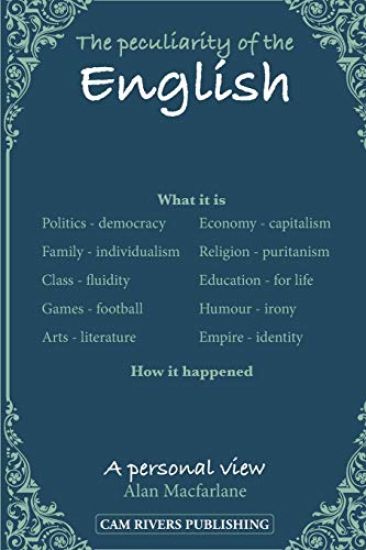
The peculiarity of the English, A personal view

Alan MacFarlane

Independently Published
2019
nidottu
Alan Macfarlane is Emeritus Professor of Anthropological Science at the University of Cambridge, a Life Fellow of King's College, Cambridge and Fellow of the British Academy. He has published more than forty books, including more than a dozen on the English.Alan Macfarlane writes as both an insider (British parents, brought up and educated and living in England, working on English history), and as an outsider (five-eighths Scots, working as an anthropologist in Nepal, Japan and China).The book explains very simply some of the key features that those who wish to understand the English might like to know about, and what has caused some of the special nature of the English. It is a companion to 'Understanding the English, A personal A-Z'.
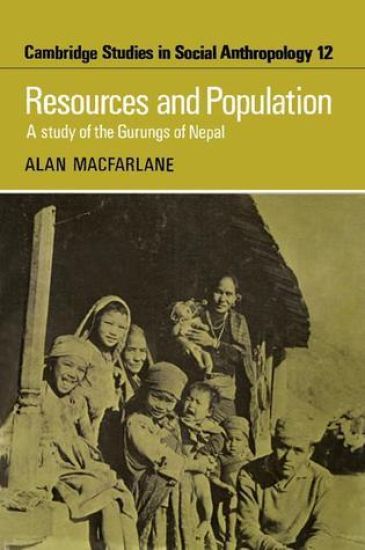
Resources and Population

Resources and Population

Alan MacFarlane

Cambridge University Press
2012
pokkari
In many areas of the world destruction of natural resources and the rapid growth of populaton are among the most important problems facing individuals and governments. This book, first published in 1976, utilises the tools of social anthropology and population studies in an attempt to see some of the causes and consequences of populations growth and some of the effects of change on natural resources. It analyses a particular 'community' in the Annapurna range of the central Himalayas during this century, and investigates how the destruction of forests and the growth of settled rice cultivation have occurred, and some of the consequences. The Gurungs are famous as recruits to the Gurkha regiments of the British and Indian armies, and the demographic and economic effects of foreign mercenary labour are among the topics examined.
Letters To Lily

Letters To Lily

Alan MacFarlane

Profile Books Ltd
2006
pokkari
Alan Macfarlane is an anthropologist; Lily his inquisitive granddaughter, constantly asks him questions about how the world works. In this book he provides her with some answers in a series of thirty letters. His answers range through history and across the world's cultures, from the personal to the philosophical to the political.
Japan Through the Looking Glass

Japan Through the Looking Glass

Alan MacFarlane

Profile Books Ltd
2008
pokkari
A JOURNEY OF DISCOVERY THROUGH JAPAN'S MULTI-FACETED CUSTOMS AND CULTURE 'An excellent book for anyone with an interest in Japanese culture' Sunday Telegraph 'Takes in everything from the mythical roots of sumo to the ubiquity of Shinto shrines' The Times Alan Macfarlane first encountered Japan full of certainty, confidence and unexamined assumptions. He soon found his preconceptions challenged on every front - as generations of visiting travellers have found themselves, too. In this fascinating and endlessly surprising book, Macfarlane takes us on an exploration of every aspect of Japanese society, from the most public spaces to the most intimate realms, uncovering the great depths and multi-faceted nature of the country and its people. Clear-sighted yet affectionate, Macfarlane shows us Japan as it has never been seen before and, in the process, helps us to see our own world anew.
A Modern Education, Advice for Ariston

A Modern Education, Advice for Ariston

Alan MacFarlane

CAM Rivers Publishing
2018
nidottu
British education is designed to teach about society andpower, play and performance, the head and the heart, thespirit and character. It is a preparation for a certain kind of'modernity.' This book explains how education can make usmodern and the way in which such an education is differentfrom that of Europe and China.Alan Macfarlane, F.B.A., is an Emeritus Professor ofAnthropology at Cambridge University and a Life Fellowof King's College. His website is alanmacfarlane.com
How Can We Survive - Thoughts for Taras

How Can We Survive - Thoughts for Taras

Alan MacFarlane

CAM Rivers Publishing
2018
nidottu
We live in a confused and confusing world. Populationgrowth, rapidly changing technologies, large migrations ofpeoples and ideas are changing everything faster. This is abrief historical overview of eight of the major problems weface and some radical ways of thinking about them. Theseinclude robots and work, computers and the internet, theincrease in life and health, the challenge to democracy, multiculturalism, educational changes, war and peace.Alan Macfarlane, F.B.A., is an Emeritus Professor ofAnthropology at Cambridge University and a Life Fellowof King's College. His website is alanmacfarlane.co
How to Discover the World - Reflections for Rosa

How to Discover the World - Reflections for Rosa

Alan MacFarlane

CAM Rivers Publishing
2018
nidottu
I have spent the last sixty years trying to understand the world. I have studied for two doctorates at Oxford and London and travelled through Nepal, Japan and China. Here I will describe what I have found about asking questions, guessing, testing, assembling evidence, creative writing and the conditions of creativity. Alan Macfarlane, F.B.A., is an Emeritus Professor of Anthropology at Cambridge University and a Life Fellow of King's College. His website is alanmacfarlane.com
How to Study the World - Suggestions for Shuo

How to Study the World - Suggestions for Shuo

Alan MacFarlane

CAM Rivers Publishing
2018
nidottu
Here I explain three ways in which we learn about our world - through participation, conversation and by absorbing creative works. I look at how this experience is worked upon, reshaped and communicated through our imagination and writing. Finally I look at how our interpretations are influenced by the wider cultural context. Alan Macfarlane, F.B.A., is an Emeritus Professor of Anthropology at Cambridge University and a Life Fellow of King's College. His website is alanmacfarlane.com
How to Understand Each Other - Notes for Nina

How to Understand Each Other - Notes for Nina

Alan MacFarlane

CAM Rivers Publishing
2018
nidottu
We live in a shrinking world where civilisations are colliding and people from all over the world are encountering former strangers as neighbours. So we need to understand each other's history and culture. To help with this deeper appreciation of the huge variety of humankind, here is a simple description of the basic features of five of the greatest current world civilisations - the Sino-sphere, Japano-sphere, Islamo-sphere, Euro-sphere and Anglo-sphere. Alan Macfarlane, F.B.A., is an Emeritus Professor of Anthropology at Cambridge University and a Life Fellow of King's College. His website is alanmacfarlane.com
Intelligent Machines - Conversations with Gerry

Intelligent Machines - Conversations with Gerry

Alan MacFarlane

CAM Rivers Publishing
2018
nidottu
The development of modern computers and Artificial Intelligence since the middle of the twentieth century is the greatest technological revolution since the invention of writing. This book explains how and why it happened, and what are the likely consequences of an exponential growth in the power of computers and robots - and how we can come to terms with this. Alan Macfarlane, F.B.A., is an Emeritus Professor of Anthropology at Cambridge University and a Life Fellow of King's College. His website is alanmacfarlane.com
Learning to Be Modern - Jottings for James

Learning to Be Modern - Jottings for James

Alan MacFarlane

CAM Rivers Publishing
2018
nidottu
The theme of this book is the transformation of a child through infancy, boarding schools and university, from the home to the wider society. By combining photographs and scans of documents, Alan Macfarlane presents an account of his 'education' from his birth in Assam, India, in 1941 through to the end of his undergraduate degree at Oxford University in 1963. This is part of a wider study of comparative education between China and the West. Alan Macfarlane, F.B.A., is an Emeritus Professor of Anthropology at Cambridge University and a Life Fellow of King's College. His website is alanmacfarlane.com
China, Japan, Europe and the Anglo-sphere, A Comparative Analysis
We live in a confused and confusing world. This is partlycaused by the massive growth of inter-civilisational contactsdriven by economic, cultural and communication changes. Itis urgent that we understand each other if we are to surviveand thrive, yet most of us know very little about the worldoutside our own civilisation.This book describes the central features of four greatcivilisations, their history and culture: China, Japan, Europeand the Anglosphere. Through a comparison of their deeper cultural logic and through investigating their dreams and nightmares, their religious, economic, political and social similarities and differences, we may come to a deeper appreciation of their worlds and our own.Drawing on fifty years of travel through these different civilisations and teaching about them at the University of Cambridge, Alan Macfarlane explores how we can remain different and yet live in some sort of harmony through mutual appreciation and understanding.