Kirjojen hintavertailu. Mukana 12 390 323 kirjaa ja 12 kauppaa.

Kirjahaku

Etsi kirjoja tekijän nimen, kirjan nimen tai ISBN:n perusteella.

33 kirjaa tekijältä Alasdair MacIntyre

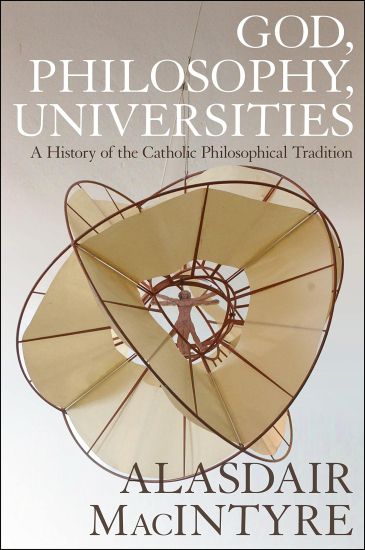
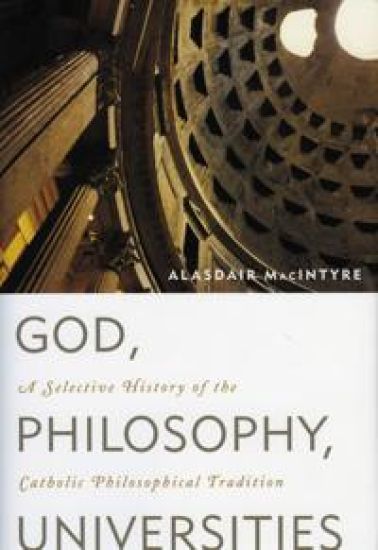
God, Philosophy, Universities

God, Philosophy, Universities

Alasdair MacIntyre

Rowman Littlefield Publishers
2009
sidottu
'What does it mean to be a human being?' Given this perennial question, Alasdair MacIntyre, one of America's preeminent philosophers, presents a compelling argument on the necessity and importance of philosophy. Because of a need to better understand Catholic philosophical thought, especially in the context of its historical development and realizing that philosophers interact within particular social and cultural situations, MacIntyre offers this brief history of Catholic philosophy. Tracing the idea of God through different philosophers' engagement of God and how this engagement has played out in universities, MacIntyre provides a valuable, lively, and insightful study of the disintegration of academic disciplines with knowledge. MacIntyre then demonstrates the dangerous implications of this happening and how universities can and ought to renew a shared understanding of knowledge in their mission. This engaging work will be a benefit and a delight to all readers.
God, Philosophy, Universities

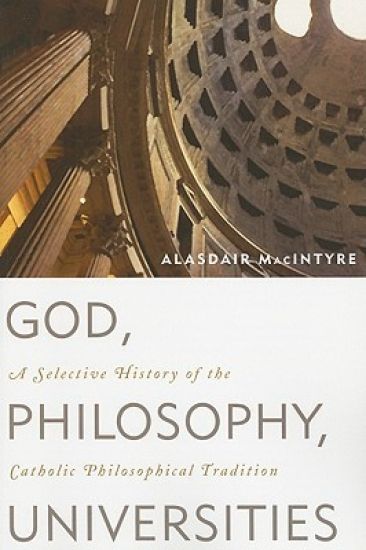
God, Philosophy, Universities

Alasdair MacIntyre

Rowman Littlefield Publishers
2011
nidottu
'What does it mean to be a human being?' Given this perennial question, Alasdair MacIntyre, one of America's preeminent philosophers, presents a compelling argument on the necessity and importance of philosophy. Because of a need to better understand Catholic philosophical thought, especially in the context of its historical development and realizing that philosophers interact within particular social and cultural situations, MacIntyre offers this brief history of Catholic philosophy. Tracing the idea of God through different philosophers' engagement of God and how this engagement has played out in universities, MacIntyre provides a valuable, lively, and insightful study of the disintegration of academic disciplines with knowledge. MacIntyre then demonstrates the dangerous implications of this happening and how universities can and ought to renew a shared understanding of knowledge in their mission. This engaging work will be a benefit and a delight to all readers.
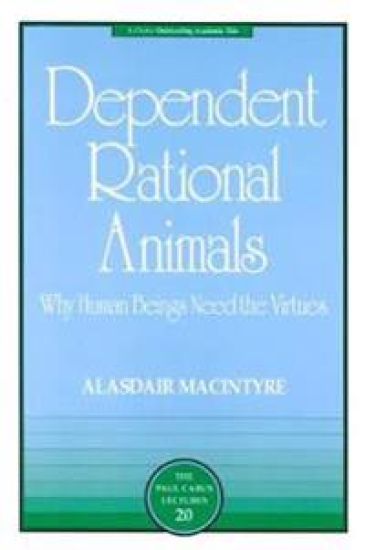
Dependent Rational Animals

Dependent Rational Animals

Alasdair MacIntyre

Open Court Publishing Co ,U.S.
1999
sidottu
This compares humans to other intelligent animals, drawing conclusions about human social life and our treatment of those whom he argues we should no longer call "disabled." The author argues that human beings are independent, practical reasoners, but they are also dependent animals who must learn from each other in order to remain largely independent. To flourish, humans must acknowledge the importance of dependence and independence, both of which are developed in and through social relationships. This requires the development of a local community in which individuals discover their own "goods" through the discovery of a common Good.
Dependent Rational Animals

Dependent Rational Animals

Alasdair MacIntyre

Open Court Publishing Co ,U.S.
2001
pokkari
This compares humans to other intelligent animals, drawing conclusions about human social life and our treatment of those whom he argues we should no longer call "disabled." The author argues that human beings are independent, practical reasoners, but they are also dependent animals who must learn from each other in order to remain largely independent. To flourish, humans must acknowledge the importance of dependence and independence, both of which are developed in and through social relationships. This requires the development of a local community in which individuals discover their own "goods" through the discovery of a common Good.
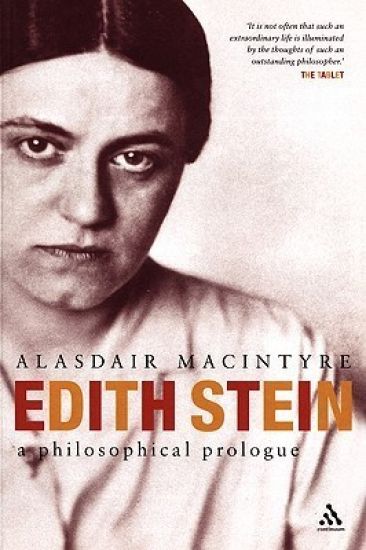
Edith Stein

Edith Stein

Alasdair MacIntyre

Continuum International Publishing Group Ltd.
2007
nidottu
MacIntyre is one of the major British philosophers of the post-war years, and a convert to Roman Catholicism. Edith Stein was an intellectual of considerable importance in the period between the two World Wars. The fact that she was also canonised as a Saint is truly remarkable: a Jewish convert to Roman Catholicism, she died in the gas chambers of Auschwitz. In this major study of Stein's development as a theologian and philosopher, MacIntyre reveals many of the fundamental issues in both disciplines and in their cross-fertilisation. Stein was a pupil of the phenomenological philosopher Edmund Husserl. She then sought in her own writing to interpret phenomenology in a Thomistic way. In this, she was as original and innovative as were the Catholic philosophers - such as Peter Geach and Elizabeth Anscombe - who made similar interpretations of the work of Wittgenstein in this country.
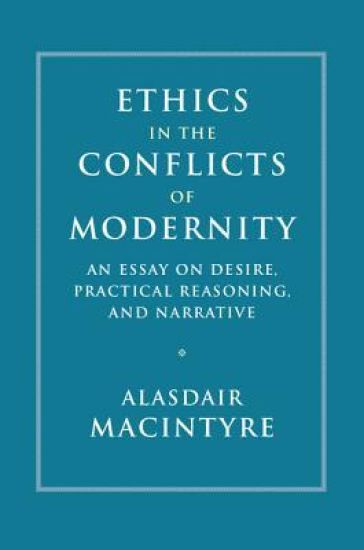
Ethics in the Conflicts of Modernity

Ethics in the Conflicts of Modernity

Alasdair MacIntyre

Cambridge University Press
2016
sidottu
Alasdair MacIntyre explores some central philosophical, political and moral claims of modernity and argues that a proper understanding of human goods requires a rejection of these claims. In a wide-ranging discussion, he considers how normative and evaluative judgments are to be understood, how desire and practical reasoning are to be characterized, what it is to have adequate self-knowledge, and what part narrative plays in our understanding of human lives. He asks, further, what it would be to understand the modern condition from a neo-Aristotelian or Thomistic perspective, and argues that Thomistic Aristotelianism, informed by Marx's insights, provides us with resources for constructing a contemporary politics and ethics which both enable and require us to act against modernity from within modernity. This rich and important book builds on and advances MacIntyre's thinking in ethics and moral philosophy, and will be of great interest to readers in both fields.
Ethics in the Conflicts of Modernity

Ethics in the Conflicts of Modernity

Alasdair MacIntyre

Cambridge University Press
2020
pokkari
Alasdair MacIntyre explores some central philosophical, political and moral claims of modernity and argues that a proper understanding of human goods requires a rejection of these claims. In a wide-ranging discussion, he considers how normative and evaluative judgments are to be understood, how desire and practical reasoning are to be characterized, what it is to have adequate self-knowledge, and what part narrative plays in our understanding of human lives. He asks, further, what it would be to understand the modern condition from a neo-Aristotelian or Thomistic perspective, and argues that Thomistic Aristotelianism, informed by Marx's insights, provides us with resources for constructing a contemporary politics and ethics which both enable and require us to act against modernity from within modernity. This rich and important book builds on and advances MacIntyre's thinking in ethics and moral philosophy, and will be of great interest to readers in both fields.
God, Philosophy, Universities

God, Philosophy, Universities

Alasdair MacIntyre

Bloomsbury Continuum
2017
nidottu
MacIntyre gives the reader an extremely perceptive account of the role of religion in modern culture and society as a whole.Three convictions underlie this book. The first is that an educated Catholic laity needs to understand a good deal more about Catholic philosophical thought than it does now. The warring partisans on the great issues that engage our culture and politics presuppose the truth of some philosophical theses and the falsity of others.Second, argues MacIntyre, Catholic philosophy is best understood historically, as a continuing conversation through the centuries, in which we turn and return to the most important voices from our past.Third, philosophy is not just a matter of propositions affirmed or denied but of philosophers in particular cultural and social situations interacting with each other in their affirmations and denials, in their argumentative wrangling. This is the context for a book of vital importance and interest for anyone involved with education in a religious context. But from someone with MacIntyre's authority and reputation, the reader can expect something extremely perceptive about the role of religion in modern culture and society as a whole. The reader will not be disappointed.
After Virtue

After Virtue

Alasdair MacIntyre

Bloomsbury Academic
2013
nidottu
Highly controversial when it was first published in 1981, Alasdair MacIntyre's After Virtue has since established itself as a landmark work in contemporary moral philosophy. In this book, MacIntyre sought to address a crisis in moral language that he traced back to a European Enlightenment that had made the formulation of moral principles increasingly difficult. In the search for a way out of this impasse, MacIntyre returns to an earlier strand of ethical thinking, that of Aristotle, who emphasised the importance of 'virtue' to the ethical life. More than thirty years after its original publication, After Virtue remains a work that is impossible to ignore for anyone interested in our understanding of ethics and morality today.
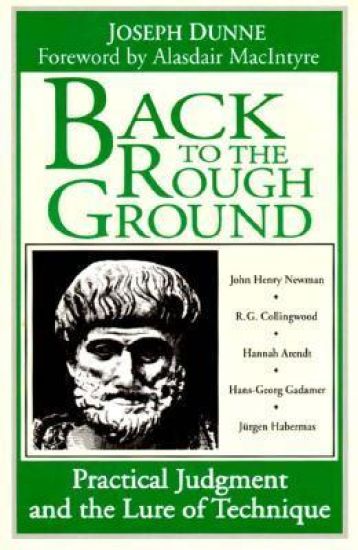
Back to the Rough Ground

Back to the Rough Ground

Joseph Dunne; Alasdair MacIntyre

University of Notre Dame Press
1997
nidottu
Back to the Rough Ground is a philosophical investigation of practical knowledge, with major import for professional practice and the ethical life in modern society. Its purpose is to clarify the kind of knowledge that informs good practice in a range of disciplines such as education, psychotherapy, medicine, management, and law. Through reflection on key modern thinkers who have revived cardinal insights of Aristotle, and a sustained engagement with the Philosopher himself, it presents a radical challenge to the scientistic assumptions that have dominated how these professional domains have been conceived, practiced, and institutionalized.
Back to the Rough Ground

Back to the Rough Ground

Joseph Dunne; Alasdair MacIntyre

University of Notre Dame Press
2016
sidottu
Back to the Rough Ground is a philosophical investigation of practical knowledge, with major import for professional practice and the ethical life in modern society. Its purpose is to clarify the kind of knowledge that informs good practice in a range of disciplines such as education, psychotherapy, medicine, management, and law. Through reflection on key modern thinkers who have revived cardinal insights of Aristotle, and a sustained engagement with the Philosopher himself, it presents a radical challenge to the scientistic assumptions that have dominated how these professional domains have been conceived, practiced, and institutionalized.
Metaphysical Beliefs

Metaphysical Beliefs

Stephen Toulmin; Ronald W. Hepburn; Alasdair MacIntyre

SCM Press
2012
nidottu
During the mid-1950s, three books appeared which, while theologically unfashionable at the time, can now be seen to have pointed the way forward that theology had to take. New Essays in Philosophical Theology, edited by Antony Flew and Alasdair Maclntyre, has been available ever since, and has been in increasing demand. Religious Language, by Ian T. Ramsey, now Bishop of Durham, was out of print in England for a while, but has been reissued and is in a second new impression. Metaphysical Beliefs, on the other hand, was never reprinted. It consists of three long essays, by Stephen Toulmin on 'Contemporary Scientific Mythology'; by Ronald Hepburn on 'Poetry and Religious Belief'; and by Alasdair Maclntyre on 'The Logical Status of Religious Belief'. When the book first appeared, The Times Literary Supplement commented: 'This volume should be widely read and discussed. It is philosophical thinking at a high level, because it faces live issues, avoids asperity towards opponents, and should provoke the right kind of controversy.' More than ten years later, the same verdict still holds true
Pragmatism and Realism

Pragmatism and Realism

Frederick L. Will; Kenneth R. Westphal; Alasdair MacIntyre

Rowman Littlefield
1996
nidottu
'I have no doubt at all, that if philosophy is to prosper in the coming decades, it will have to treat with great seriousness that splendid seriousness that splendid body of philosophical writing of which the essays in this volume constitute one major part'. from the Foreword by Alasdair MacIntyre When historians of philosophy turn to the work of distinguished philosopher Frederick L. Will, Pragmatism and Realism will be an important part of the discussion. In this collection of nine essays, Will demonstrates that a social account of human knowledge is consistent with, and ultimately requires, realism. A timely contribution to the current debate, the book culminates in a naturalistic account of the generation, assessment, and revision of cognitive, moral and social norms. It is written clearly enough for undergraduates, and includes a critical introduction by the editor discussing the bearing of Will's views on current debates among analytic epistemologists, philosophers of science, and moral theorists.