Santa Teresa is a classic religious history biography by Alexander Whyte. Santa Teresa was greatly blessed in both her parents. 'It helped me much that I never saw my father or my mother respect anything in any one but goodness.' Her father was a great reader of the best books, and he took great pains that his children should form the same happy habit and should carefully cultivate the same excellent taste. Saint Teresa of vila, also called Saint Teresa of Jesus, baptized as Teresa S nchez de Cepeda y Ahumada (28 March 1515 - 4 October 1582), was a prominent Spanish mystic, Roman Catholic saint, Carmelite nun and author during the Counter Reformation, and theologian of contemplative life through mental prayer. She was a reformer in the Carmelite Order of her time and the movement she initiated, later joined by Saint John of the Cross, eventually led to the establishment of the Discalced Carmelites, though neither she nor John were alive when the two orders separated. In 1622, forty years after her death, she was canonized by Pope Gregory XV, and on 27 September 1970 was named a Doctor of the Church by Pope Paul VI. Her books, which include her autobiography (The Life of Teresa of Jesus) and her seminal work El Castillo Interior (trans.: The Interior Castle), are an integral part of Spanish Renaissance literature as well as Christian mysticism and Christian meditation practices. She also wrote Camino de Perfecci n (trans.: The Way of Perfection). After her death, Saint Teresa was considered a candidate to become a national patron saint in Spain. A Santero image of the Immaculate Conception of El Viejo, said to have been sent with one of her brothers to Peru, Canonically crowned by Pope John Paul II on 28 December 1989 at the Shrine of El Viejo. Pious Catholic beliefs also associate Saint Teresa with the Infant Jesus of Prague with claims of former ownership and devotion. Teresa of Avila was born in 1515 in vila, Spain. Her paternal grandfather, Juan S nchez de Toledo, was a marrano (Jewish convert to Christianity) and was condemned by the Spanish Inquisition for allegedly returning to the Jewish faith. Her father, Alonso S nchez de Cepeda, a successful wool merchant and one of the wealthiest men in Avila, bought a knighthood and successfully assimilated into Christian society. Teresa's mother, Beatriz de Ahumada y Cuevas, was especially keen to raise her daughter as a pious Christian. Teresa was fascinated by accounts of the lives of the saints, and ran away from home at age seven with her brother Rodrigo to find martyrdom among the Moors. Her uncle stopped them as he was returning to the town, having spotted the two outside the town walls. When Teresa was 11 her mother died, leaving Teresa grief-stricken. This prompted her to embrace a deeper devotion to the Virgin Mary as her spiritual mother. Teresa was also enamored of popular fiction, which at the time was primarily medieval tales of knighthood, and works about caring for one's appearance. 10] 11] Teresa was sent for her education to the Augustinian nuns at vila. 12] In the monastery ("cloister" is an area where only monastics have access), she suffered greatly from illness. Early in her sickness, she experienced periods of religious ecstasy through the use of the devotional book Tercer abecedario espiritual, translated as the Third Spiritual Alphabet (published in 1527 and written by Francisco de Osuna). This work, following the example of similar writings of medieval mystics, consisted of directions for examinations of conscience and for spiritual self-concentration and inner contemplation (known in mystical nomenclature as oratio recollectionis or oratio mentalis). She also employed other mystical ascetic works such as the Tractatus de oratione et meditatione of Saint Peter of Alcantara, and perhaps many of those upon which Saint Ignatius of Loyola based his Spiritual Exercises and possibly the Spiritual Exercises themselves.
Lord, teach us to pray," Alexander Whyte declared one Sunday in the winter of 1895, quoting the Gospel of Luke 11:1. This began a long series he taught, ranging from the prayers of Jacob to Paul's prayers and thanksgivings. This compilation of powerful sermons on prayer revolves around the central theme of Luke 11:1. Whyte's use and emphasis on imagination brings the message a vividness which gives life and relevance to the Scriptures. His emphasis on prayer is coupled with an emphasis on the importance of understanding sin and grace for the believer.
Alexander Whyte's classic biographies of Biblical characters are accurate and spiritually respectful - this volume begins with Adam and concludes with Achan.The author uses depictions and quotations from classical literature together with the Old Testament to describe each character of the Bible. His own professional experience as a minister working in Free Church of Scotland, and the theological study which underpinned his education, allow Whyte to maintain accurate and canonical depictions. The characters are chronologically arranged by their appearance, beginning with the Book of Genesis, the first book of the Bible and one rich with characters and their roles in mankind's early history.Individual chapters and verses from the Bible are explained with a finesse stemming from Whyte's longtime role as an educator. By the time this work was published in 1896, the author had decades of experience in education, recounting the lives of Biblical figures to parishioners and students of Christianity. Readers can thus expect a thorough and informative account of Old Testament characters, their deeds and place in the sequence of events.
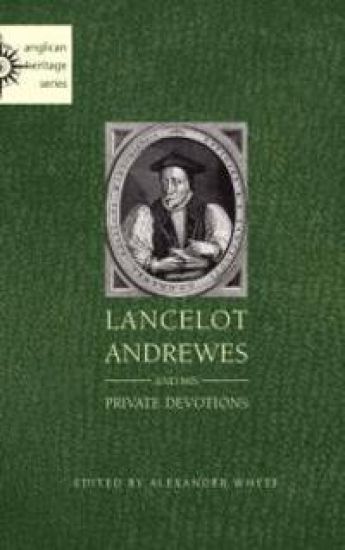
Lancelot Andrewes was born of honest and godly parents in 1555. In 1603 he assisted at the coronation of James I. In 1605 he was raised to be Bishop of Chichester, and he was one of the translators of the Bible in 1607. He was one of the most popular preachers of his day, and well beloved amongst the laity and the clergy alike. But for all of his worldly accomplishments, it is for his private devotions-never intended for publication-that he is best remembered. With that entrancing book open before us we search the histories and the biographies of his time; the home and the foreign politics of his time; the State papers, the Church controversies, and not least the Court scandals and the criminal reports of his time, with the keenest interest and the most solicitous anxiety. A timeless treasure of Anglican spirituality, now once again available from the Apocryphile Press.