Kirjojen hintavertailu. Mukana 11 627 488 kirjaa ja 12 kauppaa.

Kirjahaku

Etsi kirjoja tekijän nimen, kirjan nimen tai ISBN:n perusteella.

40 kirjaa tekijältä Andreas Öchsner

A Simplified Approach to the Classical Laminate Theory of Composite Materials

A Simplified Approach to the Classical Laminate Theory of Composite Materials

Andreas Öchsner

Springer International Publishing AG
2025
sidottu
This book provides a systematic introduction to composite materials, which are obtained by a layer-wise stacking of one-dimensional bar/beam elements. Each layer may have different mechanical properties, but each single layer is considered as isotropic. The major idea is to provide a simplified theory to easily understand the classical two-dimensional laminate theory for composites based on laminae with unidirectional fibers. In addition to the elastic behavior, failure is investigated based on the maximum stress, maximum strain, Tsai-Hill, and the Tsai-Wu criteria. Partial differential equations lay the foundation to mathematically describe the mechanical behavior of any classical structural member known in engineering mechanics, including composite materials. The so-called classical laminate theory provides a simplified stress analysis, and a subsequent failure analysis, without the solution of the system of coupled differential equations for the unknown displacements. The procedure provides the solution of a statically indeterminate system based on a generalized stress–strain relationship under consideration of the constitutive relationship and the definition of the so-called stress resultants. This laminate theory is typically provided for two-dimensional plane problems, where the basic structural element is a simple superposition of a classical plane elasticity element with a thin plate element under the consideration of an orthotropic constitutive law. This two-dimensional approach and the underlying advanced continuum mechanical modeling might be very challenging for some students, particularly at universities of applied sciences. Thus, a reduced approach, the so-called simplified classical laminate theory, has been developed. The idea is to use solely isotropic one-dimensional elements, i.e., a superposition of bar and beam elements, to introduce the major calculation steps of the classical laminate theory. Understanding this simplified theory is much easier and the final step it to highlight the differences when moving to the general two-dimensional case.
A Project-Based Introduction to Computational Statics

A Project-Based Introduction to Computational Statics

Andreas Öchsner

Springer International Publishing AG
2018
nidottu
This book uses a novel concept to teach the finite element method, applying it to solid mechanics. This major conceptual shift takes away lengthy theoretical derivations in the face-to-face interactions with students and focuses on the summary of key equations and concepts; and to practice these on well-chosen example problems. The theoretical derivations are provided as additional reading and students must study and review the derivations in a self-study approach. The book provides the theoretical foundations to solve a comprehensive design project in tensile testing. A classical clip-on extensometer serves as the demonstrator on which to apply the provided concepts. The major goal is to derive the calibration curve based on different approaches, i.e., analytical mechanics and based on the finite element method, and to consider further design questions such as technical drawings, manufacturing, and cost assessment. Working with two concepts, i.e., analytical and computational mechanics strengthens the vertical integration of knowledge and allows the student to compare and understand the different concepts, as well as highlighting the essential need for benchmarking any numerical result.
Introduction to Scientific Publishing

Introduction to Scientific Publishing

Andreas Öchsner

Springer-Verlag Berlin and Heidelberg GmbH Co. K
2013
nidottu
This book is a very concise introduction to the basic knowledge of scientific publishing. It starts with the basics of writing a scientific paper, and recalls the different types of scientific documents. In gives an overview on the major scientific publishing companies and different business models. The book also introduces to abstracting and indexing services and how they can be used for the evaluation of science, scientists, and institutions. Last but not least, this short book faces the problem of plagiarism and publication ethics.
Theorie der Balkenbiegung

Theorie der Balkenbiegung

Andreas Öchsner

Springer Vieweg
2016
nidottu
Andreas Öchsner bietet eine Einführung in die unterschiedlichen Theorien der statischen Balkenbiegung sowie deren Annahmen und Limitierungen. Er behandelt insbesondere die Theorien nach Euler-Bernoulli, Timoshenko und Levinson bei kleinen Verformungen und Dehnungen. Dieses Wissen bildet die Grundlage für die Anwendung moderner Berechnungsmethoden, zum Beispiel der Methode der finiten Elemente (FEM). Das Buch bietet eine kompakte und schnelle „Anleitung“ zur Anwendung der unterschiedlichen Balkentheorien. Die Annahmen und Limitierungen werden hier vergleichend in einem Werk dargestellt. Die grundlegenden Beziehungen, die zur beschreibenden Differenzialgleichung führen, sind ausführlich dargestellt und erläutert.
Leichtbaukonzepte

Leichtbaukonzepte

Andreas Öchsner

Springer Vieweg
2018
nidottu
Andreas Öchsner bietet eine einfache Einführung in die unterschiedlichen Konzepte des Leichtbaus, wobei der Schwerpunkt auf Konzepten der Strukturmechanik und Festigkeitslehre liegt. Neben den theoretischen Grundlagen stellt der Autor auch Fragestellungen zu praktischen Anwendungsgebieten vor. Das Leichtbaupotenzial von Konstruktionen spielt in den verschiedenen Bereichen des Transportwesens – zum Beispiel im Automobil- und Flugzeugbau – eine entscheidende Rolle, da die Betriebskosten zu einem wesentlichen Teil durch das Gewicht einer Struktur bestimmt werden. Insbesondere ist für einen Konstrukteur das Verhältnis von Betriebslast zum Eigengewicht eine wichtige Kennzahl zur Beurteilung der Leichtbaugüte einer Konstruktion.
Stoff- und Formleichtbau

Stoff- und Formleichtbau

Andreas Öchsner

Springer Fachmedien Wiesbaden
2022
muu
Dieses Lehrbuch stellt die unterschiedlichen Leichtbaukonzepte anhand einfacher eindimensionaler Strukturen in sehr verständlicher Weise dar und ermöglicht einen leichten Einstieg in das Thema. Es werden nachvollziehbare Informationen und Hinweise zur Werkstoffauswahl und geometrischen Gestaltung von Bauteilen gegeben.
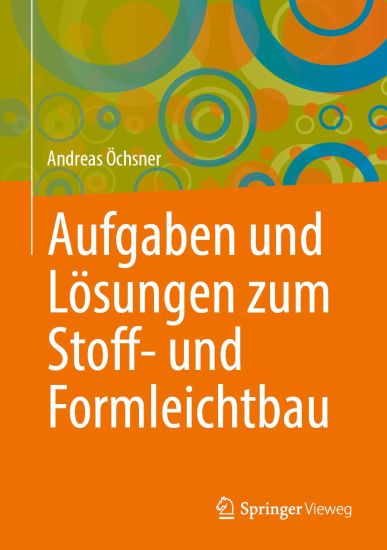
Aufgaben und Lösungen zum Stoff- und Formleichtbau

Aufgaben und Lösungen zum Stoff- und Formleichtbau

Andreas Öchsner

Springer Fachmedien Wiesbaden
2024
sidottu
Dieses Übungsbuch beinhaltet eine umfangreiche Sammlung von Aufgaben zum Themenkomplex Leichtbau. Insbesondere werden die Grundlagen der Festigkeitslehre, Stoffleichtbau und Formleichtbau sowie Sandwichelemente behandelt. Dabei wird vor allem auf Grenzbeanspruchung und Optimierung der Strukturen eingegangen. Das Buch zeichnet sich durch detaillierte Müsterlösungen aus, sodass Studierende von Bachelor- und Masterstudiengängen die Lösungswege einfach nachvollziehen können. Das Werk ist dadurch auch für das Selbststudium bestens geeignet.
Stoff- und Formleichtbau

Stoff- und Formleichtbau

Andreas Öchsner

Springer Fachmedien Wiesbaden
2025
nidottu
Dieses Lehrbuch stellt die unterschiedlichen Leichtbaukonzepte anhand einfacher eindimensionaler Strukturen in sehr verständlicher Weise dar und ermöglicht einen leichten Einstieg in das Thema. Es werden nachvollziehbare Informationen und Hinweise zur Werkstoffauswahl und geometrischen Gestaltung von Bauteilen gegeben. Studierende werden zudem durch eine Vielzahl an Übungsaufgaben und deren ausführlichen Lösungen unterstützt. Neben allgemeinen Korrekturen und Ergänzungen wurde die vorliegende dritte Auflage vor allem durch zusätzliche Übungsaufgaben erweitert.
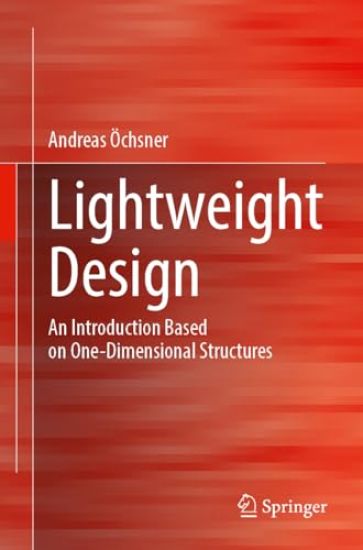
Lightweight Design

Lightweight Design

Andreas Öchsner

Springer Fachmedien Wiesbaden
2025
nidottu
This textbook presents the various lightweight design concepts using simple one-dimensional structures in a very understandable way and provides an easy introduction to the subject. It provides comprehensible information and advice on material selection and the geometric design of components. Students are also supported by a large number of exercises and their detailed solutions. It is the translation of the current third German edition.
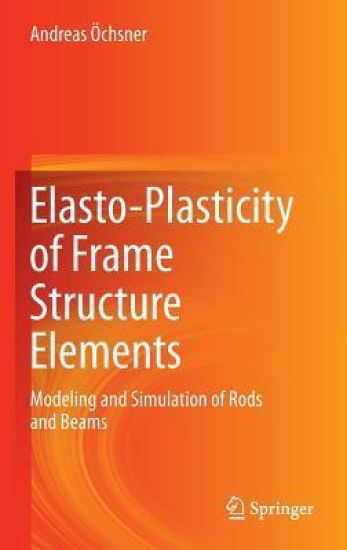
Elasto-Plasticity of Frame Structure Elements

Elasto-Plasticity of Frame Structure Elements

Andreas Öchsner

Springer-Verlag Berlin and Heidelberg GmbH Co. K
2014
sidottu
The finite element method is a powerful tool even for non-linear materials’ modeling. But commercial solutions are limited and many novel materials do not follow standard constitutive equations on a macroscopic scale. Thus, is it required that new constitutive equations are implemented into the finite element code. However, it is not sufficient to simply implement only the equations but also an appropriate integration algorithm for the constitutive equation must be provided. This book is restricted to one-dimensional plasticity in order to reduce and facilitate the mathematical formalism and theory and to concentrate on the basic ideas of elasto-plastic finite element procedures. A comprehensive set of completely solved problems is designed for the thorough understand of the presented theory. After working with this new book and reviewing the provided solved and supplementary problems, it should be much easier to study and understand the advanced theory and the respective text books.
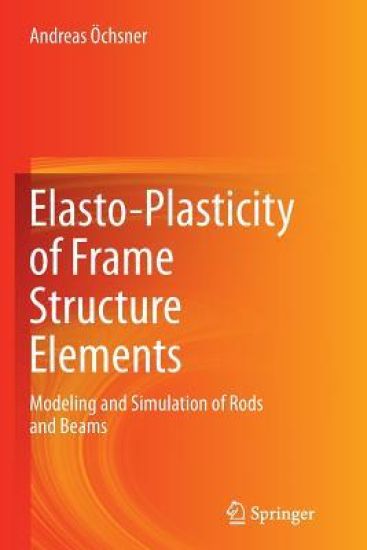
Elasto-Plasticity of Frame Structure Elements

Elasto-Plasticity of Frame Structure Elements

Andreas Öchsner

Springer-Verlag Berlin and Heidelberg GmbH Co. K
2016
nidottu
The finite element method is a powerful tool even for non-linear materials’ modeling. But commercial solutions are limited and many novel materials do not follow standard constitutive equations on a macroscopic scale. Thus, is it required that new constitutive equations are implemented into the finite element code. However, it is not sufficient to simply implement only the equations but also an appropriate integration algorithm for the constitutive equation must be provided. This book is restricted to one-dimensional plasticity in order to reduce and facilitate the mathematical formalism and theory and to concentrate on the basic ideas of elasto-plastic finite element procedures. A comprehensive set of completely solved problems is designed for the thorough understand of the presented theory. After working with this new book and reviewing the provided solved and supplementary problems, it should be much easier to study and understand the advanced theory and the respective text books.
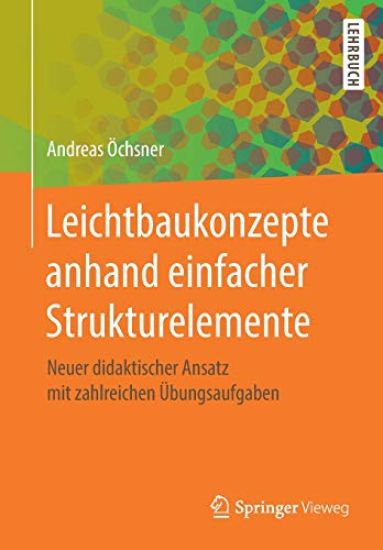
Leichtbaukonzepte anhand einfacher Strukturelemente

Leichtbaukonzepte anhand einfacher Strukturelemente

Andreas Öchsner

Springer-Verlag Berlin and Heidelberg GmbH Co. K
2019
nidottu
In der Ingenieurpraxis werden in der Regel recht komplexe Systeme, auch unter der Verwendung kommerzieller Programmpakete, optimiert. Zur Einführung der unterschiedlichen Leichtbaukonzepte im Rahmen eines Hochschulingenieurstudiums kann jedoch auch zuerst auf einfache Strukturelemente, die im Rahmen der technischen Mechanik vorgestellt werden, zurückgegriffen werden. Die einfachsten Elemente sind hierbei Stäbe und Balken, die neben Federn den eindimensionalen Strukturelementen zugerechnet werden. Anhand dieser Elemente können recht anschaulich Fragestellungen zur Werkstoffauswahl und der geometrischen Gestaltung und Optimierung von lasttragenden Strukturen diskutiert werden. Somit bietet dieses Lehrbuch eine einfache und umfassende „Anleitung“ zur Anwendung der unterschiedlichen Leichtbaukonzepte, wobei der Schwerpunkt auf dem Soff- und Formleichtbau beziehungsweise der Kombination dieser beiden Konzepte liegt.Das Buch wendet sich an Studierende der Ingenieurwissenschaften.
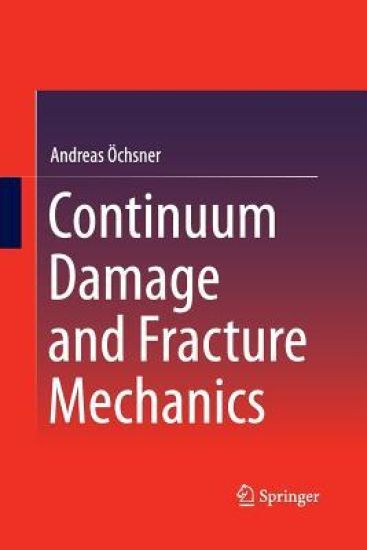
Continuum Damage and Fracture Mechanics

Continuum Damage and Fracture Mechanics

Andreas Öchsner

Springer Verlag, Singapore
2016
nidottu
This textbook offers readers an introduction to fracture mechanics, equipping them to grasp the basic ideas of the presented approaches to modeling in applied mechanicsIn the first part, the book reviews and expands on the classical theory of elastic and elasto-plastic material behavior. A solid understanding of these two topics is the essential prerequisite to advancing to damage and fracture mechanics. Thus, the second part of this course provides an introduction to the treatment of damage and fractures in the context of applied mechanicsWherever possible, the one-dimensional case is first introduced and then generalized in a following step. This departs somewhat from the more classical approach, where first the most general case is derived and then simplified to special cases. In general, the required mathematics background is kept to a minimumTutorials are included at the end of each chapter, presenting the major steps for the solution and offering valuable tips and tricks. The supplementary problems featured in the book
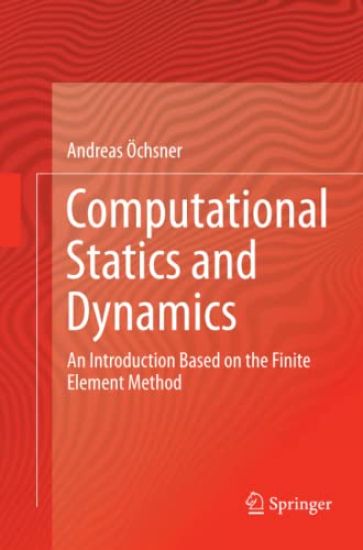
Computational Statics and Dynamics

Computational Statics and Dynamics

Andreas Öchsner

Springer Verlag, Singapore
2018
nidottu
This book introduces readers to modern computational mechanics based on the finite element method. It helps students succeed in mechanics courses by showing them how to apply the fundamental knowledge they gained in the first years of their engineering education to more advanced topics.In order to deepen readers’ understanding of the derived equations and theories, each chapter also includes supplementary problems. These problems start with fundamental knowledge questions on the theory presented in the chapter, followed by calculation problems. In total over 80 such calculation problems are provided, along with brief solutions for each.This book is especially designed to meet the needs of Australian students, reviewing the mathematics covered in their first two years at university. The 13-week course comprises three hours of lectures and two hours of tutorials per week.
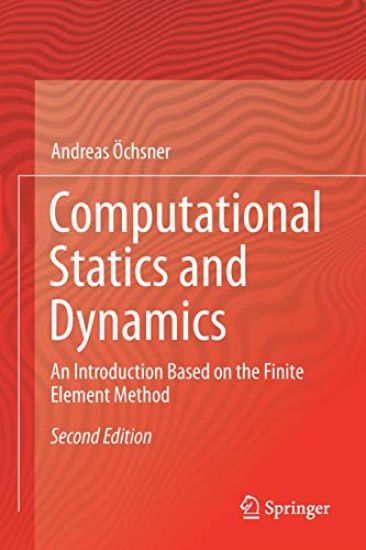
Computational Statics and Dynamics

Computational Statics and Dynamics

Andreas Öchsner

Springer Verlag, Singapore
2021
nidottu
This book is the 2nd edition of an introduction to modern computational mechanics based on the finite element method. It includes more details on the theory, more exercises, and more consistent notation; in addition, all pictures have been revised. Featuring more than 100 pages of new material, the new edition will help students succeed in mechanics courses by showing them how to apply the fundamental knowledge they gained in the first years of their engineering education to more advanced topics. In order to deepen readers’ understanding of the equations and theories discussed, each chapter also includes supplementary problems. These problems start with fundamental knowledge questions on the theory presented in the respective chapter, followed by calculation problems. In total, over 80 such calculation problems are provided, along with brief solutions for each. This book is especially designed to meet the needs of Australian students, reviewing the mathematicscovered in their first two years at university. The 13-week course comprises three hours of lectures and two hours of tutorials per week.
Continuum Damage and Fracture Mechanics

Continuum Damage and Fracture Mechanics

Andreas Öchsner

Springer Verlag, Singapore
2015
sidottu
This textbook offers readers an introduction to fracture mechanics, equipping them to grasp the basic ideas of the presented approaches to modeling in applied mechanicsIn the first part, the book reviews and expands on the classical theory of elastic and elasto-plastic material behavior. A solid understanding of these two topics is the essential prerequisite to advancing to damage and fracture mechanics. Thus, the second part of this course provides an introduction to the treatment of damage and fractures in the context of applied mechanicsWherever possible, the one-dimensional case is first introduced and then generalized in a following step. This departs somewhat from the more classical approach, where first the most general case is derived and then simplified to special cases. In general, the required mathematics background is kept to a minimumTutorials are included at the end of each chapter, presenting the major steps for the solution and offering valuable tips and tricks. The supplementary problems featured in the book
Composite Mechanics

Composite Mechanics

Andreas Öchsner

Springer International Publishing AG
2024
nidottu
This book in the advanced structured materials series provides first an introduction to the mircomechanics of fiber-reinforced laminae, which deals with the prediction of the macroscopic mechanical lamina properties based on the mechanical properties of the constituents, i.e., fibers and matrix.
A Simplified Approach to the Classical Laminate Theory of Composite Materials

A Simplified Approach to the Classical Laminate Theory of Composite Materials

Andreas Öchsner

Springer International Publishing AG
2024
nidottu
This book provides a systematic introduction to composite materials, which are obtained by a layer-wise stacking of one-dimensional bar/beam elements. Each layer may have different mechanical properties but each single layer is considered as isotropic. The major idea is to provide a simplified theory to easier understand the classical two-dimensional laminate theory for composites based on laminae with unidirectional fibers. In addition to the elastic behavior, failure is investigated based on the maximum stress, maximum strain, Tsai-Hill, and the Tsai-Wu criteria. Partial differential equations lay the foundation to mathematically describe the mechanical behavior of any classical structural member known in engineering mechanics, including composite materials. The so-called classical laminate theory provides a simplified stress analysis, and a subsequent failure analysis, without the solution of the system of coupled differential equations for the unknown displacements. Theprocedure provides the solution of a statically indeterminate system based on a generalized stress–strain relationship under consideration of the constitutive relationship and the definition of the so-called stress resultants. This laminate theory is typically provided for two-dimensional plane problems, where the basic structural element is a simple superposition of a classical plane elasticity element with a thin plate element under the consideration of an orthotropic constitutive law. This two-dimensional approach and the underlying advanced continuum mechanical modeling might be very challenging for some students, particularly at universities of applied sciences. Thus, a reduced approach, the so-called simplified classical laminate theory, has been developed. The idea is to use solely isotropic one-dimensional elements, i.e., a superposition of bar and beam elements, to introduce the major calculation steps of the classical laminate theory. Understanding this simplified theory is much easier and the final step it to highlight the differences when moving to the general two-dimensional case.