Kirjojen hintavertailu. Mukana 11 342 296 kirjaa ja 12 kauppaa.

Kirjahaku

Etsi kirjoja tekijän nimen, kirjan nimen tai ISBN:n perusteella.

146 kirjaa tekijältä Benjamin Constant

Adolphe

Adolphe

Benjamin Constant

Penguin Classics
1980
pokkari
Adolphe is a privileged and refined young man, bored by the stupidity he perceives in the world around him. After a number of meaningless conquests, he at last encounters Ellenore, a beautiful and passionate older woman. Adolphe is enraptured and gradually wears down her resistance to his declarations of love. But as they embark on an intense and tortured affair, Ellenore gives way to a flood of emotion that only serves to repel her younger lover - yet he cannot bring himself to leave her and his procrastination can only bring tragedy. Partly inspired by Constant's own stormy affair with Madame de Staël, Adolphe (1816) is a penetrating psychological depiction of love that plumbs the depths of the passions, motives and inconsistencies of the human character.
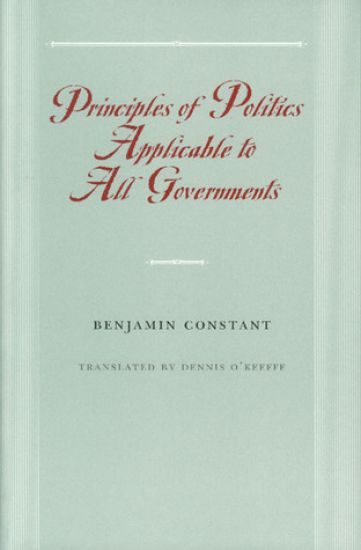
Principles of Politics Applicable to All Governments
Benjamin Constant (1767-1830) was born in Switzerland and became one of France's leading writers, as well as a journalist, philosopher, and politician. His colourful life included a formative stay at the University of Edinburgh; service at the court of Brunswick, Germany; election to the French Tribunate; and initial opposition and subsequent support for Napoleon, even the drafting of a constitution for the Hundred Days. Constant wrote many books, essays, and pamphlets. His deepest conviction was that reform is hugely superior to revolution, both morally and politically. While Constant's fluid, dynamic style and lofty eloquence do not always make for easy reading, his text forms a coherent whole, and in his translation Dennis O'Keeffe has focused on retaining the 'general elegance and subtle rhetoric' of the original. Sir Isaiah Berlin called Constant 'the most eloquent of all defenders of freedom and privacy' and believed to him we owe the notion of 'negative liberty', that is, what Biancamaria Fontana describes as "the protection of individual experience and choices from external interferences and constraints." To Constant it was relatively unimportant whether liberty was ultimately grounded in religion or metaphysics -- what mattered were the practical guarantees of practical freedom -- "autonomy in all those aspects of life that could cause no harm to others or to society as a whole." This translation is based on Etienne Hofmann's critical edition of Principes de politique (1980), complete with Constant's additions to the original work.
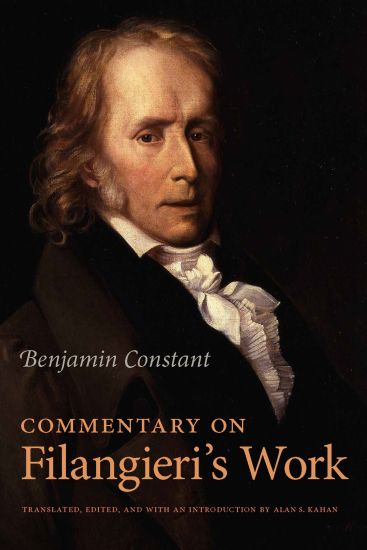
Commentary on Filangieri's Work

Commentary on Filangieri's Work

Benjamin Constant

Liberty Fund Inc
2015
sidottu
"Commentary on Filangieri's Work addresses almost every important political and social question that Constant, one of the most important liberal thinkers of the nineteenth century, ever discussed. Nevertheless, while scholars have always been aware of the work, from the time of its publication onward it has been the subject of little or no sustained discussion in its own right. This translation will help give the work its deserved importance in political theory. The Commentary is founded on the view that government should maintain a strictly limited role in society: "The functions of government are purely negative. It should repress disorder, eliminate obstacles, in a word, prevent evil from arising. Thereafter one can leave it to individuals to find the good." This is Constant's political and economic credo. Thus, Constant makes no distinction between economic liberalism and political liberalism. They both derive from his commitment to individual freedom."
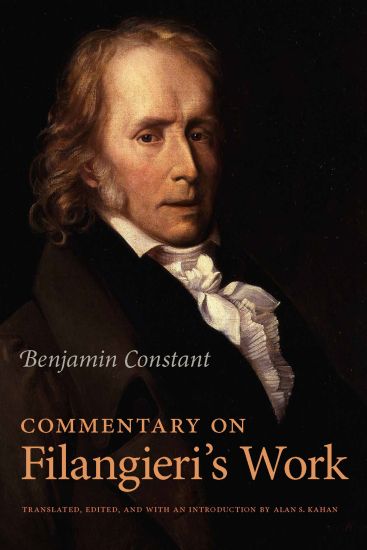
Commentary on Filangieri's Work

Commentary on Filangieri's Work

Benjamin Constant

Liberty Fund Inc
2015
nidottu
"Commentary on Filangieri's Work addresses almost every important political and social question that Constant, one of the most important liberal thinkers of the nineteenth century, ever discussed. Nevertheless, while scholars have always been aware of the work, from the time of its publication onward it has been the subject of little or no sustained discussion in its own right. This translation will help give the work its deserved importance in political theory. The Commentary is founded on the view that government should maintain a strictly limited role in society: "The functions of government are purely negative. It should repress disorder, eliminate obstacles, in a word, prevent evil from arising. Thereafter one can leave it to individuals to find the good." This is Constant's political and economic credo. Thus, Constant makes no distinction between economic liberalism and political liberalism. They both derive from his commitment to individual freedom."
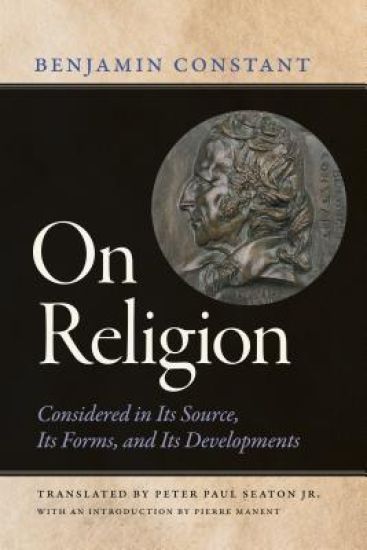
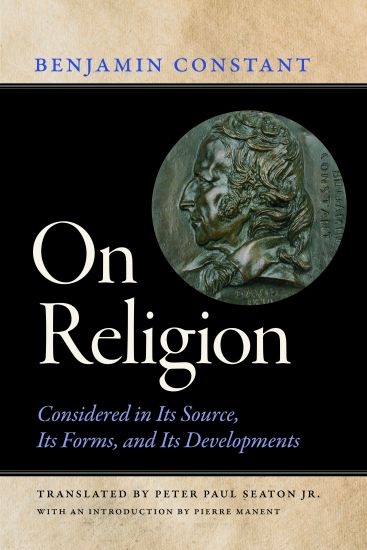
On Religion

On Religion

Benjamin Constant

Liberty Fund Inc
2017
sidottu
This is the first full-length English translation of Benjamin Constants massive study of humanitys religious forms and development, published in five volumes between 1824 and 1831. Constant (17671830) regarded On Religion, worked on over the course of many years, as perhaps his most important philosophical work. He called it the only interest, the only consolation of my life, and the book that I was destined by nature to write. While the recent revival of interest in Constants thought has been welcome and fruitful, it has been incomplete, tending to leave out of account his writings on religion. In this connection, On Religion is essential reading and of interest for many reasons. As an analysis of humanitys religious experience, the work is notable for its methodology. Unlike previous writers with dogmatic commitments, whether theological or philosophical, Constant aimed to work with well-established facts and to relate religious forms to their historical contexts and civilizational developments. In this way, he was a precursor of the scientific study of religion. This objectivity, however, was not tantamount to moral-political neutrality. In the aftermath of the French Revolution, he wanted partisans of the new order to recognize that the religious impulse was natural to the human heart: to extirpate religion was therefore a fools errand and worse. Likewise, he instructed religious reactionaries that history had left them behind: now the natural state of the religious sentiment was an unfettered spirituality left free to find new forms of expression. His counsel to contemporaries has proven prescient concerning subsequent religious developments in democratic and totalitarian societies. In his day, Constant was a consistent liberal, a life-long advocate of representative government, as well as of the central liberal arrangement concerning religion: separation of church and state. But On Religion demonstrates that principled liberalism can turn a sympathetic as well as analytic eye toward religion, and in an unbegrudging way find an important place for it in free society. There are signs that this is a lesson that contemporary liberalism would do well to relearn.
On Religion

On Religion

Benjamin Constant

Liberty Fund Inc
2017
nidottu
This is the first full-length English translation of Benjamin Constants massive study of humanitys religious forms and development, published in five volumes between 1824 and 1831. Constant (17671830) regarded On Religion, worked on over the course of many years, as perhaps his most important philosophical work. He called it the only interest, the only consolation of my life, and the book that I was destined by nature to write. While the recent revival of interest in Constants thought has been welcome and fruitful, it has been incomplete, tending to leave out of account his writings on religion. In this connection, On Religion is essential reading and of interest for many reasons. As an analysis of humanitys religious experience, the work is notable for its methodology. Unlike previous writers with dogmatic commitments, whether theological or philosophical, Constant aimed to work with well-established facts and to relate religious forms to their historical contexts and civilizational developments. In this way, he was a precursor of the scientific study of religion. This objectivity, however, was not tantamount to moral-political neutrality. In the aftermath of the French Revolution, he wanted partisans of the new order to recognize that the religious impulse was natural to the human heart: to extirpate religion was therefore a fools errand and worse. Likewise, he instructed religious reactionaries that history had left them behind: now the natural state of the religious sentiment was an unfettered spirituality left free to find new forms of expression. His counsel to contemporaries has proven prescient concerning subsequent religious developments in democratic and totalitarian societies. In his day, Constant was a consistent liberal, a life-long advocate of representative government, as well as of the central liberal arrangement concerning religion: separation of church and state. But On Religion demonstrates that principled liberalism can turn a sympathetic as well as analytic eye toward religion, and in an unbegrudging way find an important place for it in free society. There are signs that this is a lesson that contemporary liberalism would do well to relearn.