Robinson Crusoe is a novel by Daniel Defoe, first published on 25 April 1719. The first edition credited the work's protagonist Robinson Crusoe as its author, leading many readers to believe he was a real person and the book a travelogue of true incidents. Epistolary, confessional, and didactic in form, the book is presented as an autobiography of the title character (whose birth name is Robinson Kreutznaer)-a castaway who spends 28 years on a remote tropical desert island near Trinidad, encountering cannibals, captives, and mutineers, before ultimately being rescued. The story has been thought to be based on the life of Alexander Selkirk, a Scottish castaway who lived for four years on a Pacific island called "M s a Tierra", now part of Chile, which was renamed Robinson Crusoe Island in 1966, but various literary sources have also been suggested.... PLOT: Crusoe (the family name corrupted from the German name "Kreutznaer") set sail from Kingston upon Hull on a sea voyage in August 1651, against the wishes of his parents, who wanted him to pursue a career in law. After a tumultuous journey where his ship is wrecked in a storm, his lust for the sea remains so strong that he sets out to sea again. This journey, too, ends in disaster, as the ship is taken over by Sal pirates (the Sal Rovers) and Crusoe is enslaved by a Moor. Two years later, he escapes in a boat with a boy named Xury; a captain of a Portuguese ship off the west coast of Africa rescues him. The ship is en route to Brazil. Crusoe sells Xury to the captain. With the captain's help, Crusoe procures a plantation. Years later, Crusoe joins an expedition to bring slaves from Africa, but he is shipwrecked in a storm about forty miles out to sea on an island (which he calls the Island of Despair) near the mouth of the Orinoco river on 30 September 1659. 5] He observes the latitude as 9 degrees and 22 minutes north. He sees penguins and seals on his island. As for his arrival there, only he and three animals, the captain's dog and two cats, survive the shipwreck. Overcoming his despair, he fetches arms, tools and other supplies from the ship before it breaks apart and sinks. He builds a fenced-in habitat near a cave which he excavates. By making marks in a wooden cross, he creates a calendar. By using tools salvaged from the ship, and some he makes himself from "ironwood", he hunts, grows barley and rice, dries grapes to make raisins, learns to make pottery and raises goats. He also adopts a small parrot. He reads the Bible and becomes religious, thanking God for his fate in which nothing is missing but human society. More years pass and Crusoe discovers native cannibals, who occasionally visit the island to kill and eat prisoners. At first he plans to kill them for committing an abomination but later realizes he has no right to do so, as the cannibals do not knowingly commit a crime. He dreams of obtaining one or two servants by freeing some prisoners; when a prisoner escapes, Crusoe helps him, naming his new companion "Friday" after the day of the week he appeared. Crusoe then teaches him English and converts him to Christianity....... Daniel Defoe (13 September 1660 - 24 April 1731), born Daniel Foe, was an English trader, writer, journalist, pamphleteer and spy. He is most famous for his novel Robinson Crusoe, which is second only to the Bible in its number of translations. Defoe is noted for being one of the earliest proponents of the novel, as he helped to popularise the form in Britain with others such as Aphra Behn and Samuel Richardson, and is among the founders of the English novel. Defoe wrote many political tracts and often was in trouble with the authorities, including prison time. Intellectuals and political leaders paid attention to his fresh ideas and sometimes consulted with him....
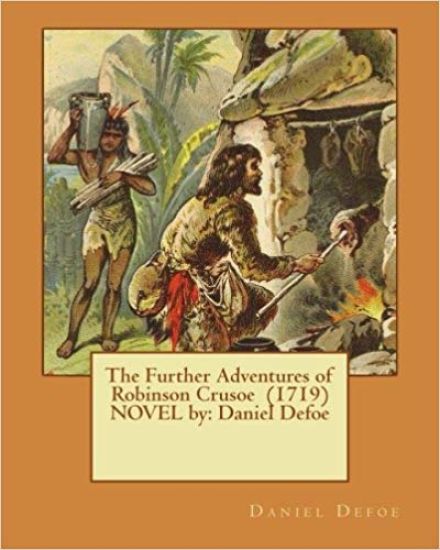
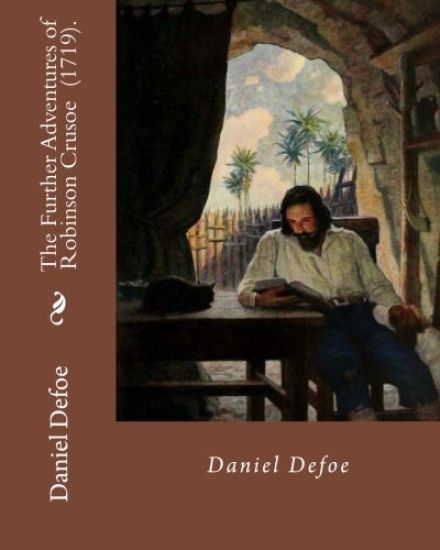
The Farther Adventures of Robinson Crusoe (now more commonly rendered as "The Further adventures of Robinson Crusoe") is a novel by Daniel Defoe, first published in 1719. Just as in its significantly more popular predecessor, Robinson Crusoe (1719), the first edition credits the work's fictional protagonist Robinson Crusoe as its author. It was published under the considerably longer original title: The Farther Adventures of Robinson Crusoe; Being the Second and Last Part of His Life, And of the Strange Surprising Accounts of his Travels Round three Parts of the Globe. Although intended to be the last Crusoe tale, the novel is followed by non-fiction book involving Crusoe by Defoe entitled Serious Reflections During the Life and Surprising Adventures of Robinson Crusoe: With his Vision of the Angelick World (1720). The story is speculated to be partially based on Moscow embassy secretary Adam Brand's journal detailing the embassy's journey from Moscow to Peking from 1693 to 1695. Plot summary The book starts with the statement about Crusoe's marriage in England. He bought a little farm in Bedford and had three children: two sons and one daughter. Our hero suffered a distemper and a desire to see "his island." He could talk of nothing else, and one can imagine that no one took his stories seriously, except his wife. She told him, in tears, "I will go with you, but I won't leave you." But in the middle of this felicity, Providence unhinged him at once, with the loss of his wife.......................... Daniel Defoe (13 September 1660 - 24 April 1731), born Daniel Foe, was an English trader, writer, journalist, pamphleteer and spy. He is most famous for his novel Robinson Crusoe, which is second only to the Bible in its number of translations. Defoe is noted for being one of the earliest proponents of the novel, as he helped to popularise the form in Britain with others such as Aphra Behn and Samuel Richardson, and is among the founders of the English novel. Defoe wrote many political tracts and often was in trouble with the authorities, including prison time. Intellectuals and political leaders paid attention to his fresh ideas and sometimes consulted with him. Defoe was a prolific and versatile writer, producing more than three hundred works-books, pamphlets, and journals-on diverse topics, including politics, crime, religion, marriage, psychology, and the supernatural. He was also a pioneer of business journalism and economic journalism. Early life: Daniel Foe (his original name) was born on 13 September, 1660, likely in Fore Street in the parish of St. Giles Cripplegate, London. Defoe later added the aristocratic-sounding "De" to his name, and on occasion claimed descent from the family of De Beau Faux. His birthdate and birthplace are uncertain, and sources offer dates from 1659 to 1662, with the summer or early autumn of 1660 considered the most likely. His father James Foe was a prosperous tallow chandler and a member of the Worshipful Company of Butchers. In Defoe's early life, he experienced some of the most unusual occurrences in English history: in 1665, 70,000 were killed by the Great Plague of London, and next year, the Great Fire of London left standing only Defoe's and two other houses in his neighbourhood. In 1667, when he was probably about seven, a Dutch fleet sailed up the Medway via the River Thames and attacked the town of Chatham in the raid on the Medway. His mother Annie had died by the time he was about ten....
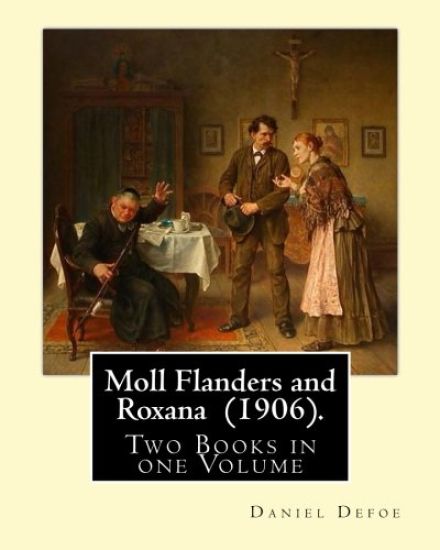
Moll's mother is a convict in Newgate Prison in London who is given a reprieve by "pleading her belly," a reference to the custom of staying the executions of pregnant criminals. Her mother is eventually transported to Colonial United States, and Moll Flanders (not her birth name, she emphasizes, taking care not to reveal it) is raised from the age of three until adolescence by a goodly foster mother. Thereafter she gets attached to a household as a servant where she is loved by both sons, the elder of whom convinces her to "act like they were married" in bed. Unwilling to marry her, he persuades her to marry his younger brother. After five years of marriage, she then is widowed, leaves her children in the care of in-laws, and begins honing the skill of passing herself off as a fortuned widow to attract a man who will marry her and provide her with security. The first time she does this, her "gentleman-tradesman" spendthrift husband goes bankrupt and flees to the Continent, leaving her on her own with his blessing to do the best she can to forget him. (They had one child together, but "it was buried.") The second time, she makes a match that leads her to Virginia with a kindly man who introduces her to his mother. After three children (one dies), Moll learns that her mother-in-law is actually her biological mother, which makes her husband her half-brother. She dissolves their marriage and after continuing to live with her brother for three years, travels back to England, leaving her two children behind, and goes to live in Bath to seek a new husband................... Roxana: The Fortunate Mistress (full title: The Fortunate Mistress: Or, A History of the Life and Vast Variety of Fortunes of Mademoiselle de Beleau, Afterwards Called the Countess de Wintselsheim, in Germany, Being the Person known by the Name of the Lady Roxana, in the Time of King Charles II) is a 1724 novel by Daniel Defoe.PLOT: Born in France, from which her parents fled because of religious persecution, Roxana grew to adolescence in England. At the age of fifteen, she married a handsome but conceited man. After eight years of marriage, during which time her husband went through all of their money, Roxana is left penniless with five children. She appeals for aid to her husband's relatives, all of whom refuse her except one old aunt, who is in no position to help her materially. Amy, Roxana's maid, refuses to leave her mistress although she receives no wages for her work. Another poor old woman whom Roxana had aided during her former prosperity adds her efforts to those of the old aunt and Amy. These good people manage to extract money from the relatives of the children's father, and all five of the little ones are given over to the care of the poor old woman. Roxana is penniless and at the point of despair when Mr. --, her landlord, after expressing his admiration for her, praises her fortitude under all of her difficulties and offers to set her up in housekeeping. He returns all the furniture he had confiscated, gives her food and money, and generally conducts himself with such kindness and candor that Amy urges Roxana to become the gentleman's mistress should he ask it. Roxana, however, clings to her virtuous independence. Fearing that the gentleman's kindness will go unrewarded, Amy, because she loves her mistress, offers to lie with the landlord in Roxana's place. This offer, however, Roxana refuses to consider. The two women talk much about the merits of the landlord, his motive in befriending Roxana, and the moral implications of his attentions..... Daniel Defoe (13 September 1660 - 24 April 1731), born Daniel Foe, was an English trader, writer, journalist, pamphleteer and spy. He is most famous for his novel Robinson Crusoe, which is second only to the Bible in its number of translations......
Robinson Crusoe is an English man from the town of York who is the youngest son of a merchant of German origin. His parents wish him to study law and would like to see him as a great lawyer but Crusoe has some other plan. He shows his wish to go to sea, but his family, especially his father is against his wish. His father tries to convince him to give up his dream to go to sea but Crusoe is determined.He sets out his sea voyage to London with his friend. At the mean time Crusoe and his friend have narrow escape in the storm. Because of this his friend refuses to go further and returns home, but Crusoe still goes on so as to become a sea merchant. The trip is successful in terms of finance and he plans another voyage, leaving his earning in the care of a friendly widow. At this time his ship is seized by Moorish pirates and he is made a slave in the North African town of Sallee. One day while fishing, he and another slave named Xury escape and sail down to the African coast. One Portuguese captain helps them: he buys Xury from Crusoe and takes him to Brazil. In Brazil he starts plantation and earns a good fortune from it. Knowing the economic advantage of slave trade, he goes to West Africa but unfortunately gets shipwrecked.
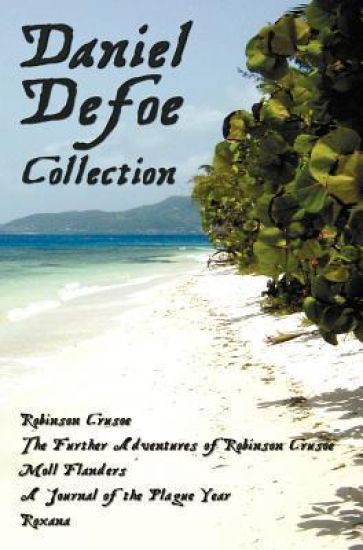
"Robinson Crusoe" was a castaway as a result of a terrible storm at sea. He was left with only a knife, some tobacco and a pipe. And so starts his education in how to survive, he learns how to build a canoe, make bread, and endure endless solitude. Until twenty-four years later he meets another human being. Robinson Crusoe has been praised by such writers as James Joyce, Virginia Woolf, and Samuel Johnson as one of the greatest novels in the English language. "The Further Adventures of Robinson Crusoe" start in England, where he is married with three children and has bought a farm. But he is desperate to see his island and can think of nothing else. His wife tells his she will go with him but then dies. And so the story unfolds and the travelling begins taking us back to the island, to Madagascar, Southeast Asia and China and then on to Siberia. "Moll Flanders" was also praised by Virginia Woolf, saying it was one of the "few English novels which we can call indisputably great." Defoe wrote this story under a pseudonym, giving the impression that the story was actually an autobiography. The tale is a journey from rags to riches of a woman who was born in prison and ascends to wealth and status. Defoe catalogues her misdemeanours, her spirit, her determination and her varied careers from a prostitute, a charming and faithful wife, a thief, and a convict. The title page gives the synopsis: "The Fortunes & Misfortunes of the Famous Moll Flanders &c. Who was Born in Newgate, and during a Life of continu'd Variety for Threescore Years, besides her Childhood, was Twelve Year a Whore, five times a Wife (whereof once to her own Brother), Twelve Year a Thief, Eight Year a Transported Felon in Virginia, at last grew Rich, liv'd Honest, and dies a Penitent. Written from her own Memorandums . . ." "A Journal of the Plague Year" chronicles the year 1665, when the Great Plague swept through London, claiming nearly 100,000 lives. Defoe so vividly chronicles the progress of the disease that this book has frequently been miscategorised as "non-fiction". Defoe is utterly convincing and this book transports us to the city, through the deserted streets and beside the houses with crosses daubed on their doors, introduces us to the citizens and we feel with them the horror, fear and hysteria growing. "Roxana" is Defoe's last and darkest novel. Again it is an autobiography of a woman who has traded her virtue, at first for survival, and then for fame and fortune. This woman is well aware of the price she is paying and of her weaknesses. She tries to learn the lessons of her trails and struggles in life. But unlike his other characters, she fails conquer these weaknesses.
La collection Conna tre une oeuvre vous offre la possibilit de tout savoir de Robinson Cruso de Daniel Defoe gr ce une fiche de lecture aussi compl te que d taill e. La r daction, claire et accessible, a t confi e un sp cialiste universitaire. Cette fiche de lecture r pond une charte qualit mise en place par une quipe d'enseignants. Ce livre contient la biographie de Daniel Defoe, la pr sentation de Robinson Cruso , le r sum d taill , les raisons du succ s, les th mes principaux et l' tude du mouvement litt raire de l'auteur.
The Works of Daniel Defoe - Carefully Selected from the Most Authentic Sources with a Life of the Author is an unchanged, high-quality reprint of the original edition of 1869. Hansebooks is editor of the literature on different topic areas such as research and science, travel and expeditions, cooking and nutrition, medicine, and other genres. As a publisher we focus on the preservation of historical literature. Many works of historical writers and scientists are available today as antiques only. Hansebooks newly publishes these books and contributes to the preservation of literature which has become rare and historical knowledge for the future.