

Kirjahaku
Etsi kirjoja tekijän nimen, kirjan nimen tai ISBN:n perusteella.
32 kirjaa tekijältä David Bohm


Aldri har det vært mer påkrevet å kunne lytte til hverandre og kommunisere med hverandre. Aldri har vi hatt mer komplekse problemer å takle i organisasjoner, i næringsliv og politikk og i samfunnet generelt. Den verdenskjente filosofen og fysikeren David Bohm (1917-1992) - en av våre mest nyskapende tenkere i siste halvdel av det tjuende århundret - var smertelig klar over dette og arbeidet i flere tiår med kreativ dialog som metode til god kommunikasjon. Her finner vi * den frie flyt av tanker og meninger * hvordan vi lytter og gir rom * hvordan vi får innsikt i underliggende antakelser og forutsetninger * hvordan vi klarlegger intensjoner og meningsinnhold og utforsker nye muligheter og en rekke andre sider ved dialogen, levende og klart fremstilt.
Denne korte bog fremsætter den verdensberømte fysiker David Bohms teorier om dialogens formåen. Bohm mener at behovet for konstruktiv dialog aldrig har været større. Med et væld af kommunikationsmetoder i bagagen, fortjener vores kommunikationsmåder også at blive plejet. Med denne bog, pointerer Bohm, trodser læseren vores tids tendenser til kynisme, og opnår dermed potentiale til at udrettet exceptionelle ting. Dialogens deltagere har potentiale til at forny deres formål ved at dele deres forforståelse og antagelser. Netop dette potentiale, der er gemt i mennesket, ligger også til grund for Bohms dialogforståelse. For at skabe forandring må vi forstå hinanden og vores forudindtagethed. Ved at blive bedre til at lytte og tilsidesætte vores fordomme, kan læseren overkomme komplekse problemer i organisationer, forretninger og samfund.
First published in 1995. Bohm, one of the foremost scientific thinkers of our time, and Hiley present a completely original approach to quantum theory which will alter our understanding of the world and reveal that a century of modern physics needs to be reconsidered.
In the The Undivided Universe, David Bohn and Basil Hiley present a radically different approach to quantum theory. They develop an interpretation of quantum mechanics which gives a clear, intuitive understanding of its meaning and in which there is a coherent notion of the reality of the universe without assuming a fundamental role for the human observer. With the aid of new concepts such as active information together with non-locality, they provide a comprehensive account of all the basic features of quantum mechanics, including the relativistic domain and quantum field theory. It is shown that, with the new approach, paradoxical or unsatisfactory features associated with the standard approaches, such as the wave-particle duality and the collapse of the wave function, do not arise. Finally, the authors make new suggestions and indicate some areas in which one may expect quantum theory to break down in a way that will allow for a test.The Undivided Universe is an important book especially because it provides a different overall world view which is neither mechanistic nor reductionist. This view will ultimately have radical implications not only in physics but also in our general approach to all areas of life.
In Science, Order and Creativity, David Bohm and F. David Peat argue that science has lost its way in recent years and needs to go beyond a narrow and fragmented view of nature and embrace a wider holistic view that restores the importance of creativity and communication for all humanity - not just scientists. The result of a close collaboration by one of the 20th century's greatest physicists and thinkers, David Bohm, with leading science writer F. David Peat, provides a rare combination of profound reflection and clear exposition that can be appreciated by anyone concerned with science and its importance in our lives. This new edition includes a new preface and an extended additional chapter by Peat which draws upon further discussions with David Bohm before the latter's death in 1992. A fascinating diagnosis and considered proposal for a cure for science's ills, it is also very accessible entry point to the work of David Bohm. Bohm and Peat contend that science has lost its bearings in the last century in favour of a narrow, abstracted, fragmented approach to nature and reality. Tracing the history of science, Bohm and Peat offer intriguing new insights into how scientific theories come into being, how to eliminate blocks of creativity and how science can lead to a deeper understanding of society, the human condition and the human mind itself.
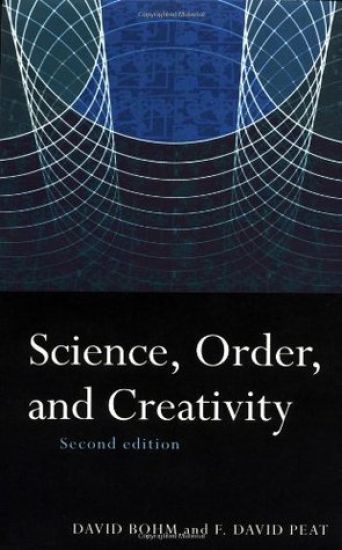
In Science, Order and Creativity, David Bohm and F. David Peat argue that science has lost its way in recent years and needs to go beyond a narrow and fragmented view of nature and embrace a wider holistic view that restores the importance of creativity and communication for all humanity - not just scientists. The result of a close collaboration by one of the 20th century's greatest physicists and thinkers, David Bohm, with leading science writer F. David Peat, provides a rare combination of profound reflection and clear exposition that can be appreciated by anyone concerned with science and its importance in our lives. This new edition includes a new preface and an extended additional chapter by Peat which draws upon further discussions with David Bohm before the latter's death in 1992. A fascinating diagnosis and considered proposal for a cure for science's ills, it is also very accessible entry point to the work of David Bohm. Bohm and Peat contend that science has lost its bearings in the last century in favour of a narrow, abstracted, fragmented approach to nature and reality. Tracing the history of science, Bohm and Peat offer intriguing new insights into how scientific theories come into being, how to eliminate blocks of creativity and how science can lead to a deeper understanding of society, the human condition and the human mind itself.
The Limits of Thought is a series of penetrating dialogues between the great spiritual leader, J. Krishnamurti and the renowned physicist, David Bohm.The starting point of their engaging exchange is the question: If truth is something different than reality, then what place has action in daily life in relation to truth and reality? We see Bohm and Krishnamurti explore the nature of consciousness and the condition of humanity. These enlightening dialogues address issues of truth, desire awareness, tradition, and love.Limits of Thought is an important book by two very respected and important thinkers. Anyone interested to see how Krishnamurti and Bohm probe some of the most essential questions of our very existence will be drawn to this great work.
The Limits of Thought is a series of penetrating dialogues between the great spiritual leader, J. Krishnamurti and the renowned physicist, David Bohm.The starting point of their engaging exchange is the question: If truth is something different than reality, then what place has action in daily life in relation to truth and reality? We see Bohm and Krishnamurti explore the nature of consciousness and the condition of humanity. These enlightening dialogues address issues of truth, desire awareness, tradition, and love.Limits of Thought is an important book by two very respected and important thinkers. Anyone interested to see how Krishnamurti and Bohm probe some of the most essential questions of our very existence will be drawn to this great work.

One of the foremost scientists and thinkers of our time, David Bohm worked alongside Oppenheimer and Einstein. In Science, Order and Creativity he and physicist F. David Peat propose a return to greater creativity and communication in the sciences. They ask for a renewed emphasis on ideas rather than formulae, on the whole rather than fragments, and on meaning rather than mere mechanics. Tracing the history of science from Aristotle to Einstein, from the Pythagorean theorem to quantum mechanics, the authors offer intriguing new insights into how scientific theories come into being, how to eliminate blocks to creativity and how science can lead to a deeper understanding of society, the human condition and the human mind itself. Science, Order and Creativity looks to the future of science with elegance, hope and enthusiasm.

One of the foremost scientists and thinkers of our time, David Bohm worked alongside Oppenheimer and Einstein. In Science, Order and Creativity he and physicist F. David Peat propose a return to greater creativity and communication in the sciences. They ask for a renewed emphasis on ideas rather than formulae, on the whole rather than fragments, and on meaning rather than mere mechanics. Tracing the history of science from Aristotle to Einstein, from the Pythagorean theorem to quantum mechanics, the authors offer intriguing new insights into how scientific theories come into being, how to eliminate blocks to creativity and how science can lead to a deeper understanding of society, the human condition and the human mind itself. Science, Order and Creativity looks to the future of science with elegance, hope and enthusiasm.