Kirjojen hintavertailu. Mukana 12 411 141 kirjaa ja 12 kauppaa.

Kirjahaku

Etsi kirjoja tekijän nimen, kirjan nimen tai ISBN:n perusteella.

124 kirjaa tekijältä David Doyle

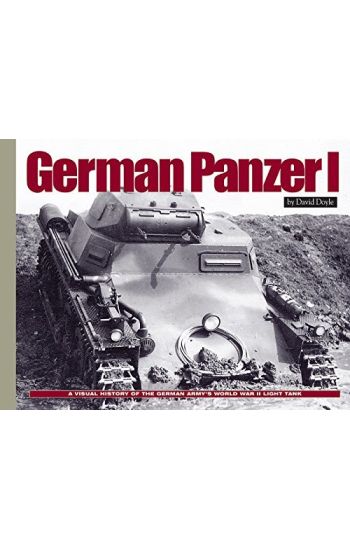
German Panzer I

German Panzer I

David Doyle

Casemate UK
2016
sidottu
Clandestinely developed during the post WWI-era during which Germany was forbidden from developing, producing or owning armored combat vehicles, the Panzer I served as a proof of concept. Manufacturers and engineers became acquainted with the creation of modern fully tracked combat vehicles and soldiers were familiarized with the driving, maintenance, logistics entailed by fielding an armored force. Once war began, not only did these experience prove invaluable, the tanks themselves, armed only with twin machine guns, nevertheless proved formidable weapons against ill-prepared enemies. Spread through 168 hardbound pages, over 200 photos document all variations of this, the cornerstone upon which Germany's famed panzer force was built.
Vehicles and Heavy Weapons of the Vietnam War
The ground war in Vietnam pitted a myriad of American tanks, artillery, APC and trucks against not only the weapons of Communist North Vietnam, but also the terrain. Through archival images, the arsenal of the US Army and USMC are revisited. From the iconic M113 APC to the M48A3 tank, M551 Armored Reconnaissance/Airborne Assault Vehicle, M151 and M54 trucks, M50 Ontos, M107 and M109 artillery, and M42 Duster, the complete array of vehicles fielded is shown. This book, the first in a series on the US military's weapons, vehicles, aircraft, and naval vessels of the Vietnam War, offers a highly illustrated reference for this wishing to delve deeper into this conflict.
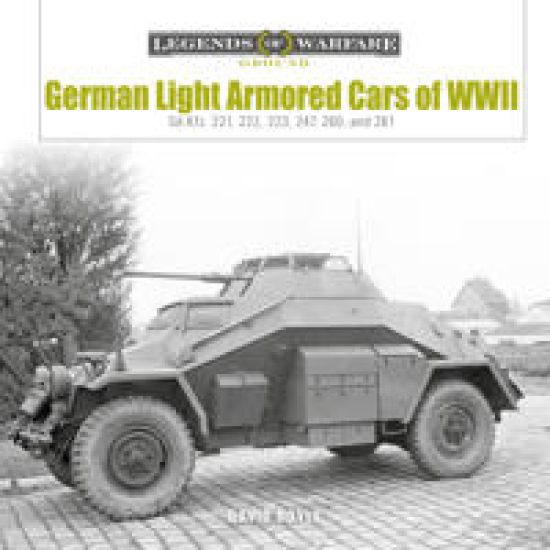
German Light Armored Cars of WWII

German Light Armored Cars of WWII

David Doyle

SCHIFFER PUBLISHING LTD
2026
sidottu
A pictorial guide to the light armored cars operated by the Wehrmacht during the Second World War The German military operated a variety of light armored cars during the Second World War. These vehicles were categorized under the umbrella of "Sonderkraftfahrzeug" (abbreviated as Sd.Kfz.), which translates roughly to special-use vehicle. The first of these purpose-built light armored cars was the Sd.Kfz. 221, which entered series production in 1935. The 221 served as the basis for the more heavily armed Sd.Kfz. 222. The 221 was once again repurposed into a mobile communications platform designated Sd.Kfz. 223. The Sd.Kfz. 260 and 261 were much like the Sd.Kfz. 223 but without armament. An entirely different chassis was implemented for the Sd.Kfz. 247 command vehicle, which was supplied in both six- and four-wheel variants. This work is inclusive of all the above designations of armored car. It includes more than 150 images with detailed captions. These contents are useful for identifying and differentiating German light armored cars and provide a clear technical description of both interior and exterior details.
Money Flows

Money Flows

Catherine De Vries; David Doyle; Hector Solaz; Katerina Tertytchnaya

Oxford University Press
2024
sidottu
Remittances, the repatriated earnings of emigrant workers, have risen spectacularly in recent decades. They are a crucial lifeline for the households that receive them and one of the largest sources of capital for developing economies, outstripping both aid and foreign direct investment. Money Flows studies how remittances shape the relationship between remittance recipients and the authorities in migrant-sending countries by providing a comprehensive study of the political effects of remittances on the attitudes of their recipients. It argues that far from being an exclusively economic risk-sharing mechanism between poorer, migrant-sending, and richer, migrant-receiving economies, remittances may compromise rudimentary accountability mechanisms in the developing world. The book leverages survey data from Central-Eastern Europe, the Caucasus, and Central Asia and original focus groups from Kyrgyzstan. It shows how remittances, and fluctuations in their volume, colour recipients' economic evaluations; shape the burden of corruption; and change how recipients interact with, and view their state, ultimately impacting the approval function of the authorities.