Kirjojen hintavertailu. Mukana 11 699 587 kirjaa ja 12 kauppaa.

Kirjahaku

Etsi kirjoja tekijän nimen, kirjan nimen tai ISBN:n perusteella.

112 kirjaa tekijältä David Roberts

The Ba'th and the Creation of Modern Syria (RLE Syria)
This book traces the development of modern Syria focusing on the contribution of the Ba’th party and Ba’thist ideology. It examines the roots of the Ba’th in the intellectual ferment of the 1940s and charts its growing influence on Syrian politics. Special attention is devoted to the crucial Sixth Congress of the Ba’th Party in 1963 and the key ideological document, the Muntalaqat, produced by Michel Aflaq. After 1963 the military became increasingly dominant until Hafiz al-Asad came to power in 1970. Since then the Party has been less dominant internally but Syria itself has established a pivotal position in regional affairs. The book concludes by reviewing the prospects for Syria after Asad and the potential for a Ba’thist revival.
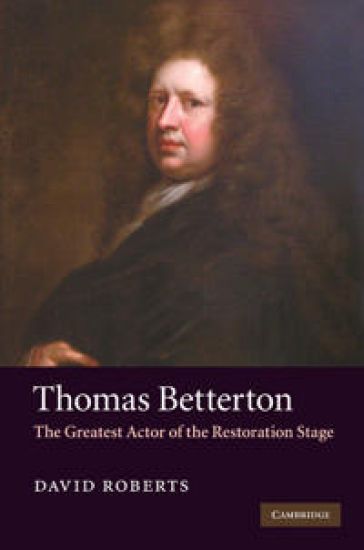
Thomas Betterton

Thomas Betterton

David Roberts

Cambridge University Press
2010
sidottu
Restoration London's leading actor and theatre manager Thomas Betterton has not been the subject of a biography since 1891. He worked with all the best-known playwrights of his age and with the first generation of English actresses; he was intimately involved in the theatre's responses to politics, and became a friend of leading literary men such as Pope and Steele. His innovations in scenery and company management, and his association with the dramatic inheritance of Shakespeare, helped to change the culture of English theatre. David Roberts's entertaining study unearths new documents and draws fresh conclusions about this major but shadowy figure. It contextualizes key performances and examines Betterton's relationship to patrons, colleagues and family, as well as to significant historical moments and artefacts. The most substantial study available of any seventeenth-century actor, Thomas Betterton gives one of England's greatest performing artists his due on the tercentenary of his death.
Political Transition in Cambodia 1991-99

Political Transition in Cambodia 1991-99

David Roberts

RoutledgeCurzon
2000
sidottu
This book illustrates the limits to the 1990s UNTAC peacekeeping intervention in Cambodia and raises a critical challenge to the assumptions underpinning key tenets of the 'Liberal Project' as a mechanism for resolving complex, severe struggles for elite political power in developing countries.The book highlights the limitations of externally imposed power-sharing. In the case of Cambodia, the imagined effect was a coalition that would share power democratically. However, this approach was appropriate only for resolving the superpower conflict that had created Cambodia's war. Rather than bringing long-term peace to Cambodia, Roberts argues, it created the temporary illusion of a democratic system that in fact recreated the military conflict and housed it in a superficial coalition.The book challenges assumptions regarding the inevitability of the globalization of liberalism as a means of ordering non-western societies. It explains the failure of democratic transition in terms of the impropriety and weakness of the plan which preceded it, and in terms of the elite's traditional reliance on absolutism and resistance to the concept of 'Opposition'.
Political Transition in Cambodia 1991-99

Political Transition in Cambodia 1991-99

David Roberts

RoutledgeCurzon
2000
nidottu
This book illustrates the limits to the 1990s UNTAC peacekeeping intervention in Cambodia and raises a critical challenge to the assumptions underpinning key tenets of the 'Liberal Project' as a mechanism for resolving complex, severe struggles for elite political power in developing countries.The book highlights the limitations of externally imposed power-sharing. In the case of Cambodia, the imagined effect was a coalition that would share power democratically. However, this approach was appropriate only for resolving the superpower conflict that had created Cambodia's war. Rather than bringing long-term peace to Cambodia, Roberts argues, it created the temporary illusion of a democratic system that in fact recreated the military conflict and housed it in a superficial coalition.The book challenges assumptions regarding the inevitability of the globalization of liberalism as a means of ordering non-western societies. It explains the failure of democratic transition in terms of the impropriety and weakness of the plan which preceded it, and in terms of the elite's traditional reliance on absolutism and resistance to the concept of 'Opposition'.
Bangor University 1884-2009

Bangor University 1884-2009

David Roberts

University of Wales Press
2009
sidottu
Relates to one of Wales' most important institutions of higher education, covering its history from its creation in 1884 as the University College of North Wales, its incarnation as the University of Wales, Bangor and to its 125th anniversary in 2009. This book traces the growth and development of the institution.
Prifysgol Bangor 1884-2009

Prifysgol Bangor 1884-2009

David Roberts

University of Wales Press
2009
sidottu
Relates to one of Wales' most important institutions of higher education, covering its history from its creation in 1884 as the University College of North Wales, its incarnation as the University of Wales, Bangor and to its 125th anniversary in 2009. This book traces the institution's origins as an 18th century coaching inn with just 58 students.
Once They Moved Like The Wind 49
The combined military might of two great mations succeeded in capturing not a single Chiricagua, not even a child.' From the Preface. Of the many tales of conflict and warfare between the US Government and the Indian tribes, perhaps none is more dramatic or revealing than the story of the Apache wars.
The Pueblo Revolt: The Secret Rebellion That Drove the Spaniards Out of the Southwest
The dramatic and tragic story of the only successful Native American uprising against the Spanish, the Pueblo Revolt of 1680. With the conquest of New Mexico in 1598, Spanish governors, soldiers, and missionaries began their brutal subjugation of the Pueblo Indians in what is today the Southwestern United States. This oppression continued for decades, until, in the summer of 1680, led by a visionary shaman named Pope, the Puebloans revolted. In total secrecy they coordinated an attack, killing 401 settlers and soldiers and routing the rulers in Santa Fe. Every Spaniard was driven from the Pueblo homeland, the only time in North American history that conquering Europeans were thoroughly expelled from Indian territory. Yet today, more than three centuries later, crucial questions about the Pueblo Revolt remain unanswered. How did Pope succeed in his brilliant plot? And what happened in the Pueblo world between 1680 and 1692, when a new Spanish force reconquered the Pueblo peoples with relative ease? David Roberts set out to try to answer these questions and to bring this remarkable historical episode to life. He visited Pueblo villages, talked with Native American and Anglo historians, combed through archives, discovered backcountry ruins, sought out the vivid rock art panels carved and painted by Puebloans contemporary with the events, and pondered the existence of centuries-old Spanish documents never seen by Anglos.
Boosters and Barkers

Boosters and Barkers

David Roberts

University of British Columbia Press
2023
sidottu
"Stick it, Canada! Buy more Victory Bonds." The First World War demanded deep personal sacrifice on the battlefield and on the home front – and it also made unrelenting financial demands. Boosters and Barkers is a highly original examination of the drive to finance Canadian participation in the conflict. David Roberts examines Ottawa's calls for direct public contributions in the form of war bonds; the intersections with imperial funding, taxation, and conventional revenue; and the substantial fiscal implications of participation in the conflict during and after the war. Canada's bond campaigns used print, images, and music to sell both the war and public engagement. They received an astounding response, generating revenue to cover almost a third of the country's total war costs, which were estimated at $6.6 billion – a dramatic charge on a dominion so far from the front. This story is one of inexorable need, shrewd propaganda, resistance, engagement, and long-term consequences.
Boosters and Barkers

Boosters and Barkers

David Roberts

University of British Columbia Press
2024
pokkari
"Stick it, Canada! Buy more Victory Bonds." The First World War demanded deep personal sacrifice on the battlefield and on the home front – and it also made unrelenting financial demands. Boosters and Barkers is a highly original examination of the drive to finance Canadian participation in the conflict. David Roberts examines Ottawa's calls for direct public contributions in the form of war bonds; the intersections with imperial funding, taxation, and conventional revenue; and the substantial fiscal implications of participation in the conflict during and after the war. Canada's bond campaigns used print, images, and music to sell both the war and public engagement. They received an astounding response, generating revenue to cover almost a third of the country's total war costs, which were estimated at $6.6 billion – a dramatic charge on a dominion so far from the front. This story is one of inexorable need, shrewd propaganda, resistance, engagement, and long-term consequences.
The Total Work of Art in European Modernism

The Total Work of Art in European Modernism

David Roberts

Cornell University Press and Cornell University Library
2011
pokkari
In this groundbreaking book David Roberts sets out to demonstrate the centrality of the total work of art to European modernism since the French Revolution. The total work of art is usually understood as the intention to reunite the arts into the one integrated whole, but it is also tied from the beginning to the desire to recover and renew the public function of art. The synthesis of the arts in the service of social and cultural regeneration was a particularly German dream, which made Wagner and Nietzsche the other center of aesthetic modernism alongside Baudelaire and Mallarmé. The history and theory of the total work of art pose a whole series of questions not only to aesthetic modernism and its utopias but also to the whole epoch from the French Revolution to the totalitarian revolutions of the twentieth century. The total work of art indicates the need to revisit key assumptions of modernism, such as the foregrounding of the autonomy and separation of the arts at the expense of the countertendencies to the reunion of the arts, and cuts across the neat equation of avant-gardism with progress and deconstructs the familiar left-right divide between revolution and reaction, the modern and the antimodern. Situated at the interface between art, religion, and politics, the total work of art invites us to rethink the relationship between art and religion and art and politics in European modernism. In a major departure from the existing literature David Roberts argues for twin lineages of the total work, a French revolutionary and a German aesthetic, which interrelate across the whole epoch of European modernism, culminating in the aesthetic and political radicalism of the avant-garde movements in response to the crisis of autonomous art and the accelerating political crisis of European societies from the 1890s forward.
Art and Enlightenment

Art and Enlightenment

David Roberts

University of Nebraska Press
2006
pokkari
The crisis of tradition early in the twentieth century—signaled by the collapse of perspective in painting and tonality in music and evident in the explosive ferment of the avant-garde movements—opened a new stage of modern art, which aesthetic theory is still struggling to comprehend. David Roberts situates the current aesthetic and cultural debates in a wider historical frame which extends from Hegel and the German Romantics to Lukács and Adorno, Benjamin and Baudrillard. Art and Enlightenment: Aesthetic Theory after Adorno is the first detailed analysis in English of Theodor Adorno's seminal Philosophy of Modern Music, which can be seen as a turning point between modern and postmodern art and theory. Adorno's diagnosis of the crisis of modernist values points back to Hegel's thesis of the end of art and also forward to the postmodernist debate. Thus the paradoxes of Adorno's negative aesthetics return to haunt the current discussion by representatives of the second generation of the Frankfurt School, Anglo-American Marxism, and French poststructuralism. Going beyond Adorno's dialectic of musical enlighten-ment, Roberts proposes an alternative model of the enlightenment, of art applied to literature and exemplified in the outline of a theory of parody. In its critique of Adorno, Art and Enlightenment clears the way for a reconsideration of twentieth-century artistic theory and practice and also, in offering a model of postmodern art, seeks to disentangle critical issues in the discussion of the avant-garde, modernism, and postmodernism.
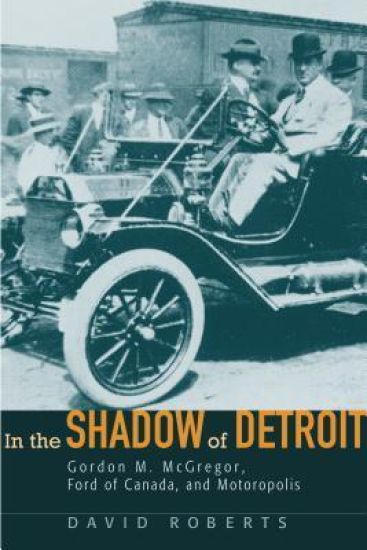
In the Shadow of Detroit

In the Shadow of Detroit

David Roberts

Wayne State University Press
2006
sidottu
Part biography and part corporate history, ""In the Shadow of Detroit"" investigates the life and career of Gordon M. McGregor, who founded and led Ford of Canada during the first two decades of the twentieth century. With no automotive background, minimal technical expertise, and only a few years of experience in business, McGregor came to Ford in 1904 from a failing wagon-building firm. David Roberts draws from diverse public and private historical sources to chronicle McGregor's swift ascension to corporate leader, including how McGregor attached himself to Henry Ford's meteoric rise, achieved remarkable success, and became for a time Windsor's preeminent industrialist and civic leader. Roberts intertwines McGregor's corporate, civic, and personal lives to trace his pioneering role in the automobile industry. Some themes from McGregor's career that are considered here include company growth, the technical and cultural concept of the automobile, the impact of automotive transportation, technological reliance on Detroit, parent-branch relations, the effects of border proximity, industrial and political lobbying, labor relations, secondary manufacturing, public involvement, and the Great War. In addition, Roberts probes McGregor's often-subservient relationship with the enigmatic Henry Ford and examines how McGregor drew praise and political ire in calling for regional governance in the ""Border Cities"" opposite Detroit. In the years before his premature death, McGregor and his company dominated and defined the growing automotive industry in Windsor-Detroit, and their story deserves to be more widely known. Both elegantly written and exhaustively researched, ""In the Shadow of Detroit"" will be enjoyable and informative reading for local historians and anyone interested in the automobile industry.
Protecting Whitney

Protecting Whitney

David Roberts

Chicago Review Press
2025
sidottu
David Roberts was Whitney Houston's bodyguard, the real one. Roberts was hired in 1988 for Houston's UK portion of the Moment of Truth world tour. Accustomed to working for diplomats and Fortune 500 clients, Roberts had reservations about working with a pop star. But Houston's heart of gold won him over from the moment they met at Heathrow airport. There's a high bar for those who work in this business: you must be willing to die for your boss. Houston made that easy. Roberts got to travel the globe with one of the most fun-loving and generous souls he'd ever met. His memoir reveals heartwarming anecdotes of life with one of the world's most recognizable stars, including privately shared moments such as the birth of Bobbi Kristina. Bet there are also shocking and heartbreaking revelations. Roberts was present for some of Houston's most challenging ordeals. And he was helpless as he watched those who claimed to love and support her betray her confidence for their greed. His heat was ultimately shattered as he witnessed her succumb to the one threat he could not protect her from: herself.