The Beautiful and Damned, first published by Scribner's in 1922, is F. Scott Fitzgerald's second novel. It explores and portrays New York caf society and the American Eastern elite during the Jazz Age before and after "the Great War" and in the early 1920s. As in his other novels, Fitzgerald's characters in this novel are complex, especially with respect to marriage and intimacy. The work is generally considered to have drawn upon and be based on Fitzgerald's relationship and marriage with his wife Zelda Fitzgerald
This Side of Paradise is the debut novel by F. Scott Fitzgerald. Published in 1920 and taking its title from a line of Rupert Brooke's poem Tiare Tahiti, the book examines the lives and morality of post-World War I youth. Its protagonist, Amory Blaine, is an attractive Princeton University student who dabbles in literature. The novel explores the theme of love warped by greed and status seeking. The novel famously helped F. Scott Fitzgerald gain Zelda Sayre's hand in marriage due to its success. Background: In the summer of 1919, after less than a year of courtship, Zelda Sayre broke up with the 22-year-old Fitzgerald. After a summer of heavy drinking, he returned to St. Paul, Minnesota, where his family lived, to complete the novel, hoping that if he became a successful novelist he could win Zelda back. While at Princeton (notably in University Cottage Club's library), Fitzgerald had written an unpublished novel, "The Romantic Egotist," and ultimately 80 pages of the typescript of this earlier work ended up in This Side of Paradise. On September 4, 1919, Fitzgerald gave the manuscript to his friend Shane Leslie to deliver to Maxwell Perkins, an editor at Charles Scribner's Sons in New York. The book was nearly rejected by the editors at Scribners, but Perkins insisted, and on September 16 it was officially accepted. Fitzgerald begged for early publication-convinced that he would become a celebrity and impress Zelda-but was told that the novel would have to wait until the spring. Nevertheless, upon the acceptance of his novel for publication he went and visited Zelda, and she agreed to marry him. Plot summary: The book is written in three parts. "Book One: The Romantic Egotist"-The novel centers on Amory Blaine, a young Midwesterner who, convinced that he has an exceptionally promising future, attends boarding school and later Princeton University. He leaves behind his eccentric mother Beatrice and befriends a close friend of hers, Monsignor Darcy. While at Princeton he goes back to Minneapolis, where he re-encounters Isabelle Borg , a young lady whom he had met as a little boy, and starts a romantic relationship with her. At Princeton he repeatedly writes ever more flowery poems, but Amory and Isabelle become disenchanted with each other after meeting again at his prom. "Interlude"-Following their break-up, Amory is shipped overseas, to serve in the army in World War I. (Fitzgerald had been in the army himself, but the war ended while he was still stationed on Long Island.) Amory's experiences in the war are not described, other than to say later in the book that he was a bayonet instructor. "Book Two: The Education of a Personage"-After the war, Amory falls in love with a New York debutante named Rosalind Connage. Because he is poor, however, this relationship collapses as well; Rosalind decides to marry a wealthy man, instead. A devastated Amory is further crushed to learn that his mentor Monsignor Darcy has died. The book ends with Amory's iconic lament, "I know myself, but that is all." Francis Scott Key Fitzgerald (September 24, 1896 - December 21, 1940), known professionally as F. Scott Fitzgerald, was an American novelist and short story writer, whose works illustrate the Jazz Age. While he achieved limited success in his lifetime, he is now widely regarded as one of the greatest American writers of the 20th century. Fitzgerald is considered a member of the "Lost Generation" of the 1920s. He finished four novels: This Side of Paradise, The Beautiful and Damned, The Great Gatsby, and Tender Is the Night. A fifth, unfinished novel, The Last Tycoon, was published posthumously. Fitzgerald also authored 4 collections of short stories, as well as 164 short stories in magazines during his lifetime.
The Beautiful and Damned, first published by Scribner's in 1922, is F. Scott Fitzgerald's second novel. It explores and portrays New York caf society and the American Eastern elite during the Jazz Age before and after "the Great War" and in the early 1920s. As in his other novels, Fitzgerald's characters in this novel are complex, especially with respect to marriage and intimacy. The work is generally considered to have drawn upon and be based on Fitzgerald's relationship and marriage with his wife Zelda Fitzgerald. Plot summary: The Beautiful and Damned tells the story of Anthony Patch, a 1910s socialite and presumptive heir to a tycoon's fortune, and his courtship and relationship with his wife Gloria Gilbert. It describes his brief service in the Army during World War I, and the couple's post-war partying life in New York, and his later alcoholism. Gloria and Anthony's love story is much more than just a couple falling in love. Their story deals with the hardships of a relationship, especially when each character has a tendency to be selfish. Joanna Stolarek suggests, Fitzgerald draws on "Zelda, the object of the writer's literary passion" (Stolarek et al. 53). 4] Toward the end of the novel, Fitzgerald sums up the plot and his intentions in writing it somewhat, even referencing his own first novel, when a financially successful writer friend tells Anthony: "You know these new novels make me tired. My God Everywhere I go some silly girl asks me if I've read 'This Side of Paradise'. Are our girls really like that? If it's true to life, which I don't believe, the next generation is going to the dogs. I'm sick of all this shoddy realism. I think there's a place for the romanticist in literature." Francis Scott Key Fitzgerald (September 24, 1896 - December 21, 1940), known professionally as F. Scott Fitzgerald, was an American novelist and short story writer, whose works illustrate the Jazz Age. While he achieved limited success in his lifetime, he is now widely regarded as one of the greatest American writers of the 20th century. Fitzgerald is considered a member of the "Lost Generation" of the 1920s. He finished four novels: This Side of Paradise, The Beautiful and Damned, The Great Gatsby, and Tender Is the Night. A fifth, unfinished novel, The Last Tycoon, was published posthumously. Fitzgerald also authored 4 collections of short stories, as well as 164 short stories in magazines during his lifetime. Early life: Born in 1896 in Saint Paul, Minnesota, to an upper middle class family, Fitzgerald was named after his famous second cousin, three times removed on his father's side, Francis Scott Key, but was always known as plain Scott Fitzgerald. He was also named after his deceased sister, Louise Scott Fitzgerald, one of two sisters who died shortly before his birth. "Well, three months before I was born," he wrote as an adult, "my mother lost her other two children ... I think I started then to be a writer." His father was Edward Fitzgerald, of Irish and English ancestry, who had moved to St. Paul from Maryland after the Civil War, and was described as "a quiet gentlemanly man with beautiful Southern manners." His mother was Mary "Molly" McQuillan Fitzgerald, the daughter of an Irish immigrant who had made his fortune in the wholesale grocery business.Edward Fitzgerald was the first cousin once removed of Mary Surratt, hanged in 1865 for conspiring to assassinate Abraham Lincoln. Scott Fitzgerald spent the first decade of his childhood primarily in Buffalo, New York, occasionally in West Virginia (1898-1901 and 1903-1908) where his father worked for Procter & Gamble, with a short interlude in Syracuse, New York, (between January 1901 and September 1903).Edward Fitzgerald had earlier worked as a wicker furniture salesman; he joined Procter & Gamble when the business failed....
A collection of radio readings of F. Scott Fitzgerald’s fiction – plus two bonus programmes Over the years the BBC has broadcast readings of many of F. Scott Fitzgerald’s novels, novellas and short stories. This collection includes some of his most famous works alongside various lesser-known tales, including three ‘lost stories’ (first published in 2017 and with an introduction written by editor Anne Margaret Daniel). Contents: The Great Gatsby - read by Sam Robards The Diamond as Big as the Ritz - read by Garrick Hagon Tender is the Night - read by Kenneth Haigh Babylon Revisited - read by Stuart Milligan The Sensible Thing - read by Stuart Milligan Bernice Bobs Her Hair - read by Laurel Lefkow Financing Finnegan - read by John SharianThe Smilers - read by John SharianAn Alcoholic Case - read by John SharianThree Hours Between Planes - read by John Sharian Pat Hobby’s Secret - read by Ed BishopPat Hobby: Teamed with Genius - read by Ed BishopPat Hobby and Orson Welles - read by Ed BishopPat Hobby: The Homes of the Stars - read by Ed Bishop Thank You for the Light - read by Karen Bartke, with an introduction read by Laurel LefkowThe Couple - read by Finn den Hertog Salute to Lucy and Elsie - read by Stuart MilliganAlso included are The Great Gatsby Letters, in which F. Scott Fitzgerald tells his editor about his hopes and fears for his new novel, and The Beautiful and the Damned: A Portrait of F. Scott Fitzgerald, featuring Ed Bishop and Sarah Keller as Fitzgerald and Zelda.Please note: some of the language in this recording reflects the era in which it was first broadcast.
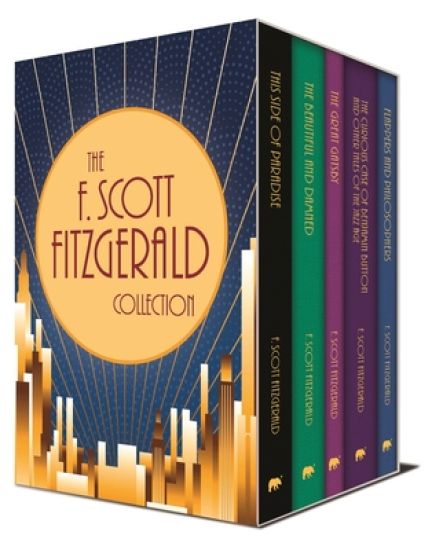
This deluxe box-set brings together selected novels, novellas and short stories by F. Scott Fitzgerald, contained in five clothbound volumes with foil stamping. Fitzgerald is considered one of the greatest novelists of the 20th century, celebrated for his penetrating and moving depictions of the Jazz Age. This beautiful slipcased collection contains his most iconic works such as The Great Gatsby and The Beautiful and Damned alongside lesser-known gems including 'The Offshore Pirate' and 'Ice Palace'. Includes: - The Great Gatsby - This Side of Paradise - The Beautiful and Damned - Flappers and Philosophers - The Curious Case of Benjamin Button and Other Tales of the Jazz Age (including the novellas 'May Day' and 'The Diamond as Big as the Ritz'). Showcasing the variety and depth of Fitzgerald's genius, this box set makes a wonderful collectible of gift for any literature lover. ABOUT THE SERIES: The Arcturus Collector's Classics series are high-quality, clothbound box-sets of classic works of literature. With elegant embossed cover-designs and colored endpapers, these editions make wonderful gifts or collectibles to treasure forever.
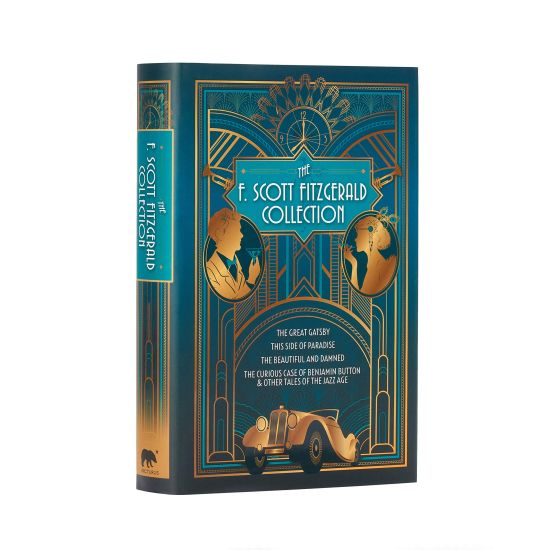
This deluxe box-set brings together selected novels, novellas and short stories by F. Scott Fitzgerald, contained in five clothbound volumes with gold-foil stamping. Fitzgerald is considered one of the greatest novelists of the 20th century, celebrated for his penetrating and moving depictions of the American Jazz Age. This beautiful slipcased collection contains his most iconic works such as The Great Gatsby and The Beautiful and Damned alongside lesser-known gems including 'The Offshore Pirate' and 'Ice Palace'.Includes:• The Great Gatsby• This Side of Paradise• The Beautiful and Damned• Flappers and Philosophers • The Curious Case of Benjamin Button and Other Tales of the Jazz Age Showcasing the variety and depth of Fitzgerald's genius, this luxurious art-deco inspired box set makes a wonderful collectible of gift for any literature lover. ABOUT THE SERIES: The Arcturus Collector's Classics series are high-quality, clothbound box-sets of classic works of literature. With elegant embossed cover-designs and coloured endpapers, these editions make wonderful gifts or collectibles to treasure forever.
F. Scott Fitzgerald is considered one of the greatest novelists of the 20th century, celebrated for his penetrating and moving depiction of the American Jazz Age. This beautiful hardback collection brings together some of Fitzgerald's finest and most iconic novels, novellas and short stories, presented in a beautiful hardback treasury. Includes: • The Great Gatsby • This Side of Paradise • The Beautiful and Damned• Flappers and Philosophers• The Curious Case of Benjamin Button & Other Tales of the Jazz Age
The novel explores the theme of love warped by greed and status seeking. The novel famously helped F. Scott Fitzgerald gain Zelda Sayre's hand in marriage due to its success. " I don't want to repeat my innocence. I want the pleasure of losing it again. " - This Side of Paraide, F. Scott Fitzgerald 1920 THE ORIGINAL CLASSIC WRITTEN BY F. SCOTT FITZGERALD BEST SELLING AUTHOR OF THE GREAT GATSBY FIRST PUBLISHED IN 1920
Today F. Scott Fitzgerald is better known for his novels, but in his own time, his fame rested squarely on his prolific achievement as one of America's most gifted writers of stories and novellas. Now, a half-century after the author's death, the premier Fitzgerald scholar and biographer, Matthew J. Bruccoli, has assembled in one volume the full scope of Fitzgerald's best short fiction: forty-three sparkling masterpieces, ranging from such classic novellas as "The Rich Boy," "May Day," and "The Diamond as Big as the Ritz" to his commercial work for the Saturday Evening Post and its sister "slicks." For the reader, these stories will underscore the depth and extraordinary range of Fitzgerald's literary talents. Furthermore, Professor Bruccoli's illuminating preface and introductory headnotes establish the literary and biographical settings in which these stories now shine anew with brighter luster than ever.
Edited and with an Introduction by Bryant MangumForeword by Roxana Robinson Benediction - Head and Shoulders - Bernice Bobs Her Hair - The Ice Palace - The Offshore Pirate - May Day - The Jelly Bean - The Diamond as Big as the Ritz - Winter Dreams - Absolution In the euphoric months before and after the publication of "This Side of Paradise, F. Scott Fitzgerald, the flapper's historian and poet laureate of the Jazz Age, wrote the ten stories that appear in this unique collection. Exploring characters and themes that would appear in his later works, such as "The Beautiful and Damned and "The Great Gatsby, these early selections are among the very best of Fitzgerald's many short stories. This Modern Library Paperback Classic includes notes, an appendix of nonfiction essays by Scott and Zelda Fitzgerald and their contemporaries, and vintage magazine illustrations.
"Pure and lovely...to read Zelda's letters is to fall in love with her." --The Washington Post Edited by renowned Jackson R. Bryer and Cathy W. Barks, with an introduction by Scott and Zelda Fitzgerald's granddaughter, Eleanor Lanahan, this compilation of over three hundred letters tells the couple's epic love story in their own words.Scott and Zelda Fitzgerald's devotion to each other endured for more than twenty-two years, through the highs and lows of his literary success and alcoholism, and her mental illness. In Dear Scott, Dearest Zelda, over 300 of their collected love letters show why theirs has long been heralded as one of the greatest love stories of the 20th century. Edited by renowned Fitzgerald scholars Jackson R. Bryer and Cathy W. Barks, with an introduction by Scott and Zelda's granddaughter, Eleanor Lanahan, this is a welcome addition to the Fitzgerald literary canon.
This Side of Paradise is the debut novel by F. Scott Fitzgerald. Published in 1920 and taking its title from a line of Rupert Brooke's poem Tiare Tahiti, the book examines the lives and morality of post-World War I youth. Its protagonist, Amory Blaine, is an attractive Princeton University student who dabbles in literature. The novel explores the theme of love warped by greed and status seeking. *Plot summary* The book is written in three parts. "Book One: The Romantic Egotist"-The novel centers on Amory Blaine, a young Midwesterner who, convinced that he has an exceptionally promising future, attends boarding school and later Princeton University. He leaves behind his eccentric mother Beatrice and befriends a close friend of hers, Monsignor Darcy. While at Princeton he goes back to Minneapolis, where he re-encounters Isabelle Borg , a young lady whom he had met as a little boy, and starts a romantic relationship with her. At Princeton he repeatedly writes ever more flowery poems, but Amory and Isabelle become disenchanted with each after meeting again at his prom. "Interlude"-Following their break-up, Amory is shipped overseas, to serve in the army in World War I. (Fitzgerald had been in the army himself, but the war ended while he was still stationed on Long Island.) Amory's experiences in the war are not described, other than to say later in the book that he was a bayonet instructor "Book Two: The Education of a Personage"-After the war, Amory falls in love with a New York debutante named Rosalind Connage. Because he is poor, however, this relationship collapses as well; Rosalind decides to marry a wealthy man, instead. A devastated Amory is further crushed to learn that his mentor Monsignor Darcy has died. The book ends with Amory's iconic lament, "I know myself, but that is all". Francis Scott Key Fitzgerald (September 24, 1896 - December 21, 1940), known professionally as F. Scott Fitzgerald, was an American novelist and short story writer, whose works are the paradigmatic writings of the Jazz Age. Oscar Fingal O'Flahertie Wills Wilde (16 October 1854 - 30 November 1900) was an Irish playwright, novelist, essayist, and poet. After writing in different forms throughout the 1880s, he became one of London's most popular playwrights in the early 1890s. He is remembered for his epigrams, his novel The Picture of Dorian Gray, his plays, as well as the circumstances of his imprisonment and early death. Rupert Chawner Brooke (middle name sometimes given as "Chaucer";3 August 1887 - 23 April 1915) was an English poet known for his idealistic war sonnets written during the First World War, especially "The Soldier". He was also known for his boyish good looks, which were said to have prompted the Irish poet W. B. Yeats to describe him as "the handsomest young man in England".