

Kirjahaku
Etsi kirjoja tekijän nimen, kirjan nimen tai ISBN:n perusteella.
256 kirjaa tekijältä Jacob Neusner
49.95

49.95
What, Exactly, Did the Rabbinic Sages Mean by "the Oral Torah"?
Jacob Neusner
Univ of South Florida
1999
sidottu

39.95
Concludes Neusner's translation of the whole of Tosefta. The fourth division is based on M. S. Zuckermandel's 1881 reproduction of the Vienna manuscript. A vine to the trellis of the Mishnah, he says, it explains, elaborates, augments, cites, glosses, and adds relevant cases and examples. The 1981 e
72.95
One of the world's experts on classical Jewish history and literature offers an authoritative interpretation of the three major periods of Jewish history from the time of the Bible up to the present. What emerges is a captivating account of the life-forming nature of a dynamic religion in vastly differing historical contexts. Glossary, maps, illustrations, photographs.
The renewed perception of Judaism's influence Judaism today is too often thought to represent a religious backwater, a highly particularistic, religion with its own esoteric tales and traditions, practices and norms. First Christians, then Jews themselves, have succumbed to this characterization, resulting in dismissal of Judaism's universal religious significance. Bereft of its religious import, Judaism is increasingly thought merely an ethnic designation-and a quickly dissipating one at that. Neusner pleas for vindication of "the universal character and appeal of Judaic monotheism in the mainstream of humanity." Of the three great monotheistic religions, only Judaism has survived without political power, military might, or great numbers of adherents and has done so because its method and message aim to persuade the world of God's dominion and the marks of God's rule.
The first in a series to study religion by description, analysis and interpretation. This book uses Judaism as an example of the importance, for all learning, of the circumstances and context in which scholarship takes place. The author argues that we learn only after we have decided what we wish to know, based on our categories of inquiry. A set of comparative studies of ancient Judaism and Christianity illustrates this thesis. Co-published with Studies in Judaism.
A collection of essays that illustrate the issue of definition and the role of context in the study of a religion, its text and its ideas. The author first addresses an important text in the canon of Judaism in its formative age. He then places the text in its context; that is, he tries to find the question that the text answers. The author concludes by offering a general theory of the history of Judaism so that Judaisms and their histories can be included in the larger history of religion. Co-published with Studies in Judaism.

A collection of essays that illustrate the issue of definition and the role of context in the study of a religion, its text and its ideas. The author first addresses an important text in the canon of Judaism in its formative age. He then places the text in its context; that is, he tries to find the question that the text answers. The author concludes by offering a general theory of the history of Judaism so that Judaisms and their histories can be included in the larger history of religion. Co-published with Studies in Judaism.

This book surveys the references to a Jewish government in writings concerning Babylonian Jewry in late antiquity. It draws together the diverse sources that tell stories about the Jewish administration of its minority in the region. Most of these derive from the Babylonian Talmud, the writings of the sages, or rabbis, who served as clerks in the Jewish court-government of the Jewish nation in the Iranian empire. This volume presents in condensed form the pertinent chapters of the former series History of the Jews in Babylonia originally published by E.J. Brill. Co-published with Studies in Judaism.
Judaism, Christianity, and Zoroastrianism in Talmudic Babylonia
Jacob Neusner
University Press of America
1986
nidottu
To find out more information about Rowman & Littlefield titles please visit us at www.rowmanlittlefield.com.
Provides a survey of stories of rabbinic literature from late antiquity and early medieval times that relates to the political condition of the Babylonian and Mesopotamian Jews. The author juxtaposes these stories, which record rabbinical opinion concerning the politics of each era, against the actual events. This volume represents an abbreviated treatment by the author of the topics originally covered in his History of the Jews in Babylonia, published by E.J. Brill. Co-published with Studies in Judaism.

Raises the contemporary issue of intertextuality, while analyzing the canonical writings of Judaism. These writings provide an ideal example of the meaning and uses of the critical initiative represented by intertextuality. In this book, the author asks in reference to these texts, how one document relates to others, thus a community of texts. He agrees that the shared conventions of rhetoric, topic and logic validate an approach to the canonical texts that ignores all social dimensions, for intrinsic to the writings are formal points of intersection and connection. Co-published with Studies in Judaism.
This volume frames a program of inquiry into the formative century of the Judaism of the dual Torah, which is the fourth century of the common era, or the age of Constantine. The study first considers the context) the historical study of Judaism. Part II is an inquiry into the text of Judaism, or a literary study of its types of writing or genres. Part III explains the circumstance, or setting, in which the study moves forward. Co-published with Studies in Judaism.
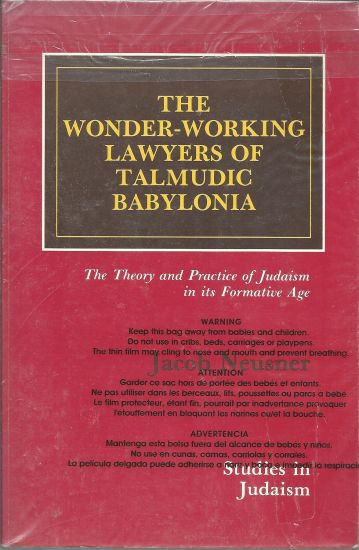
The Wonder-Working Lawyers of Talmudic Babylonia
Jacob Neusner
University Press of America
1987
nidottu
This book examines the relationship between the beliefs of the Judaic system and the life of the Jews governed by rabbis who shaped and executed those beliefs in everyday life. Four statements are presented: the relationship between the people and the law of the Torah as sages taught and applied it; the definition of the rabbi as a holy man; the rabbi as a holy man and the rabbinical institution and estate as a center of supernatural power in Israel, the Jewish people, in Sasanian Babylonia; and the rabbis as political figures who actually exercised not merely influence but coercive authority in enforcing Israel's public policy. Co-published with Studies in Judaism.

Jacob Neusner, a leading scholar of Judaism, offers a provocative statement on methodology in this history of religion. Neusner offers initial generalizations, or 'first principles,' seen as the histories of four periods of Judaism. Co-published with Studies in Judaism. Co-published with Studies in Judaism.