Kirjojen hintavertailu. Mukana 11 244 527 kirjaa ja 12 kauppaa.

Kirjahaku

Etsi kirjoja tekijän nimen, kirjan nimen tai ISBN:n perusteella.

139 kirjaa tekijältä Jacques Derrida

Specters of Marx

Specters of Marx

Jacques Derrida

Routledge
2006
nidottu
Prodigiously influential, Jacques Derrida gave rise to a comprehensive rethinking of the basic concepts and categories of Western philosophy in the latter part of the twentieth century, with writings central to our understanding of language, meaning, identity, ethics and values.In 1993, a conference was organized around the question, 'Whither Marxism?’, and Derrida was invited to open the proceedings. His plenary address, 'Specters of Marx', delivered in two parts, forms the basis of this book. Hotly debated when it was first published, a rapidly changing world and world politics have scarcely dented the relevance of this book.
Acts of Literature

Acts of Literature

Jacques Derrida

Routledge
1991
nidottu
First published in 1992. "Acts of Literature", compiled in close association with Derrida, brings together for the first time a number of Derrida's writings on literary texts on the question of literature. The essays discuss literary figures such as Rousseau, Mallarme, Joyce, Shakespeare and Kafka. Comprising pieces spanning Derrida's career, the collection includes a substantial new interview with him on questions of literature, deconstruction, politics, feminism and history. Derek Attridge provides an introductory essay on deconstruction and the question of literature, and offers suggestions for further reading. These essays examine the place and function of literature in Western culture. They highlight Derrida's interest in literature as a significant cultural institution and as a peculiarly challenging form of writing, with inescapable consequences for our thinking about philosophy, politics and ethics. This book should be of interest to undergraduates and academics in the field of literary theory and criticism and continental philosophy.
Acts of Religion

Acts of Religion

Jacques Derrida

Routledge
2001
sidottu
Acts of Religion, compiled in close association with Jacques Derrida, brings together for the first time a number of Derrida's writings on religion and questions of faith and their relation to philosophy and political culture. The essays discuss religious texts from Jewish, Christian, and Muslim traditions, as well as religious thinkers such as Kant, Levinas, and Gershom Scholem, and comprise pieces spanning Derrida's career. The collection includes two new essays by Derrida that appear here for the first time in any language, as well as a substantial introduction by Gil Anidjar that explores Derrida's return to his own "religious" origins and his attempts to bring to light hidden religious dimensions of the social, cultural, historical, and political.
Acts of Religion

Acts of Religion

Jacques Derrida

Routledge
2001
nidottu
Acts of Religion, compiled in close association with Jacques Derrida, brings together for the first time a number of Derrida's writings on religion and questions of faith and their relation to philosophy and political culture. The essays discuss religious texts from Jewish, Christian, and Muslim traditions, as well as religious thinkers such as Kant, Levinas, and Gershom Scholem, and comprise pieces spanning Derrida's career. The collection includes two new essays by Derrida that appear here for the first time in any language, as well as a substantial introduction by Gil Anidjar that explores Derrida's return to his own "religious" origins and his attempts to bring to light hidden religious dimensions of the social, cultural, historical, and political.
Geneses, Genealogies, Genres and Genius

Geneses, Genealogies, Genres and Genius

Jacques Derrida

Edinburgh University Press
2006
sidottu
He insists on my dreams, on my letters, on my Hs on my Cs, on my Js, on my Gs. G, G, G, G, jet ! A" You are my insister A" he says. A" You are my insister A" I say. No one has performed more learned yet more innocent pirouettes around words, letters, no one has ever managed to get French more joyously drunk, giving philosophy the full measure of its greatness once and for all, its tragic, its comic spell. [I never read him without being appalled at my urge to laugh with enchantment.]' Helene Cixous ORIGINAL TEXT BY DERRIDA TRANSLATED INTO ENGLISH FOR THE FIRST TIME In this book Derrida responds to the work Dream I Tell You by Helene Cixous, using it to explore the nature of the literary archive, the production of literature and Cixous' genius. These texts allow the reader to puzzle the genealogy of deconstruction and to consider the importance of the poetic and sexual difference to the entirety of Derrida's work. They also demonstrate that, as Derrida admits, he has always been a devotee of Cixous. Key Features: *The single most important work to address Helene Cixous' contribution to French thought. *Charts the influence of Cixous and Derrida on each other.
The Ear of the Other

The Ear of the Other

Jacques Derrida

University of Nebraska Press
1988
nidottu
"Originally published in French in 1982, this collection is a good representation of the range of Derrida's working styles."-South Atlantic Review "No writer has probed the riddle of the Other with more patience and insight than Jacques Derrida. . . . By rigorously interrogating the writings of major Western figures, Derrida not only forces a rethinking of the nature of reading and writing but calls into question basic as-sumptions about ourselves and our world. . . . The Ear of the Other will be especially useful to people who have little or no prior acquaintance with Derrida's work. . . . Through a careful reexamination of Nietzsche's autobiography Ecce Homo, Derrida elaborates some of the far-reaching implications of twentieth-century reinterpretations of human subjectivity."-Mark C. Taylor, Los Angeles Times Book Review. "Ably translated. . . . The long 'Roundtable on Autobiography' . . . is authentic philosophical discussion, illuminating not only the preceding lecture but Derrida's work as well."-Choice.
Edmund Husserl's "Origin of Geometry"

Edmund Husserl's "Origin of Geometry"

Jacques Derrida

University of Nebraska Press
1989
pokkari
Edmund Husserl's Origin of Geometry": An Introduction (1962) is Jacques Derrida's earliest published work. In this commentary-interpretation of the famous appendix to Husserl's The Crisis of European Sciences and Transcendental Phenomenology, Derrida relates writing to such key concepts as differing, consciousness, presence, and historicity. Starting from Husserl's method of historical investigation, Derrida gradually unravels a deconstructive critique of phenomenology itself, which forms the foundation for his later criticism of Western metaphysics as a metaphysics of presence. The complete text of Husserl's Origin of Geometry is included.
Points...

Points...

Jacques Derrida

Stanford University Press
1995
sidottu
This volume collects twenty-three interviews given over the course of the last two decades by Jacques Derrida. It illustrates the extraordinary breadth of his concerns, touching upon such subjects as the teaching of philosophy, sexual difference and feminine identity, the media, AIDS, language and translation, nationalism, politics, and Derrida's early life and the history of his writings. Often, as in the interview on Heidegger, or that on drugs, or on the nature of poetry, these interviews offer not only an introduction to other discussions, but something available nowhere else in his work. When did feminist discourse become an indispensable consideration for deconstruction? What was the impact on Derrida's work of his being an Algerian Jew growing up during World War II? Is there an ineradicable gap between language-based attitude such as those found in a deconstruction and subjectivity-oriented critical models such as those developed by Foucault and Lacan? Such questions as these are answered with great thoughtfulness and intensity. Derrida's oral style is patient, generous, and helpful. His tone varies with the questioners and the subject matter—militant, playful, strategic, impassioned, analytic: difference in modulation can sometimes be heard within the same dialogue. The informality of the interview process frequently leads to the most succinct and lucid explications to be found of many of the most important and influential aspects of Derrida's thought. Sixteen of the interviews appear here for the first time in English, including an interview, conducted especially for this volume, concerning the recent exchange of letters in the New York Review of Books.
On the Name

On the Name

Jacques Derrida

Stanford University Press
1995
sidottu
"The name: What does one call thus? What does one understand under the name of name? And what occurs when one gies a name? What does one give then? One does not offer a thing, one delivers nothing, and still something comes to be, which comes down to giving that which one does not have, as Plotinus said of the Good. What happens, above all, when it is necessary to sur-name, renaming there where, precisely, the name comes to be found lacking? What makes the proper name into a sort of sur-name, pseudonym, or cryptonym at once singular and singularly untranslatable?" Jacques Derrida thus poses a central problem in contemporary language, ethics, and politics, which he addresses in a liked series of the three essays. Passions: "An Oblique Offering" is a reflection on the question of the response, on the duty and obligation to respond, and on the possibility of not responding—which is to say, on the ethics and politics of responsibility. Sauf le nom (Post Scriptum) considers the problematics of naming and alterity, or transcendence, raised inevitably by a rigorous negative theology. Much of the text is organized around close readings of the poetry of Angelus Silesius. The final essay, Khora, explores the problem of space or spacing, of the word khora in Plato's Tmaeus. Even as it places and makes possible nothing less than the whole world, khora opens and dislocates, displaces, all the categories that govern the production of that world, from naming to gender. In addition to readers in philosophy and literature, Khora will be of special interest to those in the burgeoning field of "space studies"(architecture, urbanism, design).
Resistances of Psychoanalysis

Resistances of Psychoanalysis

Jacques Derrida

Stanford University Press
1998
sidottu
In the three essays that make up this stimulating and often startling book, Jacques Derrida argues against the notion that the basic ideas of psychoanalysis have been thoroughly worked through, argued, and assimilated. The continuing interest in psychoanalysis is here examined in the various "resistances" to analysis—conceived not only as a phenomenon theorized at the heart of psychoanalysis, but as psychoanalysis's resistance to itself, an insusceptibility to analysis that has to do with the structure of analysis itself. Derrida not only shows how the interest of psychoanalysis and psychoanalytic writing can be renewed today, but these essays afford him the opportunity to revisit and reassess a subject he first confronted (in an essay on Freud) in 1966. They also serve to clarify Derrida's thinking about the subjects of the essays—Freud, Lacan, and Foucault—a thinking that, especially with regard to the last two, has been greatly distorted and misunderstood. The first essay, on Freud, is a tour de force of close reading of Freud's texts as philosophical reflection. By means of the fine distinctions Derrida makes in this analytical reading, particularly of The Interpretation of Dreams, he opens up the realm of analysis into new and unpredictable forms—such as meeting with an interdiction (when taking an analysis further is "forbidden" by a structural limit). Following the essay that might be dubbed Derrida's "return to Freud," the next is devoted to Lacan, the figure for whom that phrase was something of a slogan. In this essay and the next, on Foucault, Derrida reencounters two thinkers to whom he had earlier devoted important essays, which precipitated stormy discussions and numerous divisions within the intellectual milieus influenced by their writings. In this essay, which skillfully integrates the concept of resistance into larger questions, Derrida asks in effect: What is the origin and nature of the text that constitutes Lacanian psychoanalysis, considering its existence as an archive, as teachings, as seminars, transcripts, quotations, etc.? Derrida's third essay may be called not simply a criticism but an appreciation of Foucault's work: an appreciation not only in the psychological and rhetorical sense, but also in the sense that it elevates Foucault's thought by giving back to it ranges and nuances lost through its reduction by his readers, his own texts, and its formulaic packaging.
Adieu to Emmanuel Levinas

Adieu to Emmanuel Levinas

Jacques Derrida

Stanford University Press
1999
sidottu
This volume contains the speech given by Derrida at Emmanuel Levinas's funeral on December 27, 1995, and his contribution to a colloquium organized to mark the first anniversary of Levinas's death. For both thinkers, the word adieu names a fundamental characteristic of human being: the salutation or benediction prior to all constative language (in certain circumstances, one can say adieu at the moment of meeting) and that given at the moment of separation, sometimes forever, as at the moment of death, it is also the a-dieu, for God or to God before and in any relation to the other. In this book, Derrida extends his work on Levinas in previously unexplored directions via a radical rereading of Totality and Infinity and other texts, including the lesser-known talmudic readings. He argues that Levinas, especially in Totality and Infinity, bequeaths to us an "immense treatise of hospitality," a meditation on the welcome offered to the other. The conjunction of an ethics of pure prescription with the idea of an infinite and absolute hospitality confronts us with the most pressing political, juridical, and institutional concerns of our time. What, then, is an ethics and what is a politics of hospitality? And what, if it ever is, would be a hospitality surpassing any ethics and any politics we know? As always, Derrida raises these questions in the most explicit of terms, moving back and forth between philosophical argument and the political discussion of immigration laws, peace, the state of Israel, xenophobia—reminding us with every move that thinking is not a matter of neutralizing abstraction, but a gesture of hospitality for what happens and still may happen.
Religion

Religion

Jacques Derrida

Stanford University Press
1998
nidottu
What should we make of the return to the sacred evidenced by the new vitality of churches, sects, and religious beliefs in many parts of the world today? What are the boundaries between the essential traits of religion and those of ethics and justice? Is there a "truth" to religion? This remarkable volume includes reflections on such questions by three of the most important philosophers of our time-Jacques Derrida, Gianni Vattimo, and Hans-Georg Gadamer. Together with other distinguished thinkers, they address a wide range of questions about the meaning, status, and future prospects of religion.In his meditation on the "return of religion," entitled "Faith and Knowledge: The Two Sources of 'Religion' at the Limits of Mere Reason," Derrida addresses the ways in which this return is intrinsically linked to transformations of which the new media are both the carriers and the symptom. Derrida coins this process one of globalatinization. This neologism signals, among other things, the process of a certain universalization of the Roman word or concept of religion, which tends to become hegemonic, as well as a certain performativity discernible in the new media and in contemporary structures of testimony and confession. Examples of this include, Derrida reminds us, not only the phenomenon of televangelism and televisual stagings of the pope's journeys, and not only the portrayal and self-presentation of Islam, but also the fetishization and becoming virtually absolute of the televisual and the multimedial as such.Using Being and Time as a point of reference, Vattimo suggests that religious experience is both an individual experience and a manifestation of a historical rhythm within which religion regularly appears and disappears. A commentary by Gadamer summarizes and enriches the contributions by Derrida and Vattimo. Four essays by Maurizio Ferraris, Eugenio Trias, Vincenzo Vitiello, and Aldo Giorgio Gargani complete the volume by examining other facets of the "religious."
Parages

Parages

Jacques Derrida

Stanford University Press
2010
sidottu
Parages brings together four essays by Derrida on the fictions of Maurice Blanchot. Three of the essays—"Living On," "Title To Be Specified," and "The Law of Genre," are by now canonical. The fourth, "Pace Not(s)" as well as Derrida's 1986 introduction to the French edition of the book, appear here in English for the first time. This was a breakthrough publication in the analysis of Blanchot, a notoriously difficult writer. It is safe to say Derrida contributed much to that writer's reputation in both French and English, always insisting on the philosophical pertinence of Blanchot's work to any discussion of the relationship between literature and critical thought. Through patient citation, and an ample collocation and readings of Blanchot's various motifs, Derrida explores a variety of questions, including the limits of genre, the procedure of crossing out, and the evocation of a non-dialectical and non-privative negativity. The book marks a crucial stage in Derrida's itinerary and provides a context for his later writings on apophatics in such works as On the Name (SUP, 1995) and his response to Heidegger on death in Aporias (SUP, 1993).
Parages

Parages

Jacques Derrida

Stanford University Press
2010
pokkari
Parages brings together four essays by Derrida on the fictions of Maurice Blanchot. Three of the essays—"Living On," "Title To Be Specified," and "The Law of Genre," are by now canonical. The fourth, "Pace Not(s)" as well as Derrida's 1986 introduction to the French edition of the book, appear here in English for the first time. This was a breakthrough publication in the analysis of Blanchot, a notoriously difficult writer. It is safe to say Derrida contributed much to that writer's reputation in both French and English, always insisting on the philosophical pertinence of Blanchot's work to any discussion of the relationship between literature and critical thought. Through patient citation, and an ample collocation and readings of Blanchot's various motifs, Derrida explores a variety of questions, including the limits of genre, the procedure of crossing out, and the evocation of a non-dialectical and non-privative negativity. The book marks a crucial stage in Derrida's itinerary and provides a context for his later writings on apophatics in such works as On the Name (SUP, 1995) and his response to Heidegger on death in Aporias (SUP, 1993).
Negotiations

Negotiations

Jacques Derrida

Stanford University Press
2002
sidottu
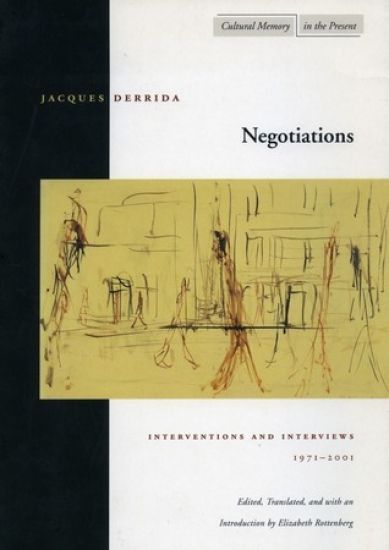
This collection of essays and interviews, some previously unpublished and almost all of which appear in English for the first time, encompasses the political and ethical thinking of Jacques Derrida over thirty years. Passionate, rigorous, beautifully argued, wide-ranging, the texts shed an entirely new light on his work and will be welcomed by scholars in many disciplines—politics, philosophy, history, cultural studies, literature, and a range of interdisciplinary programs. Derrida's arguments vary in their responsiveness to given political questions—sometimes they are vivid polemics on behalf of a position or figure, sometimes they are reflective analyses of a philosophical problem. They are united by the recurrent question of political decision or responsibility and the insistence that the apparent simplicity or programmatic character of political decision is in fact a profound avoidance of the political. This volume testifies to the possibility and the necessity of a philosophical politics. Negotiations assembles some of the most telling examples of the intrinsic relationship, so often affirmed by Derrida in more abstract philosophical terms, between deconstructive reading practices and what is called the "political"—more precisely, politics in an almost down-to-earth, pragmatic, and commonsense use of the word. Among the many subjects covered in the book are: the death penalty in the United States, the civil war in Algeria, globalization and cosmopolitanism, the American Declaration of Independence, Jean-Paul Sartre, the value of objectivity, politics and friendship, and the relationship between deconstruction and actuality.
On Touching—Jean-Luc Nancy

On Touching—Jean-Luc Nancy

Jacques Derrida

Stanford University Press
2005
sidottu
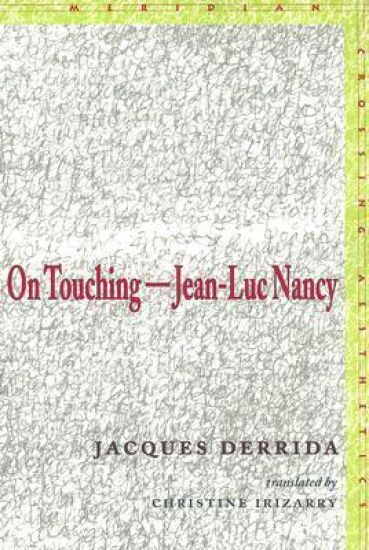
Using the philosophy of Jean-Luc Nancy as an anchoring point, Jacques Derrida in this book conducts a profound review of the philosophy of the sense of touch, from Plato and Aristotle to Jean-Luc Nancy, whose ground-breaking book Corpus he discusses in detail. Emmanuel Levinas, Maurice Merleau-Ponty, Edmund Husserl, Didier Franck, Martin Heidegger, Francoise Dastur, and Jean-Louis Chrétien are discussed, as are René Descartes, Diderot, Maine de Biran, Félix Ravaisson, Immanuel Kant, Sigmund Freud, and others. The scope of Derrida's deliberations makes this book a virtual encyclopedia of the philosophy of touch (and the body). Derrida gives special consideration to the thinking of touch in Christianity and, in discussing Jean-Luc Nancy's essay "Deconstruction of Christianity," devotes a section of the book to the sense of touch in the Gospels. Another section concentrates on "the flesh," as treated by Merleau-Ponty and others in his wake. Derrida's critique of intuitionism, notably in the phenomenological tradition, is one of the guiding threads of the book. On Touching includes a wealth of notes that provide an extremely useful bibliographical resource. Personal and detached all at once, this book, one of the first published in English translation after Jacques Derrida's death, serves as a useful and poignant retrospective on the work of the philosopher. A tribute by Jean-Luc Nancy, written a day after Jacques Derrida's death, is an added feature.
On Touching—Jean-Luc Nancy

On Touching—Jean-Luc Nancy

Jacques Derrida

Stanford University Press
2005
pokkari
Using the philosophy of Jean-Luc Nancy as an anchoring point, Jacques Derrida in this book conducts a profound review of the philosophy of the sense of touch, from Plato and Aristotle to Jean-Luc Nancy, whose ground-breaking book Corpus he discusses in detail. Emmanuel Levinas, Maurice Merleau-Ponty, Edmund Husserl, Didier Franck, Martin Heidegger, Francoise Dastur, and Jean-Louis Chrétien are discussed, as are René Descartes, Diderot, Maine de Biran, Félix Ravaisson, Immanuel Kant, Sigmund Freud, and others. The scope of Derrida's deliberations makes this book a virtual encyclopedia of the philosophy of touch (and the body). Derrida gives special consideration to the thinking of touch in Christianity and, in discussing Jean-Luc Nancy's essay "Deconstruction of Christianity," devotes a section of the book to the sense of touch in the Gospels. Another section concentrates on "the flesh," as treated by Merleau-Ponty and others in his wake. Derrida's critique of intuitionism, notably in the phenomenological tradition, is one of the guiding threads of the book. On Touching includes a wealth of notes that provide an extremely useful bibliographical resource. Personal and detached all at once, this book, one of the first published in English translation after Jacques Derrida's death, serves as a useful and poignant retrospective on the work of the philosopher. A tribute by Jean-Luc Nancy, written a day after Jacques Derrida's death, is an added feature.
Who's Afraid of Philosophy?

Who's Afraid of Philosophy?

Jacques Derrida

Stanford University Press
2002
sidottu
This volume reflects Jacques Derrida's engagement in the late 1970s with French political debates on the teaching of philosophy and the reform of the French university system. He was a founding member of the Research Group on the Teaching of Philosophy (Greph), an activist group that mobilized opposition to the Giscard government's proposals to "rationalize" the French educational system in 1975, and a convener of the Estates General of Philosophy, a vast gathering in 1979 of educators from across France. While addressing specific contemporary political issues on occasion, thus providing insight into the pragmatic deployment of deconstructive analysis, the essays deal mainly with much broader concerns. With his typical rigor and spark, Derrida investigates the genealogy of several central concepts which any debate about teaching and the university must confront. Thus there are essays on the "teaching body," both the faculty corps and the strange interplay in the French (but not only the French) tradition between the mind and body of the professor; on the question of age in teaching, analyzed through a famous letter of Hegel; on the class, the classroom, and the socio-economic concept of class in education; on language, especially so-called "natural languages" like French; and on the legacy of the revolutionary tradition, the Estates General, in the university. The essays are linked by the extraordinary care and precision with which Derrida undertakes a political intervention into, and a philosophical analysis of, the institutionalization of philosophy in the university.
Who's Afraid of Philosophy?

Who's Afraid of Philosophy?

Jacques Derrida

Stanford University Press
2002
pokkari
This volume reflects Jacques Derrida's engagement in the late 1970s with French political debates on the teaching of philosophy and the reform of the French university system. He was a founding member of the Research Group on the Teaching of Philosophy (Greph), an activist group that mobilized opposition to the Giscard government's proposals to "rationalize" the French educational system in 1975, and a convener of the Estates General of Philosophy, a vast gathering in 1979 of educators from across France. While addressing specific contemporary political issues on occasion, thus providing insight into the pragmatic deployment of deconstructive analysis, the essays deal mainly with much broader concerns. With his typical rigor and spark, Derrida investigates the genealogy of several central concepts which any debate about teaching and the university must confront. Thus there are essays on the "teaching body," both the faculty corps and the strange interplay in the French (but not only the French) tradition between the mind and body of the professor; on the question of age in teaching, analyzed through a famous letter of Hegel; on the class, the classroom, and the socio-economic concept of class in education; on language, especially so-called "natural languages" like French; and on the legacy of the revolutionary tradition, the Estates General, in the university. The essays are linked by the extraordinary care and precision with which Derrida undertakes a political intervention into, and a philosophical analysis of, the institutionalization of philosophy in the university.