Kirjojen hintavertailu. Mukana 12 220 984 kirjaa ja 12 kauppaa.

Kirjahaku

Etsi kirjoja tekijän nimen, kirjan nimen tai ISBN:n perusteella.

530 kirjaa tekijältä Leopold Von Ranke

A History of England

A History of England

Leopold von Ranke

Cambridge University Press
2010
pokkari
German historian Leopold von Ranke (1795–1886) is well known for pioneering the modern historical method which advocates empiricism, rather than a focus on the philosophy of history. Emphasising the importance of presenting history exactly as it happened, Ranke asserted that different eras need to be understood in their own contexts rather than in relation to each other: history should not be regarded as one long, teleological narrative. These principles of writing history, established in earlier publications, are all evident here. Originally published in eight volumes between 1859 and 1869, Ranke's history, 'principally in the seventeenth century', was first published in English as a six-volume history by the Clarendon Press in 1875, the mammoth task of its translation distributed among eight Oxford dons. Volume 1 prefigures the events of the seventeenth century: starting with the early Britons, Ranke summarises English history up to the early years of Charles I.
A History of England

A History of England

Leopold von Ranke

Cambridge University Press
2010
pokkari
German historian Leopold von Ranke (1795–1886) is well known for pioneering the modern historical method which advocates empiricism, rather than a focus on the philosophy of history. Emphasizing the importance of presenting history exactly as it happened, Ranke asserted that different eras need to be understood in their own contexts rather than in relation to each other: history should not be regarded as one long, teleological narrative. These principles of writing history, established in earlier publications, are all evident here. Originally published in eight volumes between 1859 and 1869, Ranke's history, 'principally in the seventeenth century', was first published in English as a six-volume history by the Clarendon Press in 1875, the mammoth task of its translation distributed among eight Oxford dons. Volume 2 details the build-up to the English civil war, troubles in Scotland, and the ultimate execution of King Charles I.
A History of England

A History of England

Leopold von Ranke

Cambridge University Press
2010
pokkari
German historian Leopold von Ranke (1795–1886) is well known for pioneering the modern historical method which advocates empiricism, rather than a focus on the philosophy of history. Emphasizing the importance of presenting history exactly as it happened, Ranke asserted that different eras need to be understood in their own contexts rather than in relation to each other: history should not be regarded as one long, teleological narrative. These principles of writing history, established in earlier publications, are all evident here. Originally published in eight volumes between 1859 and 1869, Ranke's history, 'principally in the seventeenth century', was first published in English as a six-volume history by the Clarendon Press in 1875, the mammoth task of its translation distributed among eight Oxford dons. Volume 3 focuses on the Interregnum years, detailing the rise and fall of Oliver Cromwell's Protectorate, the Restoration, and Charles II's wars with the Dutch.
A History of England

A History of England

Leopold von Ranke

Cambridge University Press
2010
pokkari
German historian Leopold von Ranke (1795–1886) is well known for pioneering the modern historical method which advocates empiricism, rather than a focus on the philosophy of history. Emphasizing the importance of presenting history exactly as it happened, Ranke asserted that different eras need to be understood in their own contexts rather than in relation to each other: history should not be regarded as one long, teleological narrative. These principles of writing history, established in earlier publications, are all evident here. Originally published in eight volumes between 1859 and 1869, Ranke's history, 'principally in the seventeenth century', was first published as a six-volume history in English by the Clarendon Press in 1875, the mammoth task of its translation distributed among eight Oxford dons. Volume 4 covers the last years of Charles II, the establishment of the Whig and Tory parties, and the Glorious Revolution of 1688.
A History of England

A History of England

Leopold von Ranke

Cambridge University Press
2010
pokkari
German historian Leopold von Ranke (1795–1886) is well known for pioneering the modern historical method which advocates empiricism, rather than a focus on the philosophy of history. Emphasizing the importance of presenting history exactly as it happened, Ranke asserted that different eras need to be understood in their own contexts rather than in relation to each other: history should not be regarded as one long, teleological narrative. These principles of writing history, established in earlier publications, are all evident here. Originally published in eight volumes between 1859 and 1869, Ranke's history, 'principally in the seventeenth century', was first published as a six-volume history in English by the Clarendon Press in 1875, the mammoth task of its translation distributed among eight Oxford dons. Volume 5 focuses on William III, ending with the reigns of Anne, George I, and George II; an appendix gives source material from contemporary documents.
A History of England

A History of England

Leopold von Ranke

Cambridge University Press
2010
pokkari
German historian Leopold von Ranke (1795–1886) is well known for pioneering the modern historical method which advocates empiricism, rather than a focus on the philosophy of history. Emphasizing the importance of presenting history exactly as it happened, Ranke asserted that different eras need to be understood in their own contexts rather than in relation to each other: history should not be regarded as one long, teleological narrative. These principles of writing history, established in earlier publications, are all evident here. Originally published in eight volumes between 1859 and 1869, Ranke's history, 'principally in the seventeenth century', was first published as a six-volume history in English by the Clarendon Press in 1875, the mammoth task of its translation distributed among eight Oxford dons. Volume 6 consists of appendices, including a discussion of other historians' opinions, and extracts from the correspondence of William III, as well as an index.
The Ecclesiastical and Political History of the Popes of Rome

The Ecclesiastical and Political History of the Popes of Rome

Leopold von Ranke

Cambridge University Press
2011
pokkari
This translation by Sarah Austin (1793–1867) of German historian Leopold von Ranke's work contributed significantly to early modern history and historiography. By some accounts 'the best living translator' of her time, Austin was a member of circles that included Jeremy Bentham and J. S. Mill. Ranke (1795–1886) worked for most of his life at the University of Berlin, writing several histories covering the fifteenth to seventeenth centuries. Austin's translation recognises Ranke's importance to Western historiography: his methodology stressed the centrality of using primary sources and of the historian's objectivity. Ranke's history engages with a much wider area than his title suggests; indeed, his subject is 'the struggle between Catholicism and Protestantism, between authority and innovation', as Austin writes. Volume 2 is almost wholly concerned with the Counter-Reformation (and coins the term), from 1563 to 1630. These volumes will be of interest to early modern historians and historiographers alike.
The Ecclesiastical and Political History of the Popes of Rome

The Ecclesiastical and Political History of the Popes of Rome

Leopold von Ranke

Cambridge University Press
2011
pokkari
This translation by Sarah Austin (1793–1867) of German historian Leopold von Ranke's work contributed significantly to early modern history and historiography. By some accounts 'the best living translator' of her time, Austin was a member of social circles that included Jeremy Bentham and J. S. Mill. Ranke (1795–1886) worked for most of his life at the University of Berlin, writing several histories covering the fifteenth to seventeenth centuries. Austin's translation recognises Ranke's importance to Western historiography: his methodology stressed the centrality of using primary sources and of the historian's objectivity. Ranke's history engages with a much wider area than his title suggests; indeed, his subject is 'the struggle between Catholicism and Protestantism, between authority and innovation', as Austin writes. Volume 3 analyses the period 1590–1630 and examines later significant events and includes an expansive appendix. These volumes will be of interest to early modern historians and historiographers alike.
A History of Servia, and the Servian Revolution

A History of Servia, and the Servian Revolution

Leopold von Ranke

Cambridge University Press
2012
pokkari
The German historian Leopold von Ranke (1795–1886) is considered a founder of modern source-based history, introducing ideas such as reliance on primary sources, emphasis on narrative history and international perspectives. (His works on the history of England and the on papacy are also reissued in this series.) While historiography and empiricism, as practised by Ranke, are now considered outdated, his emphasis on primary sources and the use of quotations to illustrate arguments remains hugely influential. First published in German in 1829, this work was based on eye-witness accounts of the Serbian Uprising of 1804, and was one of the first modern works on the Balkan nation. The early chapters review the history of the Serbs from the ninth century CE, to contextualise the chapters on the sixteenth-century Ottoman conquest and subsequent rule. This translation, published in 1847, is based on the second German edition of 1844.
Universal History

Universal History

Leopold von Ranke

Cambridge University Press
2014
pokkari
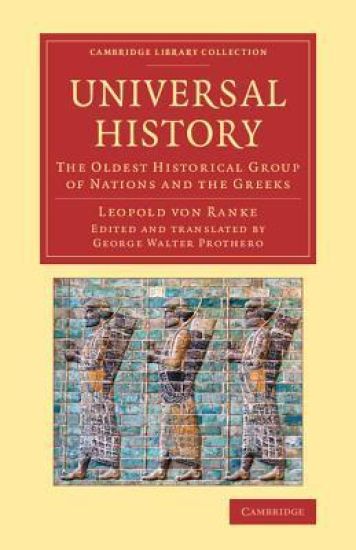
'No apology can be needed for introducing to English readers the latest work of Leopold von Ranke', states the editor's preface to this English translation, first published in 1884. Ranke (1795–1886) is well known for pioneering the modern historical method which advocates empiricism, rather than a focus on the philosophy of history. Emphasising the importance of presenting history exactly as the surviving evidence, both documentary and archaeological, reveals it to have happened, Ranke asserted that different eras need to be understood in their own contexts rather than in relation to each other. Though it is limited to the Mediterranean and the Middle East, this work takes a broad overview of 'the oldest historical group of nations and the Greeks', beginning with ancient Egypt and concluding with Alexander the Great and his immediate successors. Other works by Ranke in English translation are also reissued in the Cambridge Library Collection.