Kirjahaku
Etsi kirjoja tekijän nimen, kirjan nimen tai ISBN:n perusteella.
168 kirjaa tekijältä Maria Miller
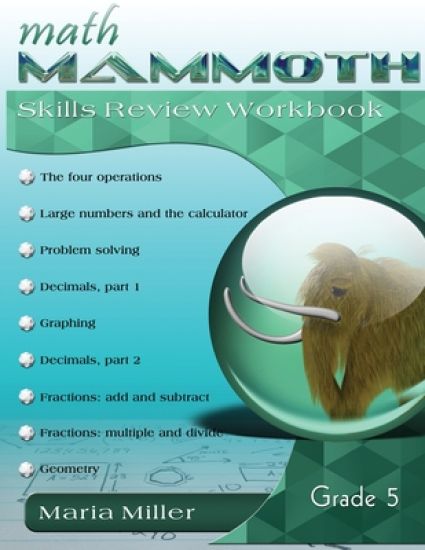
Some students benefit from spiral review, and that is exactly what Math Mammoth Grade 5 Skills Review Workbook offers It has been designed to complement the lessons in Math Mammoth Grade 5 complete curriculum, providing spiral review of the concepts in the Grade 5 curriculum.Math Mammoth Grade 5 Skills Review Workbook is divided into chapters, which correspond to the chapters in Math Mammoth Grade 5 curriculum. It is meant to be used during the school year, alongside the main curriculum. Spiral reviewing means that after a particular concept or skill has been studied in the main curriculum, it is then reviewed repeatedly over time in several different worksheets of this book.You can choose exactly when to use the worksheets within the chapter, and how many of them to use. Not all students need all of these worksheets to help them keep their math skills fresh, so please vary the amount of worksheets you assign your student(s) according to their need.Each worksheet is designed to be one page, and includes a variety of exercises in a fun way without becoming too long and tedious.The answer key is available as a separate book.
Math Mammoth Grade 5 Skills Review Workbook Answer Key contains answers to all the worksheets in Math Mammoth Grade 5 Skills Review Workbook. The workbook itself is available separately. (This is the 2023 edition.)
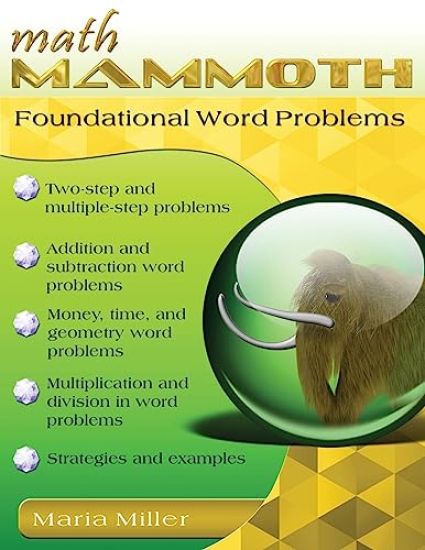
Math Mammoth Foundational Word Problems is a workbook intended for students in 3rd grade and above that need more practice with word problems. I especially aim to help students in 4th-7th grades who have trouble with word problems and who need to "go back to the beginning", so to speak, to learn to solve them.The problems are generally based on a knowledge of third grade math, such as regrouping in addition and subtraction, the multiplication tables, concept of division, and calculating change. The problems do not require long multiplication, long division, or calculations with fractions or decimals (with the exception of money amounts).The worksheets have examples and some instruction about common strategies for word problems. Students are often encouraged to write down the calculations they do. They are also encouraged to make a drawing or a sketch of the situation in the problem, to help them understand the situation and to see what math operation is involved.Overall, most of the problems require two or more steps; however, some problem sets focus on differentiating what math operation should be used, and those only require a single step.Several problem sets are designed to help students to master problems that involve equal-size groups. These questions either ask for the total (and are thus solved by multiplying), or they ask for the size of the group or for the quantity of the groups (one can write a missing number multiplication sentence, such as 3 ___ = 18 or use division).The book also includes word problems with fractions, with large numbers, with money, geometry word problems, and challenges in the form of puzzle corners.You can download sample pages from this link: https: //www.mathmammoth.com/word_problems/Foundational_Word_Problems_samples.pdf

Math Mammoth Grade 4-A worktext (Canadian version) is the student worktext for the first half of the 4th grade math, and part of Math Mammoth complete curriculum for fourth grade. This book starts out with a review of addition and subtraction, patterns, and graphs. We illustrate word problems with bar diagrams and study finding missing addends, which teaches algebraic thinking. Children also learn addition and subtraction terminology, the order of operations, and statistical graphs.Next come large numbers-up to millions, and the place value concept. At first the student reviews thousands and some mental math with them. Next are presented numbers up to one million, calculations with them, the concept of place value and comparing. In the end of the chapter we find out more about millions and an introduction to multiples of 10, 100, and 1000. The third chapter is all about multiplication. After briefly reviewing the concept and the times tables, the focus is on learning multi-digit multiplication (multiplication algorithm). The children also learn why it works when they multiply in parts. We also study the order of operations again, touch on proportional reasoning, and do more money and change related word problems.The last chapter in the 4-A worktext is about time, temperature, length, weight, and volume. Students will learn to solve more complex problems using various measuring units and to convert between measuring units. FeaturesMath Mammoth focuses on conceptual understanding. It explains the "WHY", so your children can understand the math, not just learn "HOW" to do it.The curriculum is mastery-oriented. This means it concentrates fairly long on a topic, delving into its various aspects. This promotes conceptual understanding, as opposed to spiral curricula that often tend to jump from topic to topic too much.There is a strong emphasis on mental math and number sense.It requires very little teacher preparation, which is a big help to most parents.: )The curriculum has no separate teacher's manual nor is it scripted. The introduction to each chapter has some notes for the teacher concerning the material in the chapter. All the instruction is written directly to the student.

Math Mammoth Grade 4 Tests and Cumulative Reviews, Canadian Version
Maria Miller
Math Mammoth
2023
pokkari
Math Mammoth Grade 4 Tests and Cumulative Revisions (Canadian version) contains the end-of-chapter tests, end-of-year test, and cumulative review lessons for Math Mammoth grade 4 curriculum. Note: this book does not contain answers. The answer key book for grade 4 may be purchased separately.
This book includes answers for the Math Mammoth Grade 4-A and 4-B student worktexts (Canadian version), for all the chapter tests, for the end-of-year test, and for the cumulative review lessons in Math Mammoth Grade 4 curriculum (Canadian version).
Math Mammoth Grade 5 Tests and Cumulative Reviews, Canadian Version
Maria Miller
Math Mammoth
2023
pokkari
Math Mammoth Grade 6-A worktext (Canadian version) is the first student book for sixth grade, and part of the Math Mammoth Grade 6 complete curriculum. In this book, students encounter the beginnings of algebra, learning about algebraic expressions, one-variable equations and inequalities, integers, and ratios. We also review and deepen the students' understanding of decimals, and study ratios and percent as new topics for 6th grade. The year starts out with a review of the four operations with whole numbers (including long division), place value, and rounding. Students are also introduced to exponents and do some problem solving.Chapter 2 starts the study of algebra topics, delving first into expressions and equations. Students practice writing expressions in many different ways, and use properties of operations and the idea of maintaining the equality of both sides of an equation to solve simple one-step equations. We also study briefly inequalities and using two variables. Chapter 3 has to do with decimals. This is a long chapter, as we review all of decimal arithmetic, just using more decimal digits than in 5th grade. Students also convert measuring units in this chapter. Ratios is a new topic (chapter 4). Students are already familiar with finding fractional parts from earlier grades, and now it is time to advance that knowledge into the study of ratios, which arise naturally from dividing a quantity into many equal parts. We study such topics as rates, unit rates, equivalent ratios, and problem solving using bar models.Percent (chapter 5) is an important topic to understand thoroughly, because of its many applications in real life. The goal of this chapter is to develop a basic understanding of percent, to see percentages as decimals, and to learn to calculate discounts. This curriculum is essentially the same as the U.S. version of Math Mammoth, only customized for the Canadian audience in these aspects: The curriculum uses the metric measurement units. Since Canadians do use imperial units, such as inches and pounds, in some contexts, the curriculum does mention them, but not often.The spelling conforms mostly to American English, taking into account a few key differences where Canadian English follows British English.Numbers are formatted with a space as a thousands separator, and a point as a decimal separator.Page (paper) size is Letter.The US version of the curriculum is aligned to the Common Core Standards, which means this curriculum may not be properly aligned to the sixth grade standards in any Canadian province. However, you can probably find material for any missing topics in the neighbouring grade levels of Math Mammoth materials.Available separately, Math Mammoth Grade 6-B worktext covers the second half of 6th grade math. Also available are the answer keys and a book containing cumulative reviews and chapter tests.
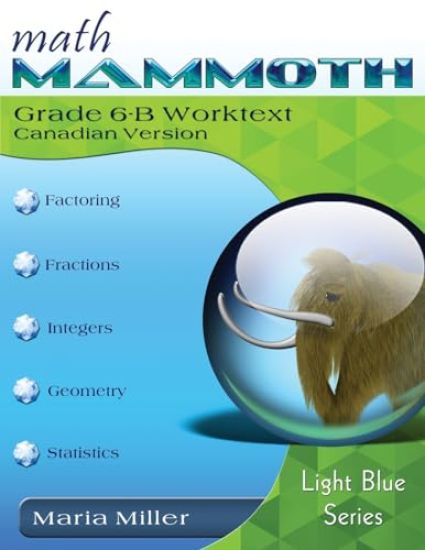
Math Mammoth Grade 6-B worktext (Canadian version) is the second student book for sixth grade, and part of the Math Mammoth Grade 6 complete curriculum. This book contains chapters 6-10 of the curriculum.In chapter 6, we first review prime factorization, and then study the greatest common factor and the least common multiple.Chapter 7 first presents a thorough review of fraction operations from 5th grade (addition, subtraction, and multiplication). The topic of focus in the chapter is fraction division. Students also do some problem solving with fractions.In chapter 8, students are introduced to integers. They plot points in all four quadrants of the coordinate plane and learn to add and subtract with negative numbers. Multiplication and division of integers are studied in 7th grade.In geometry (chapter 9), the focus is on the area of polygons. This is studied in a logical progression: first, the area of right triangles, then the area of parallelograms, then, the area of triangles, and lastly the area of polygons. We also review some topics from earlier grades (quadrilaterals, perimeter, basic drawing). Other major topics in this chapter are calculating surface area of some solids using nets, and volume of rectangular prisms with fractional edge lengths.Lastly, in chapter 10, students study statistics. The focus idea is that of a statistical distribution. Students learn about measures of center and measures of variability, and how to summarize distributions using those. They learn how to make dot plots, histograms, boxplots, and stem-and-leaf plots.This curriculum is essentially the same as the U.S. version of Math Mammoth, only customized for the Canadian audience in these aspects: The curriculum uses the metric measurement units. Since Canadians do use imperial units, such as inches and pounds, in some contexts, the curriculum does mention them, but not often.The spelling conforms mostly to American English, taking into account a few key differences where Canadian English follows British English.Numbers are formatted with a space as a thousands separator, and a point as a decimal separator.Page (paper) size is Letter.The US version of the curriculum is aligned to the Common Core Standards, which means this curriculum may not be properly aligned to the sixth grade standards in any Canadian province. However, you can probably find material for any missing topics in the neighbouring grade levels of Math Mammoth materials.Available separately, Math Mammoth Grade 6-A worktext covers the first half of 6th grade math. Also available are the answer keys and a book containing cumulative reviews and chapter tests.
Math Mammoth Grade 6 Tests and Cumulative Reviews, Canadian Version
Maria Miller
Math Mammoth
2023
pokkari
Math Mammoth Grade 6 Tests & Cumulative Reviews (Canadian version) contains the end-of-chapter tests, the end-of-year test, and cumulative reviews lessons to match Math Mammoth Grade 6 curriculum (Canadian version).
This book includes answers for the Math Mammoth Grade 6-A and 6-B student worktexts (Canadian version), for all the chapter tests and end-of-year test, and for the cumulative reviews for grade 6. The other parts of the 6th grade curriculum (the 6-A and 6-B worktexts and the cumulative reviews & tests book) may be purchased separately.
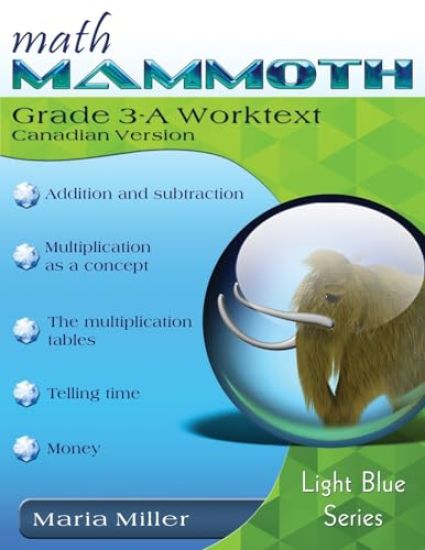
Math Mammoth Grade 3-A worktext (Light Blue Series) is the student book for the first half of third grade math. In this part A, the main areas of study are: addition and subtraction within 1,000 (including mental math); the concept of multiplication; the multiplication tables; telling time and working with time intervals; counting coins and solving problems related to money.FeaturesMath Mammoth focuses on conceptual understanding. It explains the "WHY", so your children can understand the math, not just learn "HOW" to do it.Concepts are often explained with visual models, followed by exercises using those models. These visual models can take the place of manipulatives for many children; however, it is very easy to add corresponding manipulatives to the lessons if so desired.The curriculum is mastery-oriented. This means it concentrates fairly long on a topic, delving into its various aspects. This promotes conceptual understanding, as opposed to spiral curricula that often tend to jump from topic to topic too much.There is a strong emphasis on mental math and number sense.It requires very little teacher preparation, which is a big help to most parents. The curriculum has no separate teacher's manual nor is it scripted. The introduction to each chapter has some notes for the teacher concerning the material in the chapter. All the instruction is written directly to the student in the worktext, and there also exist accompanying videos where you can see Maria herself teach the material.After each chapter introduction, you will find a list of Internet links and resources (games, quizzes, animations, etc.) that can be used for fun, illustrations and further practice.For multiplication tables and division facts, you can use our online practice program (free).This curriculum is essentially the same as the U.S. version of Math Mammoth Grade 3, only customized for the Canadian audience in these aspects: The curriculum teaches the metric measurement units. Imperial units, such as inches and pounds, are not used.The spelling conforms mostly to American English, taking into account a few key differences where Canadian English follows British English.Numbers are formatted with a space as a thousands separator, and a point as a decimal separator.Page (paper) size is Letter.
Math Mammoth Grade 3-B Worktext (Canadian version) is the student book for the second half of third grade math. In this part B, the main areas of study are: place value (4-digit numbers)the concept of division and basic division facts; geometry (area and perimeter); measurement; fractions. The curriculum is essentially the same as the U.S. version of Math Mammoth Grade 3, only customized for the Canadian audience in these aspects: The curriculum teaches the metric measurement units. Imperial units, such as inches and pounds, are not used.The spelling conforms mostly to American English, taking into account a few key differences where Canadian English follows British English.Numbers are formatted with a space as a thousands separator, and a point as a decimal separator.Page (paper) size is Letter.FeaturesMath Mammoth focuses on conceptual understanding. It explains the "WHY", so your children can understand the math, not just learn "HOW" to do it.Concepts are often explained with visual models, followed by exercises using those models. These visual models can take the place of manipulatives for many children; however, it is very easy to add corresponding manipulatives to the lessons if so desired.The curriculum is mastery-oriented. This means it concentrates fairly long on a topic, delving into its various aspects. This promotes conceptual understanding, as opposed to spiral curricula that often tend to jump from topic to topic too much.There is a strong emphasis on mental math and number sense.It requires very little teacher preparation, which is a big help to most parents. The curriculum has no separate teacher's manual nor is it scripted. The introduction to each chapter has some notes for the teacher concerning the material in the chapter. All the instruction is written directly to the student in the worktext, and there also exist accompanying videos where you can see Maria herself teach the material.After each chapter introduction, you will find a list of Internet links and resources (games, quizzes, animations, etc.) that can be used for fun, illustrations and further practice.For multiplication tables and division facts, you can use our online practice program (free).A companion to this book, Math Mammoth Grade 3-A worktext, covers the first half of 3rd grade math (available separately).
Math Mammoth Grade 3 Tests and Cumulative Reviews, Canadian Version
Maria Miller
Math Mammoth
2023
pokkari
Math Mammoth Grade 3 Tests and Cumulative Reviews (Canadian Version) contains the chapter tests, end-of-year test, and cumulative revision worksheets for Math Mammoth grade 3 curriculum. It does not contain answers; the answer key book may be purchased separately at Lulu.