Kirjojen hintavertailu. Mukana 11 457 424 kirjaa ja 12 kauppaa.

Kirjahaku

Etsi kirjoja tekijän nimen, kirjan nimen tai ISBN:n perusteella.

28 kirjaa tekijältä Mark Hendricks

Forty-Nine Long Lost Arban Duets For Trombone (...that Arban never wrote!)

Forty-Nine Long Lost Arban Duets For Trombone (...that Arban never wrote!)

Mark Hendricks

Createspace Independent Publishing Platform
2015
nidottu
The original studies written by J.B. Arban that are the basis for these forty-nine duets are among the most assigned, practiced, played, and reviewed by all brass players - beginner, intermediate, advanced, and pro alike. But there were never duets based on them... until now Practicing and playing them with your friends, students, and colleagues will yield tremendous benefits for all involved. You can even play these with trumpet players, they have their own edition also. Here's just a few suggestions for using these classic studies as duets: - Actually schedule a time each week to play duets. We all need to have ensembles to play and perform in, and a duet is the easiest to organize - it's just you and your duet partner. Or add a third player to make things even more fun (plus this makes sure you are resting properly by having only two of you play while the third is resting). - As you play, be listening closely to yourself and your duet partner to match the attack, tone, phrasing, articulations, dynamics, and intonation to create a truly musical experience. Don't just play notes - always make music - Be sure to practice and play both parts. Each player will benefit from playing the 1st and 2nd parts. Have the 2nd part player follow the musical example of the 1st part player, then switch parts for more "follow the leader" practice. - After perfecting duets 19-37 as single tongue duets, speed up the tempo and use double tongue or triple tongue for even more fun. - These duets are also great for practicing sight reading, transposition, building endurance, increasing range by transposing them into higher keys, and playing rhythmically. - Practice slowly at first - work for even tone and rhythm, then speed up as you can play cleanly. Always REST as much as you play to avoid overdoing your practicing Get your copy now and start playing them Mark Hendricks MPHmusic.com
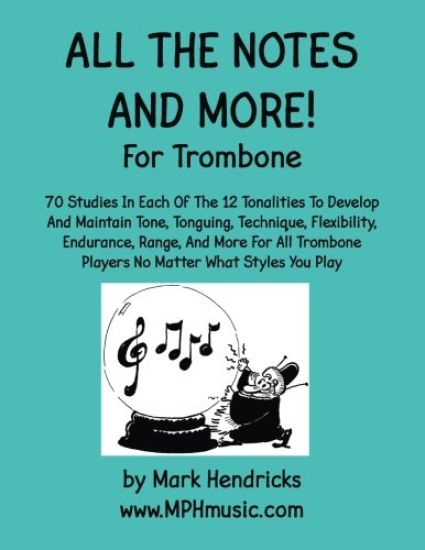
All The Notes And More for Trombone: 70 Studies In Each Of The 12 Tonalities To Develop And Maintain Tone, Tonguing, Technique, Flexibility, Endurance
ALL THE NOTES AND MORE is designed to help you develop and maintain your tone, tonguing, technique, flexibility, endurance, range, and more no matter what styles you play. In it you will practice and master all kinds of scales and arpeggios in all ranges of your instrument. They are the necessary building blocks of music, and all top performers have them ingrained into their playing so they can perform at the highest levels of musicianship. Here's just a few suggestions for using these studies: - Always play with a great sound. No matter whether you're playing high or low, fast or slow...always listen to yourself closely to play with a great sound. That's what others are hearing, make them say... "Oh what a sound " ...when you play. - It is never possible to play these studies too slowly. However it is possible to play them too fast. By playing slow, you can listen closely to the fundamentals of playing to make adjustments that make playing the studies quicker much easier and more musical. As you play, be listening closely to yourself so that each note has a pleasing sound. - Don't just play notes - always make music - When learning a study, you may wish to start with the last measure, play it a few times until you are comfortable with it, then back up one measure and play the last two measures. Then practice the last three measures. Repeat this strategy until you are at the beginning of the study. This way you will have lots of practice finishing strong. - Always use various articulations for the studies. Examples: all slurred, all tongued, slur four, slur two tongue two, tongue two slur two, multiple tonguing and on and on. Mix it up as you play through a tonality, it will help you keep your embouchure fresh and mind alert. - When first going through the studies, you may want to spend a week, or a month, on learning a tonality. After you have learned all the tonalities, you may want to review one tonality a day split up into a few different practice sessions to maintain your level of playing. - ALTERNATE METHOD (recommended) - start with study #1 in the C tonality, play it. Then play #1 in the F tonality, then #1 in Bb, then #1 in Eb, and so on all the way through the 12 tonalities. When learning the studies do this for a week (or two) on each study and you will master it in all tonalities. Then proceed to study #2 and use the same system to learn it in all 12 tonalities. Continue through all the studies in this manner. Always vary the articulations you use throughout your practice session of these studies. - For younger players, play to the top of your range then skip notes to pick-up the pattern and continue to the end. - Practice slowly at first - work for even tone and rhythm, then speed up as you can play cleanly. - Always REST as much as you play to avoid overdoing your practicing By Mark Hendricks More info at www.MPHmusic.com
All The Notes And More for Saxophone: 70 Studies In Each Of The 12 Tonalities To Develop And Maintain Tone, Tonguing, Technique, Flexibility, Enduranc
ALL THE NOTES AND MORE is designed to help you develop and maintain your tone, tonguing, technique, flexibility, endurance, range, and more no matter what styles you play. In it you will practice and master all kinds of scales and arpeggios in all ranges of your instrument. They are the necessary building blocks of music, and all top performers have them ingrained into their playing so they can perform at the highest levels of musicianship. Here's just a few suggestions for using these studies: - Always play with a great sound. No matter whether you're playing high or low, fast or slow...always listen to yourself closely to play with a great sound. That's what others are hearing, make them say... "Oh what a sound " ...when you play. - It is never possible to play these studies too slowly. However it is possible to play them too fast. By playing slow, you can listen closely to the fundamentals of playing to make adjustments that make playing the studies quicker much easier and more musical. As you play, be listening closely to yourself so that each note has a pleasing sound. - Don't just play notes - always make music - When learning a study, you may wish to start with the last measure, play it a few times until you are comfortable with it, then back up one measure and play the last two measures. Then practice the last three measures. Repeat this strategy until you are at the beginning of the study. This way you will have lots of practice finishing strong. - Always use various articulations for the studies. Examples: all slurred, all tongued, slur four, slur two tongue two, tongue two slur two, and on and on. Mix it up as you play through a tonality, it will help you keep things interesting and your mind alert. - When first going through the studies, you may want to spend a week, or a month, on learning a tonality. After you have learned all the tonalities, you may want to review one tonality a day split up into a few different practice sessions to maintain your level of playing. - ALTERNATE METHOD (recommended) - start with study #1 in the C tonality, play it. Then play #1 in the F tonality, then #1 in Bb, then #1 in Eb, and so on all the way through the 12 tonalities. When learning the studies do this for a week (or two) on each study and you will master it in all tonalities. Then proceed to study #2 and use the same system to learn it in all 12 tonalities. Continue through all the studies in this manner. Always vary the articulations you use throughout your practice session of these studies. - For advanced players, you will want to expand the studies into the altissimo register by playing them up an octave. - Practice slowly at first - work for even tone and rhythm, then speed up as you can play cleanly. By Mark Hendricks - More info at www.MPHmusic.com