Kirjojen hintavertailu. Mukana 12 390 323 kirjaa ja 12 kauppaa.

Kirjahaku

Etsi kirjoja tekijän nimen, kirjan nimen tai ISBN:n perusteella.

48 kirjaa tekijältä Michael Novak

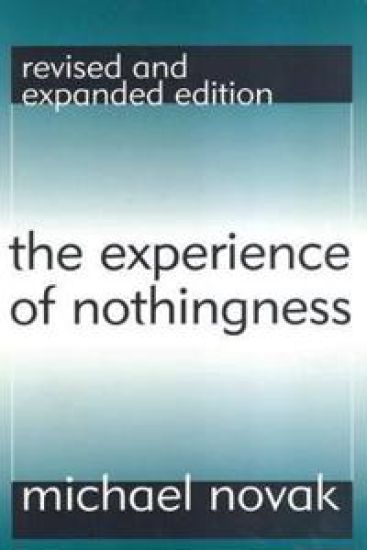
The Experience of Nothingness

The Experience of Nothingness

Michael Novak

Routledge
2017
sidottu
In The Experience of Nothingness, Michael Novak has two objectives. First, he shows the paths by which the experience of nothingness is becoming common among all those who live in free societies. Second, he details the various experiences that lead to the nothingness point of view. Most discussions of these matters have been so implicated in the European experience that the term "nihilism" has a European ring. Novak, however, articulates this experience of formlessness in an American context.In his new introduction, the author lists four requirements that must be met by an individual in order for the experience of nothingness to emerge: a commitment to honesty, a commitment to courage, recognition of how widespread the experience of nothingness is, and a virtue of will. Novak writes that these principles are what guide self-described philosophical nihilists. But many people simply borrow the nihilistic conclusions without observing the moral commitments to them. For this reason Novak believes that nihilism is fraudulent as a theory intended to explain the experience of nothingness. Nihilism in practice, he maintains, often results in a form of intolerance. The Experience of Nothingness is a work that will cause many scholars to rethink their beliefs. It should be read by philosophers, theologians, sociologists, political theorists, and cultural historians.

The Guns of Lattimer

The Guns of Lattimer

Michael Novak

Routledge
2018
sidottu
On September 10, 1897, in the hamlet of Lattimer mines, Pennsylvania, an armed posse took aim and fired into a crowd of oncoming mine workers, who were marching in their corner of the coal-mining region to call their fellow miners out on strike. The marchers Poles, Slovaks, Hungarians, most of whom could not yet speak English were themselves armed only with an American flag and a timid, budding confidence in their new found rights as free men in their newly adopted country. The mine operators took another view of these rights and of the strange, alien men who claimed them. When the posse was done firing, nineteen of the demonstrators were dead and thirty-nine were seriously wounded. Some six months later a jury of their peers was to exonerate the deputies of any wrong-doing.This long-forgotten incident is here movingly retold by Michael Novak, himself the son of Slovak immigrants and one of our most gifted writers and social observers. In his hands, the so-called "Lattimer Massacre" becomes not only a powerful story in its own right (and an invaluable key to the history of the growth of the united mine Workers), but an allegory of that peculiarly American experience undergone over and over again throughout the land, and down to this very day; the experience of new immigrants, still miserable with poverty and bewilderment and suffering the trauma of culture shock, being confronted by the hostility and blind contempt of the "real" Americans.In Michael Novak's uniquely vivid account, the incident at Lattimer is seen as a tragedy brought on not so much by inhumanity as by the profound failure of majority WASP society to understand the needs and responses of "foreigners." The Guns of Lattimer is a gripping book that tells Americans, old and new, a great deal about themselves and the society they live in.
The History of Science and the New Humanism
In this classic work, the foremost historian of science in our time, George Sarton, sums up his reflections on the role of science and of the humanities in our culture. Voicing his opposition to the old-fashioned humanists on the one hand, and to the 'uneducated' men of science and technicians on the other, Sarton points out to the former that the humanities without scientific are essentially incomplete. He warns the latter that without history, without philosophy, without arts and letters, without a living religion, human life on this planet would cease to be worthwhile.After outlining his 'Faith of a Humanist' in the opening section, Sarton goes on to analyze 'The History of Science and the History of Civilization,' to discuss the progress of scientific thought since ancient times in 'East and West,' and to propose the solution for the educational and cultural crisis of our time in 'The New Humanism' and in 'The History of Science and the Problems of Today.' He concludes not only that science is a source of technological development that has changed the face of the earth and has convulsed our lives for good and evil, but that it nonetheless affords the best means of understanding the world, its people, and the multitude of their relationships. 'Science is the conscience of mankind.'Included in this edition is Robert M. Merton's address before the Sarton Centennial meeting of November 1984. It is a stunning tour de force in its own right, providing insights into Sarton, teaching and research at Harvard in the 1930s, and the personal interaction between Sarton the mentor, and Merton the pupil. The essay supplements May Sarton's earlier 'Informal Portrait of George Sarton.'
The Open Church

The Open Church

Michael Novak

Routledge
2017
sidottu
Michael Novak's eyewitness report on the second and pivotal session of Vatican II in 1964 vividly inter weaves pageantry, politics, and theology. An unusually well-informed lay intellectual, who had earned a theological degree just before the Council, Novak applauded the purposes of Pope John XXIII and his successor Paul VI-"to throw open the windows of the church." In this report, he coined the classic description of the foes of the reforms at Vatican II as the party of "nonhistorical orthodoxy," emphasizing the eternal and unchanging, neglecting history and contingency. The author recounts many moments of high drama-Pope Paul VI's opening speech, the vote on the collegiality of bishops, the plea of Cardinal Bea on behalf of the chapter on Jews, and Bishop De Smedt's defense of religious freedom. His colorful chapter on the American bishops in 1964 serves as a fascinating benchmark, as do his many insights into the new role of the laity. His final chapter is a moving tribute to the Open Church engaging the contemporary world, and his new introduction brings this report up to date. This work will be of compelling interest to those interested in the post-conciliar fall of Communism, under the great John Paul II-who took his name from his two predecessors at Vatican II. The winner of the million-dollar Templeton Prize for Progress in Religion (1994), Michael Novak is a theologian, author, and former U.S. ambassador. He currently holds the George Frederick Jewett Chair in Religion and Public Policy at the American Enterprise Institute in Washington, D.C. where he is director of social and political studies. His writings have appeared in every major Western language, and in Chinese, Bengali, Korean, and Japanese. Also available from Transaction are his Catholic Social Thought and Liberal Institutions, The Experience of Nothingness, The Guns of Lattimer, Unmeltable Ethnics, Belief and Unbelief, and Choosing Presidents.
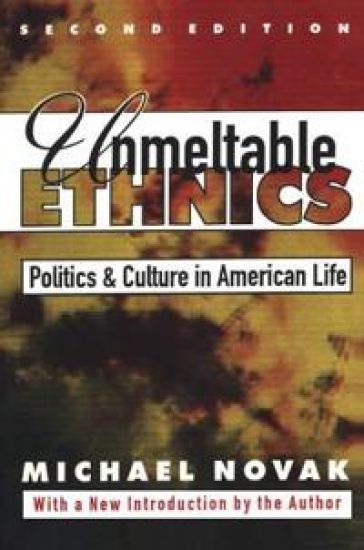
Unmeltable Ethnics

Unmeltable Ethnics

Michael Novak

Routledge
2018
sidottu
This new, enlarged edition of an influential book originally published in 1972 as The Rise of the Unmeltable Ethnicsextends the author's wise and generous view of ethnicity. Its aim "is to raise consciousness about a crucial part of the American experience: to involve each reader in self-inquiry. Who, after all, are you? What history brought you to where you are? Why are you different from others?" But the point of such inquiry is civility: "The new ethnic consciousness embodied in this book delights in recognition of subtle differences in the movements of the soul. It is not a call to separatism but to self-consciousness. It does not seek division but rather accurate, mutual appreciation."This new edition contains six new essays by the author, including the acclaimed "Pluralism: A Humanistic Perspective." New, too, is Novak's comprehensive introduction, bringing the argument up to date. Novak describes how and why ethnicity has become a prominent issue in American politics. He also sharply denounces the current ideology of "multiculturalism" as a disfiguration of genuine ethnicity. "Multiculturalism is moved by the eros of Narcissus" Novak writes, "the new ethnicity is driven by the eros of unrestricted understanding."When the book first appeared, Time said that "Novak has attacked the American Dream in order to open up a possible second chapter for it." Newsweek called it "a tough-minded, provocative book which could well signal an important change in American politics."This new edition adds crucial distinctions for those seeking an intelligent path through such current-day mystifications as "multiculturalism" and "diversity." Twenty-five years ago, Novak's argument led the way in focusing on families, neighborhoods, and other "mediating institutions" of civil society. It is an argument critical to a realistic sense of national community.
The Myth of Romantic Love and Other Essays

The Myth of Romantic Love and Other Essays

Michael Novak

AldineTransaction
2013
sidottu
Written by noted Catholic philosopher Michael Novak, the selections in The Myth of Romantic Love and Other Essays highlight the arc of his intellectual career. Collectively demonstrating the fundamental unity of Novak's work, the sixteen essays in this book span a broad range of political, economic, and social topics.The selections offer clarity of thinking for the sake of concrete ends. For example, "The Myth of Romantic Love," the chapter from which the title of this work is drawn, sharply distinguishes the "love" that popular culture portrays from the true Christian vision of love. And "The Family out of Favor" argues, "if things go well with the family, life is worth living; when the family falters, life falls apart." Thus, true Christian love manifest in marriage and family life is a greater resource for civilized society than any other institution.Although this collection shows that Novak's viewpoints did evolve over time, he remains a thinker that is clearly rooted in the ancient and medieval Catholic tradition. From his discussions of gender relations, to economics, culture, and politics, his perspective honors the primacy of man and his immediate experience, and thereby ultimately glorifies the Creator. Novak's writing will infuriate some readers, and inspire many others—but both comrades-in-arms and intellectual opponents will find the clarity and intensity of his writings undeniable.
Choosing Presidents

Choosing Presidents

Michael Novak

Transaction Publishers
1991
nidottu
In Choosing Presidents, Novak uses the election of an American president as a means to dissect the symbols of our national life and politics, exposing many as distorted perceptions of American realities. This work is a guide to the complexities of electoral politics and a lasting contribution to our understanding of the presidency.The author is Michael Novak.
Belief and Unbelief

Belief and Unbelief

Michael Novak

Transaction Publishers
1994
nidottu
This is perhaps the most widely read of Michael Novak's books. Belief and Unbelief attempts to push intelligence and articulation as far as possible into the stuff of what so many philosophers set aside as subjectivity. It is an impassioned critique of the idea of an unbridgeable gap between the emotive and the cognitive — and in its own way, represents a major thrust at positivist analysis.Written in a context of personal tragedy as well as intellectual search, the book is grounded in the belief that human experience is enclosed within a person to person relationship with the source of all things — sometimes in darkness, other tunes in aridity, but always in deep encounter with community and courage. It is written with a deep fidelity to classical Catholic thought as well as a sense of the writings of sociology, anthropology, and political theory—from Harold Lasswell to Friedrich von Hayek.This third edition includes Novak's brilliant 1961 article "God in the Colleges" from Harper's — a critique of the technification of university life that rules issues of love, death, and personal destiny out of bounds, and hence leaves aside the mysteries of contingency and risk, in favor of the certainties of research, production, and consumption. For such a "lost generation" Belief and Unbelief will remain of tremendous interest and impact.When the book first appeared thirty years ago, it was praised by naturalists and religious thinkers alike. Sidney Hook called it "a remarkable book, written with verve and distinction." James Collins termed it "a lively and valuable essay from which a reflective, religiously concerned reader can draw immense profit." And The Washington Post reviewer claimed that "Novak has written a rich, relentlessly honest introduction to the problem of belief. It is a deeply personal book, rigorous in argument and open ended in conclusions."
The Guns of Lattimer

The Guns of Lattimer

Michael Novak

Transaction Publishers
1996
nidottu
On September 10, 1897, in the hamlet of Lattimer mines, Pennsylvania, an armed posse took aim and fired into a crowd of oncoming mine workers, who were marching in their corner of the coal-mining region to call their fellow miners out on strike. The marchers Poles, Slovaks, Hungarians, most of whom could not yet speak English were themselves armed only with an American flag and a timid, budding confidence in their new found rights as free men in their newly adopted country. The mine operators took another view of these rights and of the strange, alien men who claimed them. When the posse was done firing, nineteen of the demonstrators were dead and thirty-nine were seriously wounded. Some six months later a jury of their peers was to exonerate the deputies of any wrong-doing.This long-forgotten incident is here movingly retold by Michael Novak, himself the son of Slovak immigrants and one of our most gifted writers and social observers. In his hands, the so-called "Lattimer Massacre" becomes not only a powerful story in its own right (and an invaluable key to the history of the growth of the united mine Workers), but an allegory of that peculiarly American experience undergone over and over again throughout the land, and down to this very day; the experience of new immigrants, still miserable with poverty and bewilderment and suffering the trauma of culture shock, being confronted by the hostility and blind contempt of the "real" Americans.In Michael Novak's uniquely vivid account, the incident at Lattimer is seen as a tragedy brought on not so much by inhumanity as by the profound failure of majority WASP society to understand the needs and responses of "foreigners." The Guns of Lattimer is a gripping book that tells Americans, old and new, a great deal about themselves and the society they live in.
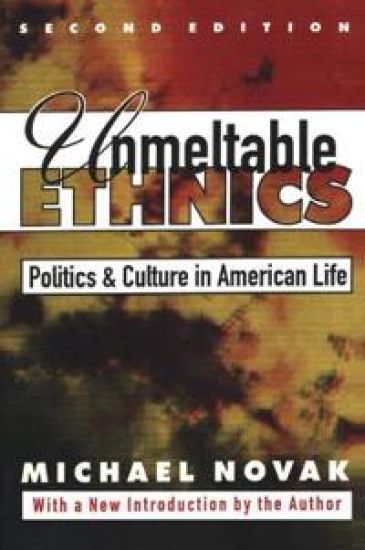
Unmeltable Ethnics

Unmeltable Ethnics

Michael Novak

Transaction Publishers
1995
nidottu
This new, enlarged edition of an influential book—originally published in 1972 as The Rise of the Unmeltable Ethnics—extends the author's wise and generous view of ethnicity. Its aim "is to raise consciousness about a crucial part of the American experience: to involve each reader in self-inquiry. Who, after all, are you? What history brought you to where you are? Why are you different from others?" But the point of such inquiry is civility: "The new ethnic consciousness embodied in this book delights in recognition of subtle differences in the movements of the soul. It is not a call to separatism but to self-consciousness. It does not seek division but rather accurate, mutual appreciation."This new edition contains six new essays by the author, including the acclaimed "Pluralism: A Humanistic Perspective." New, too, is Novak's comprehensive introduction, bringing the argument up to date. Novak describes how and why ethnicity has become a prominent issue in American politics. He also sharply denounces the current ideology of "multiculturalism" as a disfiguration of genuine ethnicity. "Multiculturalism is moved by the eros of Narcissus" Novak writes, "the new ethnicity is driven by the eros of unrestricted understanding."When the book first appeared, Time said that "Novak has attacked the American Dream in order to open up a possible second chapter for it." Newsweek called it "a tough-minded, provocative book which could well signal an important change in American politics."This new edition adds crucial distinctions for those seeking an intelligent path through such current-day mystifications as "multiculturalism" and "diversity." Twenty-five years ago, Novak's argument led the way in focusing on families, neighborhoods, and other "mediating institutions" of civil society. It is an argument critical to a realistic sense of national community.
The Experience of Nothingness

The Experience of Nothingness

Michael Novak

Transaction Publishers
1997
nidottu
In The Experience of Nothingness, Michael Novak has two objectives. First, he shows the paths by which the experience of nothingness is becoming common among all those who live in free societies. Second, he details the various experiences that lead to the nothingness point of view. Most discussions of these matters have been so implicated in the European experience that the term "nihilism" has a European ring. Novak, however, articulates this experience of formlessness in an American context.In his new introduction, the author lists four requirements that must be met by an individual in order for the experience of nothingness to emerge: a commitment to honesty, a commitment to courage, recognition of how widespread the experience of nothingness is, and a virtue of will. Novak writes that these principles are what guide self-described philosophical nihilists. But many people simply borrow the nihilistic conclusions without observing the moral commitments to them. For this reason Novak believes that nihilism is fraudulent as a theory intended to explain the experience of nothingness. Nihilism in practice, he maintains, often results in a form of intolerance. The Experience of Nothingness is a work that will cause many scholars to rethink their beliefs. It should be read by philosophers, theologians, sociologists, political theorists, and cultural historians.

Joy of Sports, Revised

Joy of Sports, Revised

Michael Novak

Madison Books
1993
pokkari
Combines an immediate enjoyment of sports with an awareness of the influence of athletic heroes on our society's spiritual life, and relates each popular sport to the particular virtue and grace it ritualizes
The Tiber Was Silver

The Tiber Was Silver

Michael Novak

Ave Maria University Press
2005
nidottu
This reprint of Michael Novak’s first novel is an intriguing story about a young man preparing for priesthood in Rome and studying theology at the Gregorianum, and his struggles with whether he is truly called to the priesthood. It takes place in the 1950’s, a time of the Hungarian Revolution, the launching of the Sputnik, when Kennedy succeeded Eisenhower, just before Pope John XXIII would take the place of Pope Pius XII, and when there were evident stirrings within the Church that would ultimately result in Vatican II. The Tiber Was Silver provides a unique view of the pre-conciliar Church through the eyes of a young seminarian and draws the reader into his momentous decision.
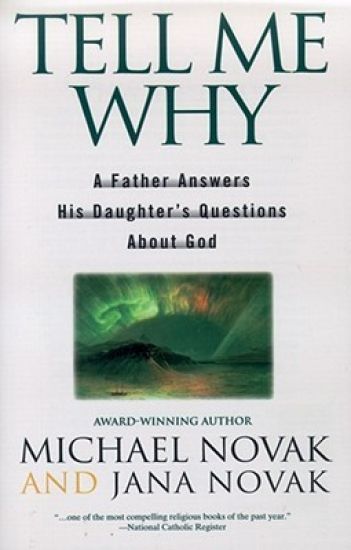
Tell ME Why

Tell ME Why

Michael Novak; Jana Novak

Pocket Books
1999
pokkari
Hailed as a new classic in faith exploration, this remarkable book offers a rare chance to eavesdrop on a conversation between a believing father and a skeptical daughter about God, faith, and morals. World-renowned theologian Michael Novak accepts a unique challenge when his twentysomething daughter Jana sends him a long fax filled with practical questions about life and religion. His answers -- warm, wise, and unfaltering -- serve as guideposts to faith at a critical time in his daughter's life. For her part, Jana is not interested in a scholarly essay but in straight and honest replies; she challenges what she doesn't understand, and she never hesitates to bat back an answer she doesn't like. The result is a lively, thought-provoking dialogue that addresses the concerns of Jana's generation while also taking on the questions of the ages -- from the purpose of religion in our lives, to how "good" must a Christian be, to the problems of suffering, compassion, and the existence of God. Enacting as it does the difficult passing on of a noble tradition, Tell Me Why offers an illuminating path for anyone searching to embrace or deepen their faith.
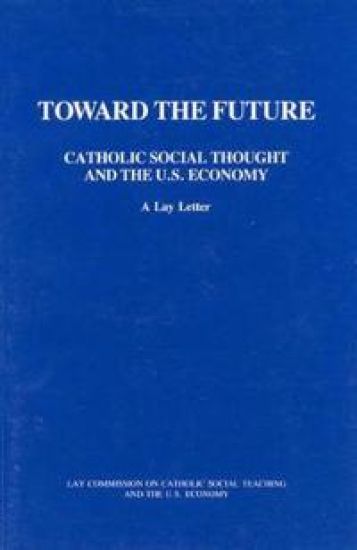
Toward the Future

Toward the Future

Michael Novak; Michael Joyce

University Press of America
1985
nidottu
A response to the Catholic Bishops' Pastoral on the U.S. economy, this book presents a lay point of view on Catholic social thought and the economy. Three fundamental principles of Catholic social thought are stated: the sacred dignity of the person, the social nature of human life, and the obligation to assign social decisions to the level of authority best suited to take them (subsidiarity). Within those principles, a sense of balance must be maintained. Co-published with the Lay Commission on Catholic Social Teaching and the U.S. Economy.
On Cultivating Liberty

On Cultivating Liberty

Michael Novak; Brian C. Anderson

Rowman Littlefield
1999
sidottu
Few writers have covered the intellectual terrain traversed by Michael Novak, who has written on theology, philosophy, political economy, and business theory. This book brings together many of Novak's crucial essays on "moral ecology": the ethos that must be cultivated and preserved if liberal democratic societies are to survive. Novak argues in defense of the free and virtuous society by examining the family, welfare reform, free markets, self-government, and the American founding. A series of remarkable intellectual studies on figures such as Jacques Maritain, St. Thomas Aquinas, and John Courtney Murray, along with an autobiographical essay by Novak and an introduction by Brian C. Anderson, complete On Cultivating Liberty, an indispensable book for anyone concerned about the future of the democratic project as we enter the third millennium.