One of them is very pretty-you can see that at a glance: under the simple bonnet, and through the thin little veil, which throws no cloud upon its beauty, shines the sweetest girl's face imaginable. It is only eighteen years old, and not at all of the heroical cast, but it brightens like a passing sunbeam through all the sombre line of passengers, and along the dull background of this ordinary street. There is no resisting that sweet unconscious influence: people smile when they pass her, unawares; it is a natural homage paid involuntarily to the young, sweet, innocent loveliness, unconscious of its own power. People have smiled upon her all her days; she thinks it is because everybody is amiable, and seeks no further for a cause. The other one is not very pretty; she is twenty: she is taller, paler, not so bright of natural expression, yet as far from being commonplace as can be conceived.
"And who is this young widow of yours whom I hear so much about? I understand Lucy's rapture over any stranger; but you, too, mother-" "I too-well, there is no particular witchcraft about it; a nice young woman has as much chance with me as with any one, Ralph-" "Oh, if it's only a nice young woman-" "It's a great deal more," said Lucy. "Why, Miss Jones at the school is a nice young woman-don't you be taken in by mother's old-fashioned stilts. She is a darling-she is as nice as nice can be. She's pretty, and she's good, and she's clever. She has read a lot, and seen a lot, and been everywhere, and knows heaps and heaps of people, and yet just as simple and as nice as if she had never been married, never had a baby, and was just a girl like the rest of us-Mother there is nothing wrong in what I said?" Lucy suddenly cried, stopping short and blushing all over with the innocent alarm of a youthfulness which had not been trained to modern modes of speech. "Nothing wrong, certainly," said the mother, with a half smile; "but-there is no need for entering into all these details."
"And who is this young widow of yours whom I hear so much about? I understand Lucy's rapture over any stranger; but you, too, mother-" "I too-well, there is no particular witchcraft about it; a nice young woman has as much chance with me as with any one, Ralph-" "Oh, if it's only a nice young woman-" "It's a great deal more," said Lucy. "Why, Miss Jones at the school is a nice young woman-don't you be taken in by mother's old-fashioned stilts. She is a darling-she is as nice as nice can be. She's pretty, and she's good, and she's clever. She has read a lot, and seen a lot, and been everywhere, and knows heaps and heaps of people, and yet just as simple and as nice as if she had never been married, never had a baby, and was just a girl like the rest of us-Mother there is nothing wrong in what I said?" Lucy suddenly cried, stopping short and blushing all over with the innocent alarm of a youthfulness which had not been trained to modern modes of speech. "Nothing wrong, certainly," said the mother, with a half smile; "but-there is no need for entering into all these details." "They would have found out immediately, though," said Lucy, with a lowered voice, "that there was-Tiny, you know."
Theodore Warrender was still at Oxford when his father died. He was a youth who had come up from his school with the highest hopes of what he was to do at the university. It had indeed been laid out for him by an admiring tutor with anticipations which were almost certainties: "If you will only work as well as you have done these last two years " These years had been spent in the dignified ranks of Sixth Form, where he had done almost everything that boy can do. It was expected that the School would have had a holiday when he and Brunson went up for the scholarships in their chosen college, and everybody calculated on the "double event." Brunson got the scholarship in question, but Warrender failed, which at first astonished everybody, but was afterwards more than accounted for by the fact that his fine and fastidious mind had been carried away by the schylus paper, which he made into an exhaustive analysis of the famous trilogy, to the neglect of other less inviting subjects. His tutor was thus almost more proud of him for having failed than if he had succeeded, and Sixth Form in general accepted Brunson's success apologetically as that of an "all-round" man, whose triumph did not mean so much. But if there is any place where the finer scholarship ought to tell, it should be in Oxford, and his school tutor, as has been said, laid out for him a sort of little map of what he was to do.
I THOUGHT I heard a slight rustle, as if Sarah had taken off her spectacles, but I was really so interested in the matter which I was then discussing with Mr. Cresswell, our solicitor, that I did not look round, as I certainly should have done in any other circumstances; but imagine my utter amazement and the start which Mr. Cresswell gave, nearly upsetting the ink on the drab table-cover, which never could have got the better of it, when my sister Sarah, who never speaks except to me, and then only in a whisper, pronounced distinctly, loud out, the following words: "His Christian name was Richard Arkwright; he was called after the cotton-spinner; that was the chief thing against him in my father's days."
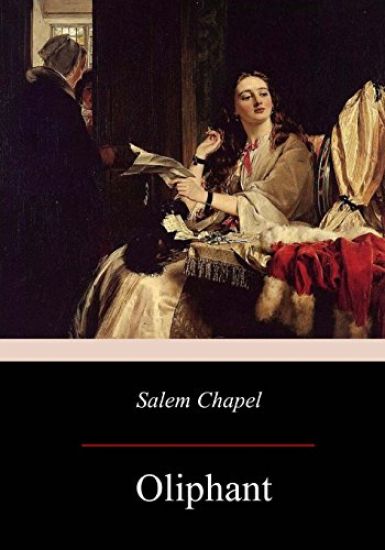
TOWARDS the west end of Grove Street, in Carlingford, on the shabby side of the street, stood a red brick building, presenting a pinched gable terminated by a curious little belfry, not intended for any bell, and looking not unlike a handle to lift up the edifice by to the public observation. This was Salem Chapel, the only Dissenting place of worship in Carlingford. It stood in a narrow strip of ground, just as the little houses which flanked it on either side stood in their gardens, except that the enclosure of the chapel was flowerless and sombre, and showed at the farther end a few sparsely-scattered tombstones-unmeaning slabs, such as the English mourner loves to inscribe his sorrow on. On either side of this little tabernacle were the humble houses-little detached boxes, each two storeys high, each fronted by a little flower-plot-clean, respectable, meagre, little habitations, which contributed most largely to the ranks of the congregation in the Chapel. The big houses opposite, which turned their backs and staircase windows to the street, took little notice of the humble Dissenting community. Twice in the winter, perhaps, the Miss Hemmings, mild evangelical women, on whom the late rector-the Low-Church rector, who reigned before the brief and exceptional incumbency of the Rev. Mr. Proctor-had bestowed much of his confidence, would cross the street, when other profitable occupations failed them, to hear a special sermon on a Sunday evening. But the Miss Hemmings were the only representatives of anything which could, by the utmost stretch, be called Society, who ever patronised the Dissenting interest in the town of Carlingford. Nobody from Grange Lane had ever been seen so much as in Grove Street on a Sunday, far less in the chapel. Greengrocers, dealers in cheese and bacon, milkmen, with some dressmakers of inferior pretensions, and teachers of day-schools of similar humble character, formed the lite of the congregation. It is not to be supposed, however, on this account, that a prevailing aspect of shabbiness was upon this little community; on the contrary, the grim pews of Salem Chapel blushed with bright colours, and contained both dresses and faces on the summer Sundays which the Church itself could scarcely have surpassed. Nor did those unadorned walls form a centre of asceticism and gloomy religiousness in the cheerful little town. Tea-meetings were not uncommon occurrences in Salem-tea-meetings which made the little tabernacle festive, in which cakes and oranges were diffused among the pews, and funny speeches made from the little platform underneath the pulpit, which woke the unconsecrated echoes with hearty outbreaks of laughter. Then the young people had their singing-class, at which they practised hymns, and did not despise a little flirtation; and charitable societies and missionary auxiliaries diversified the congregational routine, and kept up a brisk succession of "Chapel business," mightily like the Church business which occupied Mr. Wentworth and his Sisters of Mercy at St. Roque's. To name the two communities, however, in the same breath, would have been accounted little short of sacrilege in Carlingford.
Memoir of Count de Montalembert, Peer of France, Deputy for the Department of Doubs - Vol. I is an unchanged, high-quality reprint of the original edition of 1872. Hansebooks is editor of the literature on different topic areas such as research and science, travel and expeditions, cooking and nutrition, medicine, and other genres. As a publisher we focus on the preservation of historical literature. Many works of historical writers and scientists are available today as antiques only. Hansebooks newly publishes these books and contributes to the preservation of literature which has become rare and historical knowledge for the future.
Memoir of Count de Montalembert - A Chapter of recent french History - Vol. I is an unchanged, high-quality reprint of the original edition of 1872. Hansebooks is editor of the literature on different topic areas such as research and science, travel and expeditions, cooking and nutrition, medicine, and other genres. As a publisher we focus on the preservation of historical literature. Many works of historical writers and scientists are available today as antiques only. Hansebooks newly publishes these books and contributes to the preservation of literature which has become rare and historical knowledge for the future.