

Kirjahaku
Etsi kirjoja tekijän nimen, kirjan nimen tai ISBN:n perusteella.
27 kirjaa tekijältä Patrick Barrett



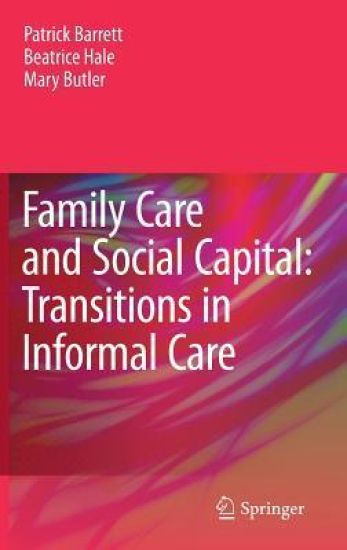
Family Care and Social Capital: Transitions in Informal Care
Patrick Barrett; Beatrice Hale; Mary Butler
Springer
2013
sidottu
Becoming a caregiver is increasingly an inevitable experience for many people and, therefore, a likely life transition. Drawing on research and personal experiences of working with family caregivers, this book examines a range of family caregiving situations from across the life course. It seeks to capture the dynamics of caregiving in a number of common situations: caregiving during infancy, for adults who acquire a disability through accidents or illness, for older people with age-related issues, and caregiving by children and adolescent carers and grandparent carers. In drawing attention to key moments of vulnerability faced by family and informal caregivers, and by suggesting how to assist ‘reconnection’ at these moments, the book provides a guide for those working in the area of health, disability and care. Informal care is conceptualised as occurring with the context of personal interrelationships, these being nested within wider kin networks and linked with wider professional formal care networks. Informal care is seen both as an expression of social capital and as an activity that builds social capital. It is an indicator of resources of mutual support within social networks, and it has the effect of adding to the stock of social resources. The book makes a case, therefore, for facilitating the development of social capital by strengthening the capacity of informal caregivers and caregiver groups, and by improving the linkages with formal care organisations.

Family Care and Social Capital: Transitions in Informal Care
Patrick Barrett; Beatrice Hale; Mary Butler
Springer
2015
nidottu
Becoming a caregiver is increasingly an inevitable experience for many people and, therefore, a likely life transition. Drawing on research and personal experiences of working with family caregivers, this book examines a range of family caregiving situations from across the life course. It seeks to capture the dynamics of caregiving in a number of common situations: caregiving during infancy, for adults who acquire a disability through accidents or illness, for older people with age-related issues, and caregiving by children and adolescent carers and grandparent carers. In drawing attention to key moments of vulnerability faced by family and informal caregivers, and by suggesting how to assist ‘reconnection’ at these moments, the book provides a guide for those working in the area of health, disability and care. Informal care is conceptualised as occurring with the context of personal interrelationships, these being nested within wider kin networks and linked with wider professional formal care networks. Informal care is seen both as an expression of social capital and as an activity that builds social capital. It is an indicator of resources of mutual support within social networks, and it has the effect of adding to the stock of social resources. The book makes a case, therefore, for facilitating the development of social capital by strengthening the capacity of informal caregivers and caregiver groups, and by improving the linkages with formal care organisations.

This book investigates the experiences of older people who remain at home with care. It examines the transition points for the important life changes faced by family members who take on a greater care-giving role. The book draws on demographic analyses and qualitative fieldwork to explore the shift from independence to increasing dependence, and suggests that this transition constitutes movement into a new stage of life, that of an Age of Supported Independence. Applying the anthropological concept of rites of passage in their analysis, the authors focus on the changes in everyday living within the spatial environment of the home, the temporal organization of daily life, and the reshaping of relationships. They suggest that many older people – as well as the family members who become carers – remain in a state of ‘liminality’: unable to make sense of their new situation and experience and, despite assumptions that ageing-in-place sustains social connectedness, excluded from their communities.