Kirjojen hintavertailu. Mukana 12 390 323 kirjaa ja 12 kauppaa.

Kirjahaku

Etsi kirjoja tekijän nimen, kirjan nimen tai ISBN:n perusteella.

165 kirjaa tekijältä Peter Handke

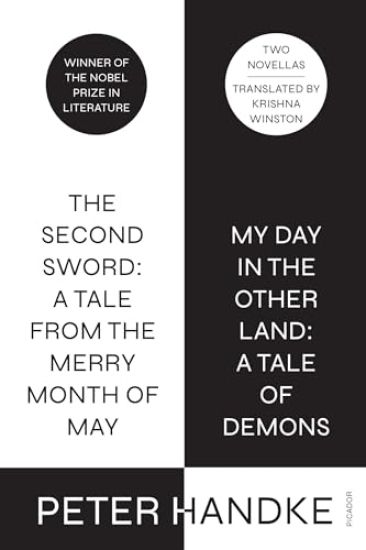
The Second Sword: A Tale from the Merry Month of May, and My Day in the Other Land: A Tale of Demons
The Second Sword and My Day in the Other Land are two new novellas by the 2019 Nobel laureate Peter Handke. The first picks up the story where Handke’s last work of fiction, The Fruit Thief (described in The New York Times as “an experience of unadulterated literature”), left off. Here a man has returned to his home in the suburbs of Paris, only to soon set out again. Why? We learn, over the course of a story redolent of Handke’s harrowing A Sorrow Beyond Dreams, that he is seeking to avenge his mother, who has been unjustly denounced in the pages of a newspaper. The Second Sword is a suspenseful work of self-examination: Will the narrator’s journey end in him throwing down the gauntlet? My Day in the Other Land is Handke’s most recently published work - and the first to be written after he was awarded the Nobel Prize. Evoking imagery from the Bible and classical mythology, it portrays a man who has been possessed by demons, causing him to rage endlessly against the inhabitants of his rural village. Aided by his sister, he embarks on a journey to a lake on whose opposite shore lies the “other land.” What ensues is an exorcism of sorts - and one of Handke’s most evocative and original endings.
Crossing the Sierra de Gredos

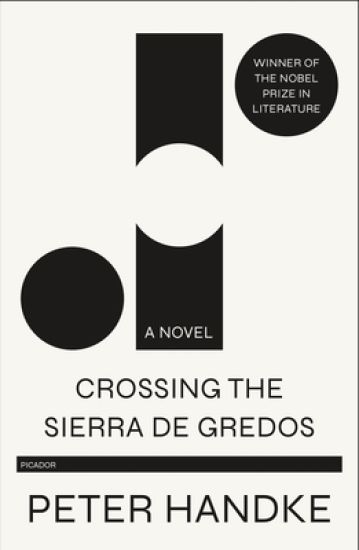
Crossing the Sierra de Gredos

Peter Handke

Picador USA
2020
pokkari
In this visionary novel, Nobel Prize winner Peter Handke offers descriptions of objects, relationships, and events that teach readers a renewed way of seeing; he creates a wealth of images to replace those lost to convention and conformity. On the outskirts of a northwestern European river port city lives a powerful woman banker, a public figure admired and hated in equal measure, who has decided to turn from the worlds of high finance and modern life to embark on a quest. Having commissioned a famous writer to undertake her "authentic" biography, she journeys through the Spanish Sierra de Gredos and the region of La Mancha to meet him. As she travels by all-terrain vehicle, bus, and finally on foot, the nameless protagonist encounters five way stations that become the stuff of her biography and the biography of the modern world, a world in which genuine images and unmediated experiences have been exploited and falsified by commercialization and by the voracious mass media. Crossing the Sierra de Gredos is a very human book of yearning and the ancient quest for love, peopled with memorable characters (from multiple historical periods) and imbued with Handke's inimitable ability to portray universal, inner-worldly adventures that blend past, future, present, and dreamtime.
On a Dark Night I Left My Silent House
A short, powerful new novel by one of the greatest writers in the German language. On a Dark Night I Left My Silent House is Nobel Prize-winning author Peter Handke's evocative, moving, often fantastic, novel about one man's conflict with himself and his journey toward resolution. During one night shift, an unnamed, middle-aged pharmacist in Taxham, an isolated suburb of Salzburg, tells his story to a narrator. The pharmacist is known and well-respected, but lonely and estranged from his wife. He feels most comfortable wandering about in nature, collecting and eating hallucinogenic mushrooms. One day he receives a blow to the head that leaves him unable to speak, and the narrative is transformed from ironic description into a collection of sensual impressions, observations and reflections. The pharmacist, who is now called the driver, sets out on a quest, travelling into the Alps with two companions--a former Olympic skiing champion and a formerly famous poet--where he is beaten and later stalked by a woman. He drives through a tunnel and has a premonition of death, then finds himself in a surreal, foreign land. In a final series of bizarre, cathartic events, the driver regains his speech and is taken back to his pharmacy--back to his former life, but forever changed. A powerful, poetic exploration of language, longing and dislocation in the human experience, On a Dark Night I Left My Silent House reveals Handke at his magical best.
My Year in the No-Man's-Bay

My Year in the No-Man's-Bay

Peter Handke

Picador USA
2020
pokkari
Nobel Prize winner Peter Handke's autobiographical novel My Year in No-Man's Bay is "a meditation on two decades of a writer's life culminating in a solitary, sobering year of reckoning" (Publishers Weekly).In his most substantial novel to date, Handke tells the story of an Austrian writer--a man much like Handke himself--who undergoes a "metamorphosis" from self-assured artist into passive "observer and chronicler." He explores the world and describes his many severed relationships, from his tenuous contact with his son, to a failed marriage to "the Catalan," to a doomed love affair with a former Miss Yugoslavia. As the writer sifts through his memories, he is also under pressure to complete his next novel, but he cannot decide how to come to terms with both the complexity of the world and the inability of his novel to reflect it.
Jukebox and Other Essays on Storytelling

Jukebox and Other Essays on Storytelling

Peter Handke

St. Martins Press-3pl
2020
nidottu
Nobel Prize winner Peter Handke offers three intimate, eloquent meditations that map a self-reflexive journey from Alaska to the Austria of his childhood, while illuminating the act of writing itself. In his "Essay on Tiredness," Handke transforms an everyday experience--often precipitated by boredom--into a fascinating exploration of the world of slow motion, differentiating degrees of fatigue, the types of weariness, its rejuvenating effects, as well as its erotic, cultural, and political implications. The title essay is Handke's attempt to understand the significance of the jukebox, a quest which leads him, while on a trip in Spain, into the literature of the jukebox, the history of the music box, and memories of the Beatles' music, in turn elucidating various stages of his own life. And in his "Essay on the Successful Day," for which there is no prescription, Handke invents a picture of tranquility, using a self-portrait by Hogarth as his point of departure to describe a state of being at peace. Playful, reflective, insightful, and entertaining, The Jukebox and Other Essays on Storytelling constitutes a literary triptych that redefines the art of the essay and challenges the form of the short story, confirming Peter Handke's stature as "one of the most original and provocative of contemporary writers" (Lawrence Graver, The New York Times Book Review).
The Afternoon of a Writer

The Afternoon of a Writer

Peter Handke

Picador USA
2020
nidottu
In Nobel Prize-winning author Peter Handke's The Afternoon of a Writer, a writer, fearful of losing his abilities and hence his connection with the world, takes an afternoon walk and has several encounters that reaffirm his confidence...
Repetition

Repetition

Peter Handke

Picador USA
2020
nidottu
Set in 1960, Nobel Prize winner Peter Handke's Repetition tells of Filib Kobal's journey from his home in Carinthia to Slovenia on the trail of his missing brother, Gregor. He is armed only with two of Gregor's books: a copy book from agricultural school, and a Slovenian - German dictionary, in which Gregor has marked certain words. The resulting investigation of the laws of language and naming becomes a transformative investigation of himself and the world around him. "Handke's eminence, displayed in a substantial oeuvre of plays, novels and poems, is reaffirmed brilliantly by Repetition]." - Publishers Weekly
The Weight of the World: A Journal

The Weight of the World: A Journal

Peter Handke

Picador USA
2020
nidottu
A combination of professional notebook and personal diary that records -- both in short, informal jottings and through more formal, extended meditations -- the details of Handke's daily life in Paris from November 1975 through March 1977. Along with references to such mentors as Truffaut, John Cowper Powys, Robert DeNiro and Goethe, the journal recounts Handke's passing impressions of strangers; the deep and delicate nature of his relationship with his daughter; and a brief hospital stay which stirs his ever-present fear of death.
The Left-Handed Woman

The Left-Handed Woman

Peter Handke

Picador USA
2020
nidottu
In Nobel Prize-winning author Peter Handke's The Left-Handed Woman, a young woman faces loneliness and alienation on a journey to find her own life outside of being a wife and mother.One evening, when Marianne and her husband, Bruno, are dining out together to celebrate his return from a business trip, Marianne listens to him speak and realizes suddenly yet finally that Bruno will leave her. Whether at that moment, or in years to come, she will be deserted. And instinctively Marianne knows she must fend for herself and her young son now, before that time comes. She sends Bruno away and settles down to a life alone, at first experiencing moments of panic, restlessly wandering in rooms grown stifling. The stillness of the house wears her down, and she starts taking long walks, or visiting with her close friend, Franziska. Gradually, what began as a selfish escape from the prospects of the future becomes in fact liberation. The environment she'd always hated--a no man's land of identical houses, with all curtains drawn--recedes; her relationships with those dear to her become less threatening, less necessary; and Marianne finds a new pattern for her life and the strength to go on alone. Handke adapted the novel himself into a film of the same name in 1978.
A Moment of True Feeling

A Moment of True Feeling

Peter Handke

Picador USA
2020
nidottu
At the beginning of Nobel Prize winner Peter Handke's novel A Moment of True Feeling, Gregor Keuschnig awakens from a nightmare in which he has committed murder, and announces, "From today on, I shall be leading a double life." The duplicity, however, lies only in Keuschnig's mind; his everyday life as the press attach for the Austrian Embassy in Paris continues much as before: routine paperwork, walks in the city, futile intimacies with his family and his mistress. But Keuschnig is oblivious to it all, merely simulating his previous identity while he searches for a higher significance, a mystical moment of true sensation which can free him from what the novel calls life's "dreadful normalcy." Convinced that, if he fails, life's meaning will be revealed to him only when it is too late, he looks for portents everywhere. Keuschnig's search takes him through all of Paris. At every step, his feelings are interwoven with acute observation of its streets, buildings, cafes, parks, sky. It is an intimate and evocative journey, in a city that is at once supportive and familiar, strange and provocative.
The Ride Across Lake Constance and Other Plays
A collection of six plays by Nobel Prize winner Peter Handke, spanning the early years of the Austrian playwright's career The first full-length play The Ride Across Lake Constance, is one of Handke's best-known works. It deals directly with one of Handke's favorite themes: the realities of theater itself, independent of the offstage world, and the way language (dialogue) and objects (props) operate in the skewed world of the stage. Therein it anticipates They Are Dying Out, the second full-length play in this volume. In some ways more conventional than many of Handke's plays, They Are Dying Out presents one of his most fascinating protagonists, Quitt, a businessman who first induces a group of colleagues to set up a monopoly and then torpedoes the scheme. The four short plays that round out the book--Prophecy, Calling for Help, Quodlibet, and My Foot My Tutor--were written before The Ride Across Lake Constance and show Handke moving from the experimental mode of his early work toward the richness and complexity that have marked him as the most important dramatist since Becket. Together, Handke's plays bear witness to the truth of Richard Gilman's observation that "in Handke's theater, language, exposed, assaulted, wrestled with, driven to limits, and pursued still further, begins to take on, like the color returning to the cheeks of a nearly hanged man, the signs of a strange and unexpected resurrection."
The Fruit Thief

The Fruit Thief

Peter Handke

St Martin's Press
2023
nidottu
On a summer day under a blue sky a man is stung on his foot by a bee. “The sting signaled that the time had come to set out, to hit the road. Off with you. The hour of departure has arrived.” The man boards a train to Paris, crosses the city by Métro, then boards another, disembarking in a small town on the plains to the north. He is searching for a young woman he calls the Fruit Thief, who, like him, has set off on a journey to the Vexin plateau. What follows is a vivid but dreamlike exploration of topography both physical and affective, charting the Fruit Thief’s perambulations across France’s internal borderlands: alongside rivers and through ravines, beside highways and to a bolt-hole under the stairs of an empty hotel. Chance encounters - with a man scrambling through the underbrush in search of his lost cat, and with a delivery boy who abandons his scooter to become a fellow traveler for a day - are like so many throws of the dice, each exposing new facets of this mysterious individual in the manner of a cubist portrait. In prose of unrivaled precision, lucidly rendered into English by Krishna Winston, The Fruit Thief elevates the terrain of everyday life to epic status, and situates the microgeography of an individual at the center of a book like few others. This is one of Nobel laureate Peter Handke’s most significant and original achievements.
Quiet Places: Collected Essays

Quiet Places: Collected Essays

Peter Handke

Picador USA
2023
nidottu
A career-spanning collection of essays by the Nobel laureate Peter Handke, featuring two new works never before published in English Quiet Places brings together Peter Handke's forays into the border regions of life and story, upending the distinction between literature and the literary essay. Proceeding from the specificity of place (the mountains of Carinthia and Spain, the hinterlands of Paris) to specific objects (the jukebox, the boletus mushroom) to the irreducible particularity of our moods and mental impressions, these works--each a novella in its own right--offer rare insight into the affinities that can develop between a storyteller and the unlikeliest of subjects. Here, Handke posits a reevaluation of the possibilities and proper concerns of literature in a style unmistakably his own. This collection unites the three essays from The Jukebox with two new works: "Essay on a Mushroom Maniac," the story of a friend's descent into and ascent from the depths of obsession, and "Essay on Quiet Places," a memoiristic tour d'horizon of bathrooms and their place in Handke's life and work. Featuring masterful translations by Krishna Winston and Ralph Manheim, this collection encapsulates the oeuvre of one of our greatest living writers.
Short Letter, Long Farewell

Short Letter, Long Farewell

Peter Handke

NYRB Classics
2009
pokkari
Short Letter, Long Farewell is one the most inventive and exhilarating of the great Peter Handke's novels. Full of seedy noir atmospherics and boasting an air of generalized delirium, the book starts by introducing us to a nameless young German who has just arrived in America, where he hopes to get over the collapse of his marriage. No sooner has he arrived, however, than he discovers that his ex-wife is pursuing him. He flees, she follows, and soon the couple is running circles around each other across the length of America--from Philadelphia to St. Louis to the Arizona desert, and from Portland, Oregon, to L.A. Is it love or vengeance that they want from each other? Everything's spectacularly unclear in a book that is travelogue, suspense story, domestic comedy, and Western showdown, with a totally unexpected Hollywood twist at the end. Above all, Short Letter, Long Farewell is a love letter to America, its landscapes and popular culture, the invitation and the threat of its newness and wildness and emptiness, with the promise of a new life--or the corpse of an old one--lying just around the corner.
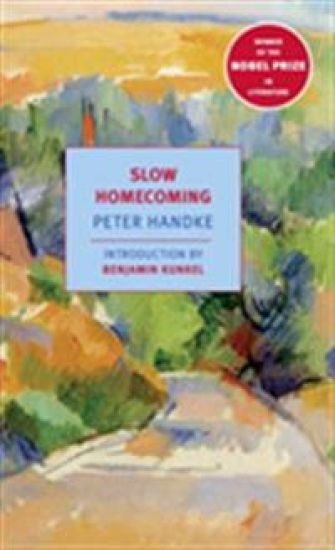
Slow Homecoming

Slow Homecoming

Peter Handke

New York Review Books
2009
pokkari
Provocative, romantic, and restlessly exploratory, Peter Handke is one of the great writers of our time. Slow Homecoming, originally published in the late 1970s, is central to his achievement and to the powerful influence he has exercised on other writers, chief among them W.G. Sebald. A novel of self-questioning and self-discovery, Slow Homecoming is a singular odyssey, an escape from the distractions of the modern world and the unhappy consciousness, a voyage that is fraught and fearful but ultimately restorative, ending on an unexpected note of joy. The book begins in America. Writing with the jarring intensity of his early work, Handke introduces Valentin Sorger, a troubled geologist who has gone to Alaska to lose himself in his work, but now feels drawn back home: on his way to Europe he moves in ominous disorientation through the great cities of America. The second part of the book, "The Lesson of Mont Sainte-Victoire," identifies Sorger as a projection of the author, who now writes directly about his own struggle to reconstitute himself and his art by undertaking a pilgrimage to the great mountain that Cézanne painted again and again. Finally, "Child Story" is a beautifully observed, deeply moving account of a new father--not so much Sorger or the author as a kind of Everyman--and his love for his growing daughter.
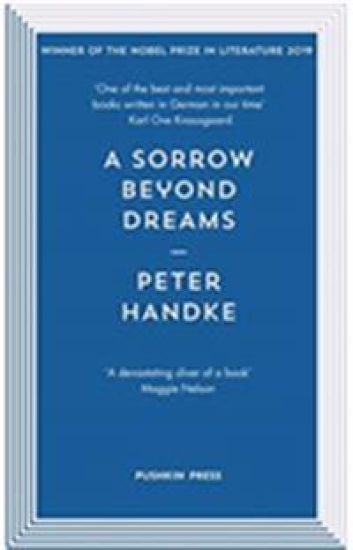
A Sorrow Beyond Dreams

A Sorrow Beyond Dreams

Peter Handke

Pushkin Press
2019
nidottu
"My mother has been dead for almost seven weeks: I had better go to work before the need to write about her, which I felt so strongly at her funeral, dies away and I fall back into the dull speechlessness with which I reacted to the news of her suicide." So begins Peter Handke's extraordinary confrontation with his mother's death. In a painful and courageous attempt to deal with the almost intolerable horror of her suicide, he sets out to piece together the facts of her life, as he perceives them. What emerges is a loving portrait of inconsolable grief, a woman whose lively spirit has been crushed not once but over and over again by the miseries of her place and time. Yet well into middle age, living in the Austrian village of her birth, she still remains haunted by her dreams.