
Kirjahaku
Etsi kirjoja tekijän nimen, kirjan nimen tai ISBN:n perusteella.
81 kirjaa tekijältä Sallust

Sallust's History Of The Conspiracy Of Catiline, And Jugurthine War (1855)
Sallust
KESSINGER PUBLISHING CO
2008
muu
Unfortunately, without any additional information, it is impossible to provide a complete description of this book. Sallust could refer to the ancient Roman historian and politician Gaius Sallustius Crispus, or it could refer to a book or series of books about him or his works. Similarly, Rose and William could be the author, editor, or translator of the book. Without more context, it is impossible to provide a comprehensive description.This Is A New Release Of The Original 1835 Edition.This scarce antiquarian book is a facsimile reprint of the old original and may contain some imperfections such as library marks and notations. Because we believe this work is culturally important, we have made it available as part of our commitment for protecting, preserving, and promoting the world's literature in affordable, high quality, modern editions, that are true to their original work.
![Oeuvres Complètes de Salluste. [Précédée d'Une] Nouvelle Étude Sur Salluste (N Éd) (Éd.1865)](/covers/9782012595392.jpg)
Oeuvres Complètes de Salluste. [Précédée d'Une] Nouvelle Étude Sur Salluste (N Éd) (Éd.1865)
Sallust
Hachette Livre - BNF
2012
pokkari
Les Auteurs latins expliques d'apres une methode nouvelle par deux traductions francaises... Salluste. Jugurtha http: //gallica.bnf.fr/ark: /12148/bpt6k582125

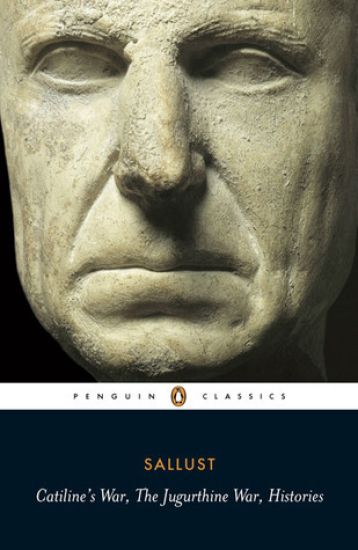
Sallust (86–c. 35 bc) is the earliest Roman historian of whom complete works survive, a senator of the Roman Republic and younger contemporary of Cicero, Pompey and Julius Caesar. His Catiline’s War tells of the conspiracy in 63 bc led by L. Sergius Catilina, who plotted to assassinate numerous senators and take control of the government, but was thwarted by Cicero. Sallust’s vivid account of Roman public life shows a Republic in decline, prey to moral corruption and internal strife. In The Jugurthine War he describes Rome’s fight in Africa against the king of the Numidians from 111 to 105 bc, and provides a damning picture of the Roman aristocracy. Also included in this volume are the major surviving extracts from Sallust’s now fragmentary Histories, depicting Rome after the death of the dictator Sulla.
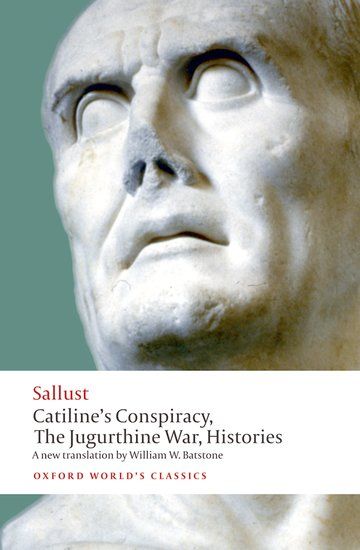
'the glory of wealth and physical beauty is fluid and fragile; but virtue is held brilliant and eternal' The Roman historian Sallust lived through troubled times. He deplored the moral and political decline of the Republic, and in his two monographs he set out to exemplify the reasons for the years of civil strife. Catiline's Conspiracy is an account of the rebellion against the state led by the disaffected Catiline. For Sallust it was 'especially memorable because of the unprecedented nature of the crime and the danger it caused'. Rome's fight against the king of Numidia in The Jugurthine War is a graphic depiction of power struggles in Rome and brutal battles in Africa that eventually resulted in the capture of Jugurtha. Sallust's abrupt and distinctive style is the perfect vehicle for his moral urgency, bitter condemnation, and satirical cynicism. This new translation, which also includes Sallust's fragmentary Histories, captures his effects in an accessible English idiom, and provides a comprehensive introduction to his work as history and literature. ABOUT THE SERIES: For over 100 years Oxford World's Classics has made available the widest range of literature from around the globe. Each affordable volume reflects Oxford's commitment to scholarship, providing the most accurate text plus a wealth of other valuable features, including expert introductions by leading authorities, helpful notes to clarify the text, up-to-date bibliographies for further study, and much more.
Sallust (86-35 BC) was a historian of major importance, writing at the time of the late Roman Republic. This is the first ever full-length commentary and English translation of one of his major works, the Histories, covering the years 78-67 BC, one of the least well-documented periods of the era. The translation is based on a text freshly examined for the first time since the original edition of 1891-3, and also includes newly discovered material.

The period covered by Sallust's Histories - 78-67 BC - forms part of the less well-documented eras of the late Republic. Sallust's contribution, despite its fragmentary transmission (about five hundred fragments of narrative, four speeches, and two letters preserved intact), remains of major importance to ancient historians. For nearly a century, scholars have consulted the edition of B. Maurenbrecher (1891-3) - a work, for its time, of considerable merit. Continuing research on the period has produced material with a bearing on the interpretation of the text; in addition, several fragments not known to Maurenbrecher have subsequently been discovered. For this new translation, Dr McGushin has freshly revised Maurenbrecher's placement and ordering of the fragments, and incorporated this newly discovered material. Together with a comprehensive introduction, he also provides a detailed interpretation in the first ever full-length commentary on the work.
Two military monographs.Sallust, Gaius Sallustius Crispus (86–35 BC), a Sabine from Amiternum, acted against Cicero and Milo as tribune in 52, joined Caesar after being expelled from the Senate in 50, was restored to the Senate by Caesar and took part in his African campaign as praetor in 46, and was then appointed governor of New Africa (Numidia). Upon his return to Rome he narrowly escaped conviction for malfeasance in office, retired from public life, and took up historiography. Sallust’s two extant monographs take as their theme the moral and political decline of Rome, one on the conspiracy of Catiline and the other on the war with Jugurtha.Although Sallust is decidedly unsubtle and partisan in analyzing people and events, his works are important and significantly influenced later historians, notably Tacitus. Taking Thucydides as his model but building on Roman stylistic and rhetorical traditions, Sallust achieved a distinctive style, concentrated and arresting; lively characterizations, especially in the speeches; and skill at using particular episodes to illustrate large general themes.For this edition, Rolfe’s text and translation of the Catiline and Jugurtha have been thoroughly revised in line with the most recent scholarship.
Chronicles of a Caesarean partisan.Sallust, Gaius Sallustius Crispus (86–35 BC), a Sabine from Amiternum, acted as tribune against Cicero and Milo in 52, joined Caesar after being expelled from the Senate in 50, was restored to the Senate by Caesar and took part in his African campaign as praetor in 46, and was then appointed governor of New Africa (Numidia). Upon his return to Rome he narrowly escaped conviction for malfeasance in office, retired from public life, and took up historiography. Sallust’s last work, the annalistic Histories in five books, is much more expansive than his monographs on Catiline and Jugurtha (LCL 116), treating the whole of Roman history at home and abroad in the post-Sullan age. Although fragmentary, it provides invaluable information and insight about a crucial period of history spanning the period from 78 to around 67 BC.Although Sallust is decidedly unsubtle and partisan in analyzing people and events, his works are important and significantly influenced later historians, notably Tacitus. Taking Thucydides as his model but building on Roman stylistic and rhetorical traditions, Sallust achieved a distinctive style, concentrated and arresting; lively characterizations, especially in the speeches; and skill at using particular episodes to illustrate large general themes.For this volume, which completes the Loeb Classical Library edition of Sallust’s works, John T. Ramsey has freshly edited the Histories and the two pseudo-Sallustian Letters to Caesar, supplying ample annotation.


The History of Catiline's Conspiracy, and the Jugurthine War. with a New Translation of Cicero's Four Orations Against Catiline. to Which Is Prefixed
Sallust
Gale Ecco, Print Editions
2010
pokkari