
Kirjahaku
Etsi kirjoja tekijän nimen, kirjan nimen tai ISBN:n perusteella.
37 kirjaa tekijältä Samuel Alexander

Reprint of the original, first published in 1872. The publishing house Anatiposi publishes historical books as reprints. Due to their age, these books may have missing pages or inferior quality. Our aim is to preserve these books and make them available to the public so that they do not get lost.

Reprint of the original, first published in 1872. The publishing house Anatiposi publishes historical books as reprints. Due to their age, these books may have missing pages or inferior quality. Our aim is to preserve these books and make them available to the public so that they do not get lost.

This book has been considered by academicians and scholars of great significance and value to literature. This forms a part of the knowledge base for future generations. So that the book is never forgotten we have represented this book in a print format as the same form as it was originally first published. Hence any marks or annotations seen are left intentionally to preserve its true nature.

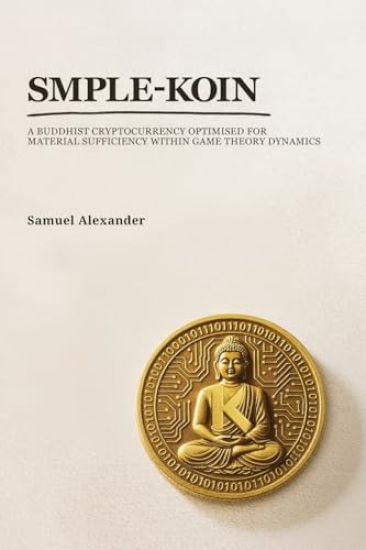
Smple-Koin: A Buddhist Cryptocurrency Optimised for Material Sufficiency within Game Theory Dynamics
Samuel Alexander
Simplicity Institute
2025
nidottu
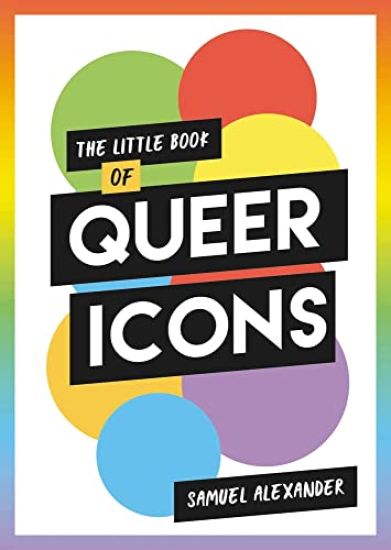
An inspiring collection of the biographies of previously marginalized people whose stories deserve to be told and celebrated. Discover the fascinating stories behind 38 queer icons, all of them ground-breakers, risk-takers and game-changers. Whether they are activists, sportspeople, scientists or superstars, every one of these people has been a trailblazer in their field, and deserves to have their achievements celebrated the world over. Be empowered and inspired by their extraordinary life stories, their awesome achievements and their wonder-words of wisdom with this pocketbook of remarkable people, and prepare to be introduced to your new superheroes.


"Death for Gaia" is a philosophical story about a group of scientists who create and release a biological weapon they call 'Hemlock-42'. This virus is designed with a single goal in mind: to eradicate most of humanity as a means of preserving what remains of planetary ecosystems and the declining diversity of species. Less than ten percent of humanity survives the pandemic. Forty-six years after this momentous disruption, various tribes of the After World have gathered, in this period of fragile but renewed stability, to discuss the justifiability of the acts that led to the Great Die-Off. Professor Durruk Senjen, the sole surviving activist who released Hemlock-42, has been called to defend his acts and face judgement. Note from the authors: Readers may draw parallels between the fictional virus described in this book and the outbreak of COVID-19 at the beginning of 2020. Our manuscript was complete and under review in July 2019 and thus any similarities are purely coincidental. We offer this book with condolences to those who have lost loved ones to the pandemic.

This book addresses a central dilemma of the urban age: how to make the vast suburban landscapes that ring the globe safe and sustainable in the face of planetary ecological crisis. The authors argue that degrowth, a planned contraction of economic overshoot, is the only feasible principle for suburban renewal. They depart from the anti-suburban sentiment of much environmentalism to show that existing suburbia can be the centre-ground of transition to a new social dispensation based on the principle of self-limitation. The book offers a radical new urban imaginary, that of degrowth suburbia, which can arise Phoenix like from the increasingly stressed cities of the affluent Global North and guide urbanisation in a world at risk. This means dispensing with much contemporary green thinking, including blind faith in electric vehicles and high-density urbanism, and accepting the inevitability and the benefits of planned energy descent. A radical but necessary vision for the times.

This book addresses a central dilemma of the urban age: how to make the vast suburban landscapes that ring the globe safe and sustainable in the face of planetary ecological crisis. The authors argue that degrowth, a planned contraction of economic overshoot, is the only feasible principle for suburban renewal. They depart from the anti-suburban sentiment of much environmentalism to show that existing suburbia can be the centre-ground of transition to a new social dispensation based on the principle of self-limitation. The book offers a radical new urban imaginary, that of degrowth suburbia, which can arise Phoenix like from the increasingly stressed cities of the affluent Global North and guide urbanisation in a world at risk. This means dispensing with much contemporary green thinking, including blind faith in electric vehicles and high-density urbanism, and accepting the inevitability and the benefits of planned energy descent. A radical but necessary vision for the times.
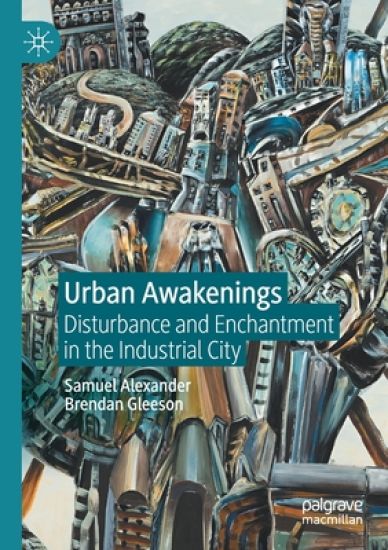
This book presents a series of urban investigations undertaken in the metropolis of Melbourne. It is based on the idea that ‘enchantment’ as an affective state is important to ethical and political engagement. Alexander and Gleeson argue that a sense of enchantment can give people the impulse to care and engage in an increasingly troubled world, whereas disenchantment can lead to resignation. Applying and extending this theory to the urban landscape, the authors walk their home city with eyes open to the possibility of seeing and experiencing the industrial city in different ways. This unique methodology, described as ‘urban tramping’, positions the authors as freethinking freewalkers of the city, encumbered only with the duty to look through the delusions of industrial capitalism towards its troubled, contradictory soul. These urban investigations were disrupted midway by COVID-19, a plague that ended up confirming the book’s central thesis of a fractured modernity vulnerable to various internal contradictions.
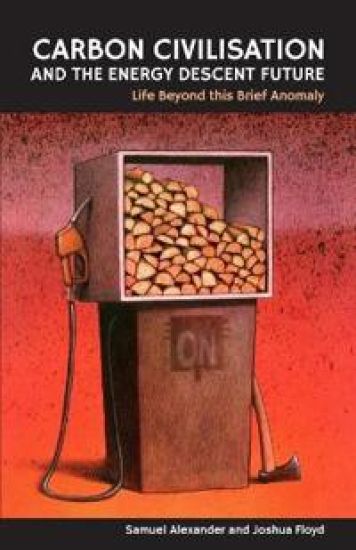
Carbon Civilisation and the Energy Descent Future
Joshua Floyd; Samuel Alexander
Simplicity Institute
2018
pokkari
Carbon civilisation is powered predominately by finite fossil fuels and with each passing day it becomes harder to increase or even maintain current supply. Our one-off fossil energy inheritance is but a brief anomaly in the evolution of the human story, a momentary energy spike from the perspective of deep time. Today humanity faces the dual crises of fossil fuel depletion and climate change, both of which are consequences of the modern world's fundamental reliance on the energy abundance provided by fossil energy sources. Can renewable energy replace the fossil energy foundations of carbon civilisation? This book examines these issues and presents a narrative linking energy and society that maintains we should be preparing for renewable futures neither of energy abundance nor scarcity, but rather energy sufficiency. For industrial societies, this means navigating energy descent futures.
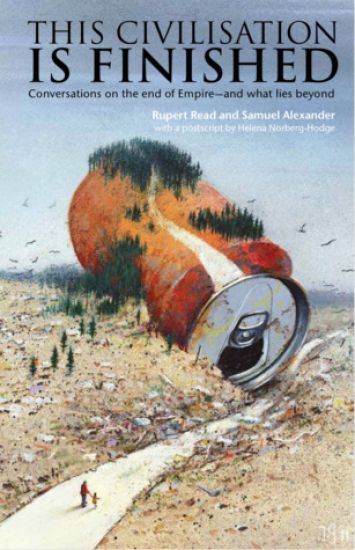
Industrial civilisation has no future. It requires limitless economic growth on a finite planet. The reckless combustion of fossil fuels means that Earth's climate is changing disastrously, in ways that cannot be resolved by piecemeal reform or technological innovation. Sooner rather than later this global capitalist system will come to an end, destroyed by its own ecological contradictions. Unless humanity does something beautiful and unprecedented, the ending of industrial civilisation will take the form of collapse, which could mean a harrowing die-off of billions of people.This book is for those ready to accept the full gravity of the human predicament - and to consider what in the world is to be done. How can humanity mindfully navigate the inevitable descent ahead? Two critical thinkers here remove the rose-tinted glasses of much social and environmental commentary. With unremitting realism and yet defiant positivity, they engage each other in uncomfortable conversations about the end of Empire and what lies beyond.

Diese Zivilisation ist gescheitert
Rupert Read; Samuel Alexander
Meiner Felix Verlag GmbH
2020
nidottu